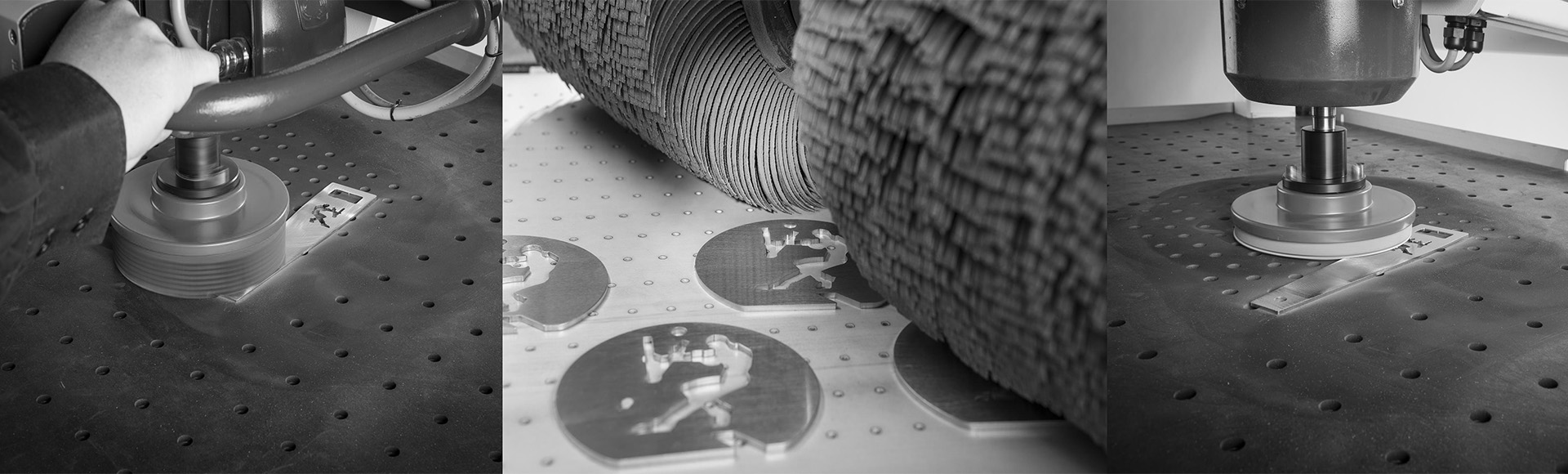
Deburring and Grinding Machines
2.jpg "Timesavers 10 Series - Manual Grinder")
.jpg "Timesavers 12 Series - Deburring and Finishing Machine")
How to Select a Deburring and Grinding Machine: A Technical Decision Guide for Engineers and Procurement Managers
Selecting the right deburring and grinding machine is one of the highest-leverage decisions in a sheet metal or heavy fabrication operation. When the equipment is correctly matched to the upstream cutting process, the part geometry, and the downstream finishing specification, the entire production flow stabilises. Edge quality becomes consistent and repeatable. Coating adhesion improves. Manual rework disappears from the line. Throughput increases without additional labour.
That alignment is the objective of this guide.
It is written for engineers, operations managers, and technical procurement professionals who need a structured analytical framework - not a product catalogue - to navigate this decision with confidence. Work through the six variables below against your specific production conditions, and the correct machine will be identifiable without ambiguity.
Cutting Method and Defect Type: The Primary Technical Driver of Machine Selection
The upstream cutting process is the most deterministic factor in any deburring machine selection. The cutting method defines the nature of the residue left on the part, and the residue defines the mechanical response required to remove it. Every other variable - part size, finish specification, production volume - operates within the constraints that this relationship establishes.
Laser cutting is the dominant technology in modern sheet metal fabrication, and laser cut parts present two distinct finishing challenges. The vertical burr along the cut edge is sharp, relatively fine, and responsive to controlled abrasive action using abrasive belts or a grinding belt. Laser oxide is less visible but equally significant - a thin, chemically stable film that forms along the cut edge as a direct byproduct of the thermal cutting process. Because it bonds persistently to the surface, it acts as a barrier between the base metal and any applied coating, directly compromising coating adhesion and paint adhesion on finished metal parts. Oxide removal requires a rotary brush system capable of conditioning the edges without the aggressive material removal of a standard grinding belt.
Punching and waterjet cutting generate sharp but mechanically lighter burrs on sheet metal that respond well to controlled abrasive removal. Deburring and edge rounding of punched parts can be completed in one pass with the right machine, delivering consistent quality and rounded edges regardless of part dimensions or thin sheet metal variables.
Plasma and flame cutting - thermal cutting processes that prioritise speed and material thickness - require a fundamentally different approach. The heavy slag left behind on plasma cut parts is mechanically bonded to the base material, categorically different from a burr and unresponsive to abrasive grinding. The correct technical response is an impact-based removal mechanism, for example the Hammerhead module in the Timesavers 22 Series Hammerhead, which dislodges bonded heavy slag through kinetic energy rather than friction.
For operations running multiple cutting technologies, modern multi-head metal deburring machines equipped with abrasive belts, rotary brushes, and impact modules can handle different defect types across metal parts in one pass - but only when specified with that combination as an explicit design objective.
Establishing which cutting methods are present in your production, and in what proportions, is the essential first step before any machine is evaluated.
Part Geometry and Handling Stability: The Specification Detail That Determines Finishing Consistency
A deburring machine produces consistent results only when the part moves through it predictably, maintaining correct and uniform contact with the abrasive or brush elements throughout the entire pass. Part geometry directly governs this stability, and it deserves as much attention as any performance specification.
Small parts and lightweight components - thin sheet metal blanks, small punched parts, narrow profiles - tend to shift or lift under the mechanical forces of the deburring process. Machines designed for this range address the issue through integrated vacuum beds or magnetic conveyor tracks that maintain positive positional control throughout the pass. For operations processing a significant proportion of small parts, this is a functional prerequisite for consistent results across all edges, not an optional upgrade.
Beyond flat surfaces, complex geometries introduce additional considerations. Metal parts with inner and outer contours, slots, or cutouts require machines equipped with the right combination of abrasive brushes and processing units to ensure that both outer contours and recessed areas receive uniform, rounded treatment. Single sided processing is standard for most flat sheet metal applications.
Large, heavy plate requires transport systems with sufficient rigidity and drive capacity to maintain uniform pressure and consistent rounded edge quality across the full working width without variation or inconsistency under load.
The practical implication is straightforward: specify the metal deburring machine against your actual production mix and specific needs, not your theoretical maximum part size.
Finish Specification: Define the Output Before You Evaluate the Equipment
Finish requirements must be defined by the downstream process and, where applicable, by the customer drawing or quality specification. Establishing them precisely before any equipment is evaluated is the single most effective way to arrive at the right machine configuration for your specific needs.
A directional surface finish is produced by abrasive belts running in a fixed direction across the part, creating a visible grain pattern on the surface. It is specified for aesthetic or functional reasons - brushed stainless steel panels, decorative metalwork, or components where surface finishing forms part of the product and assembly specification.
A non-directional, uniform finish is the correct specification for metal parts destined for powder coating, liquid paint, painting, or any other applied surface treatment. Generated by rotary brushes working simultaneously in multiple directions, it produces a homogeneous surface condition that supports consistent coating adhesion and paint adhesion across the entire component. For fabricators supplying coated parts to OEM customers, a non-directional uniform edge finish is frequently a contractual quality requirement backed by incoming inspection criteria.
A defined edge radius is increasingly present in European OEM drawings and assembly quality standards. A consistent radius of 2 mm across all edges prevents coating from thinning at sharp corners - a primary initiation mechanism for rust risk and reduced corrosion resistance in service. Achieving rounded edges, uniform edge rounding, and a consistent radius across inner and outer contours requires a multi-brush rotary system with abrasive rotary brushes running in a controlled process. A grinding belt or single-pass abrasive treatment delivers edge breaking but will not produce rounded edges with a controlled, consistent radius adequate for painting, assembly, and downstream quality standards.
Production Volume and Automation Level: Calibrating the Investment to the Operation
Volume and production pattern determine the appropriate level of machine capability and automation.
Low-volume, high-variety production - prototyping, maintenance workshops, small job shops - prioritises flexibility. The ability to handle irregular shapes, process varied metal parts with complex geometries, and change configurations quickly without time-consuming recalibration outweighs raw throughput capacity.
Medium-volume or mixed-batch production - the operating context for the majority of European sheet metal fabricators - benefits from semi-automatic machines with programmable settings and efficient changeover capability. Recipe storage, intuitive controls, and stable performance from abrasive belts and rotary brushes across different materials are the practical priorities at this level. Machines at this tier are well equipped to handle mixed programmes of laser cut parts, punched parts, and components requiring deburring and edge rounding in one pass, delivering consistent quality and rounded edges across all cut parts in a single shift.
High-volume, continuous production - automotive supply chains, structural component producers, facilities operating across multiple shifts - requires automatic deburring machines built for uptime and process integration. Multi-head metal deburring machines with multiple processing units that complete deburring, edge rounding, oxide removal, and surface finishing in one pass are operationally necessary at this level. Industry 4.0 connectivity, programmable recipe management, and energy-efficient operating modes determine cost per part over a multi-year horizon.
In European fabrication environments, automated deburring machines at the appropriate scale typically return their investment within two to four years, driven by reductions in direct labour, lower consumable consumption, reduced scrap and rework, and higher effective throughput per shift.
Wet vs. Dry Operation: A Process Safety Specification, Not a Preference
The default for most industrial deburring applications is dry operation, supported by high-performance dust extraction and filtration systems. For the majority of mild steel applications and materials, this configuration is both technically appropriate and operationally straightforward.
Wet deburring becomes the technically indicated choice when processing stainless steel, aluminum, or other non-ferrous materials that generate heat-sensitive surface conditions or combustible airborne particles. Coolant controls heat generation at the contact point - preventing thermal discoloration on stainless steel and thermal stress on aluminum - and suppresses the fine metallic dust that creates combustion and inhalation risk in dry systems.
Total Cost of Ownership: The Financial Framework That Should Drive the Procurement Decision
The capital expenditure figure in a machine quotation is the starting point of the financial evaluation, not its conclusion. Total cost of ownership over a five-year operational horizon determines whether a machine investment creates value at the expected rate.
Consumable wear - abrasive belts, grinding belts, abrasive brushes, and rotary brushes - is the most substantial recurring cost in most deburring operations. A machine with a transport system that maintains consistent part contact distributes wear evenly across the abrasive surface, extending belt and brush life proportionally. Specifying the correct metal deburring machine for your specific needs is therefore also the most effective consumable cost control strategy available. Access to an extensive inventory of compatible abrasive belts, grinding belts, abrasive rotary brushes, and replacement processing units further reduces the risk of unplanned downtime and protects finishing quality and assembly readiness across all materials.
Setup time carries particular weight in mixed-batch environments. Machines equipped with programmable recipe storage eliminate the manual recalibration that adds hidden cost across every changeover in a high-variety production schedule.
Energy consumption, maintenance access, spare parts availability, and integration cost all contribute to TCO and should be addressed in the supplier conversation before a purchase decision is made. Minex Group will support this analysis with application expertise and, where appropriate, with real-part testing before commitment.
Timesavers Deburring and Grinding Machines Available Through Minex Group
Each machine in the Timesavers range addresses a specific combination of the selection variables covered above. Use this table to match your production requirements to the right configuration.
| Machine | Best Use Case | Core Technology | Working Width | Operation Mode | Recommended Production Context | Select This Machine When |
| Timesavers 10 Series – Manual Grinder | Entry-level surface finishing, flexible manual tasks, irregular and complex geometries, and repair work | Disc + Brush | 1,300 × 800 mm vacuum table; parts up to 100 mm thick | Dry | Small job shops, prototyping, maintenance workshops | Part variety is high, production volumes are low, and manual flexibility takes priority over automated throughput |
| Timesavers 12 Series – Deburring and Finishing Machine | Economical automated deburring of small flat sheet metal parts from laser, punch, and waterjet cutting; consistent burr removal, rounded edges, and edge breaking on laser cut parts and punched parts in one pass | Roller + Brush; 1–2 heads | 600 mm | Dry | Sheet metal fabrication, HVAC, enclosure manufacturing | Consistent processing of cut parts with light burrs is required at moderate production volumes, with a focus on operational efficiency and low operating cost |
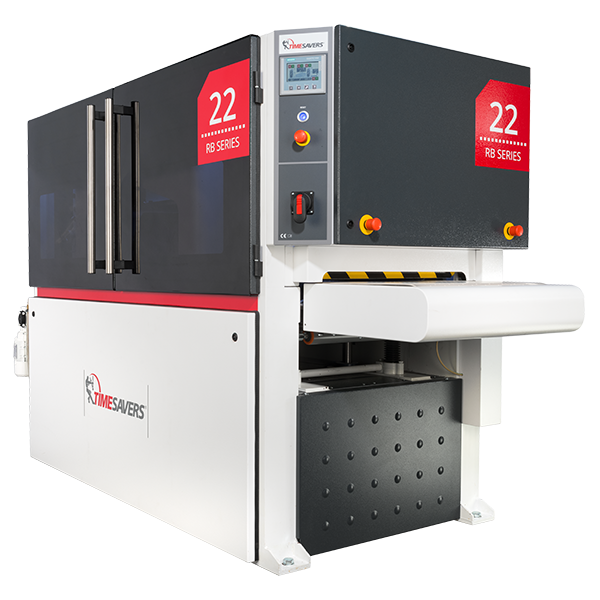
| Timesavers 22 RB Series – Dry-Operating Rotary Brush Machine for Deburring, Edge Rounding and Finishing | Precision deburring and edge rounding, uniform edge rounding, and laser oxide removal on small-to-medium sheet metal parts; consistent radius and rounded edges across all outer contours in one pass | 4 Abrasive Rotary Brushes | 600 mm | Dry | Laser job shops, stainless steel fabricators, metal furniture producers | Coating adhesion and paint adhesion are defined quality requirements, a consistent radius is specified, and production covers small-to-medium laser cut or punched parts |
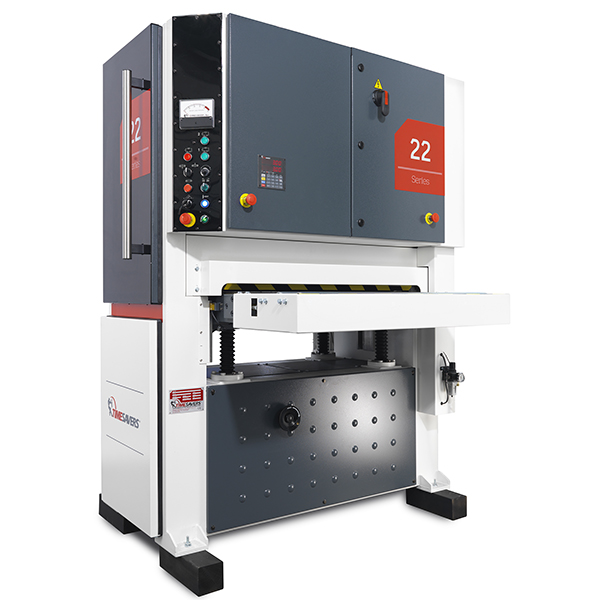
| Timesavers 22 Series Hammerhead – Deburring and Finishing Machine | Heavy slag removal on plasma cut parts and flame-cut steel, combined with secondary surface finishing; rounded and assembly-ready edges on complex geometries achieved in one pass | Hammerhead Impact Module + Multi-Head Options | 900 / 1,050 / 1,280 mm | Dry | Structural steel fabrication, shipbuilding, heavy industry | Parts carry mechanically bonded heavy slag from thermal cutting and must be brought to a functional, assembly-ready finished condition efficiently |
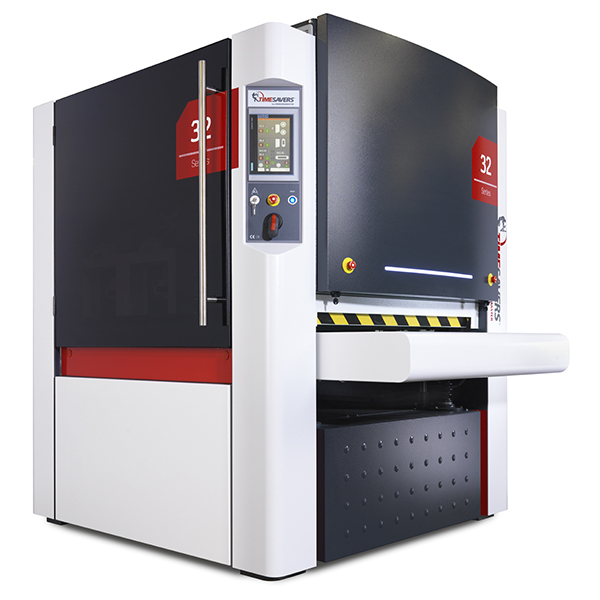
| Timesavers 32 RB Series – Mid-Sized Deburring, Edge Rounding, Laser Oxide Removal and Finishing Machine | Versatile mid-range finishing across mixed metal parts and materials; deburring edge rounding and oxide removal; rounded edges across all cut parts | 4 Abrasive Rotary Brushes; 1–3 processing units (hammerhead, wide belt, rotary brush) | 1,100 mm | Dry | General metalworking, OEM component production, subcontract fabricators | Production involves frequent changeovers, varied part geometry and materials, and the operation requires a balance between finishing quality and investment level |
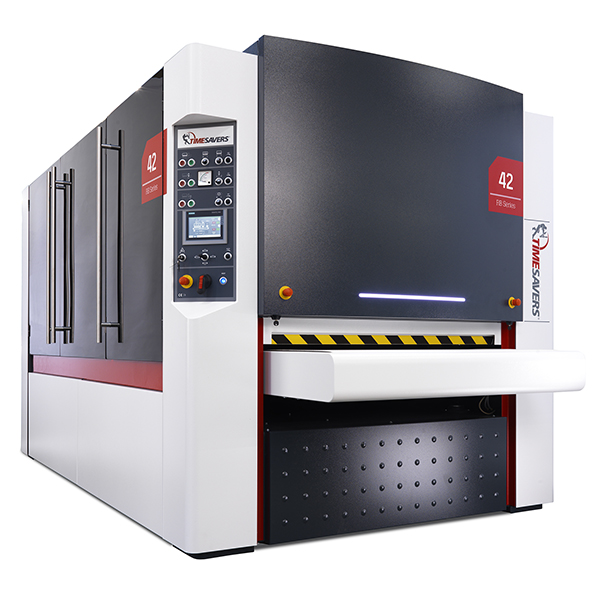
| Timesavers 42 RB Series – Rotary Brush Machine for Deburring, Edge Rounding, Laser Oxide Removal, Heavy Slag Removal and Finishing | High-volume continuous finishing with a controlled radius of 2 mm, uniform edge rounding and rounded edges across all cut parts, and slag removal on large and heavy plate | 8 Abrasive Rotary Brushes (up to 6 top brushes); 1–4 processing units | 1,350 / 1,525 / 1,600 mm | Dry or Wet (with integrated filtration and component dryer) | Automotive supply chains, heavy industry, 24/7 multi-shift production; non-ferrous and mixed-material programmes including aluminum requiring wet capability | Throughput is high, a consistent radius and rounded edges on all cut parts are contractual quality requirements, multi-shift reliability is non-negotiable, and Industry 4.0 integration with programmable recipe management is operationally required |
Validating the Selection Against Real Production Conditions
A machine specification built on clearly defined variables is a sound foundation. The final step that converts it into operational certainty is validation against real parts, real tolerances, and real throughput targets before the investment is committed.
Running representative metal parts - laser cut parts, punched parts, or plasma cut parts - through the proposed machine configuration confirms edge quality, cycle time, and handling stability in practice. It validates consistent results and rounded edges across all cut parts on your actual mix, confirms that the deburring process delivers the required radius and surface finishing standard for assembly and painting, and provides the evidence base for a confident final decision.
For applications involving combinations of cutting methods, strict OEM tolerances, or complex geometries, this validation step is the most valuable conversation you can have before signing a purchase order.
Talk to a Minex Technical Expert
The right deburring and grinding machine is the one fully aligned with your cutting process, part range, finish specification, and production volume. Translating that alignment from technical analysis into a confirmed machine configuration is where application expertise makes the difference.
Our technical team at Minex Group is available to review your production requirements in detail - your parts, your edge conditions, your downstream specification, and your throughput targets - and to provide a clear, evidence-based recommendation tailored to your specific needs.
Frequently Asked Questions
A deburring machine removes burrs, sharp edges, and surface defects from metal parts created during cutting, punching, or laser processes, ensuring components are safe to handle, dimensionally ready for assembly, and able to accept coatings reliably. Automatic deburring machines replace a time-consuming manual process with a controlled, repeatable deburring process that delivers consistent results and rounded edges with uniform edge quality across every batch.
Match the machine technology to your cutting method and defect type. Abrasive belts and a grinding belt handle burr removal and edge breaking on laser cut parts and punched parts. Abrasive rotary brushes deliver deburring and edge rounding, uniform edge rounding, and oxide removal on sheet metal. Hammerhead modules are the correct choice for slag removal on plasma cut parts from thermal cutting. For mixed production, multi-head metal deburring machines equipped with multiple processing units handle several defect types across all edges in one pass, delivering consistent quality and rounded edges for assembly and downstream processes.
Part thickness, overall dimensions, minimum part size, and the presence of inner and outer contours determine the working width, conveyor design, and the number of processing units required for uniform edge quality and consistent finishing across all cut parts. Small parts require machines equipped with vacuum or magnetic transport; large plate demands wider working widths and a robust transport system
Modern metal deburring machines produce everything from basic burr removal and edge breaking through directional surface finishing and non-directional pre-painting finishes, to a defined radius of 2 mm or greater with rounded edges across all cut parts. A consistent radius improves coating adhesion, paint adhesion, and corrosion resistance - and rounded edges significantly improve safety and dimensional consistency during assembly and handling of finished metal parts.
Wet machines are recommended when processing stainless steel, aluminum, or mixed non-ferrous materials at volume, because coolant controls heat, prevents discoloration, and suppresses fine metallic dust. Within the Timesavers range distributed by Minex Group, the 42 RB Series is equipped for wet operation with integrated filtration and a component dryer; the 12 Series and 22 RB Series are equipped for dry operation only.
Low-volume, high-mix operations benefit from manual or basic automatic deburring machines that prioritise flexibility across varied metal parts and complex geometries. Higher volumes and multi-shift production justify fully automatic metal deburring machines equipped with multiple processing units and recipe storage, keeping cost per part competitive and delivering consistent results - including precise edge rounding, rounded edges with a uniform radius, and reliable oxide removal - across extended production runs.
The main TCO drivers are consumable use - abrasive belts, grinding belts, abrasive brushes, and rotary brushes - energy consumption, maintenance, changeover time, labour requirements, and scrap or rework from inconsistent finishing or inadequate edge rounding. Specifying the correct metal deburring machine for your specific needs across your actual materials and part mix is the most effective way to control consumable costs, protect finishing quality, and ensure every part reaches assembly with rounded edges and a consistent radius.
Follow the manufacturer's maintenance schedule, inspect and replace abrasive belts, grinding belts, abrasive brushes, and rotary brushes at the correct intervals, service the extraction or filtration system, and perform safety checks on guards, emergency stops, and interlocks. Consistent maintenance supports consistent results in the deburring process, protects the quality of rounded edges across all materials, and safeguards operators handling metal parts with sharp edges.
Key risks include sharp edges on metal parts, airborne dust from the deburring process, sparks from grinding, noise, and entanglement at moving abrasive belts or rotary brushes. Operators must use appropriate PPE, ensure correct guarding is in place, and operate the machine with suitable dust extraction or coolant matched to the materials being processed. Properly rounded edges and a controlled deburring process reduce handling injuries during assembly and all downstream operations.
Run representative parts - laser cut parts, punched parts, or plasma cut parts - through the proposed configuration and verify edge quality, the consistency of the edge radius, surface finishing results, cycle time, handling stability for small parts, and consumable wear across all materials. For applications with complex geometries or inner and outer contours, real-part validation is essential to confirm the machine delivers the consistent results, rounded edges, and uniform edge quality your assembly and downstream processes demand.