Industrial Welding Solutions
Accuracy, Automation & Reliable Performance
Industrial Welding: Safety, Reliability & Performance at Scale
In every industrial environment, welding defines structural integrity and operational reliability. By joining metals, it guarantees the long-term stability of ships, pipelines, automotive frames, and steel bridges. The weld is formed by heating the base material until a weld pool of molten material develops and solidifies. In welding, the base metal—the primary material being joined—plays a crucial role, as its properties and how it responds to heat input directly affect the strength and quality of the weld joint. Around it, the heat affected zone alters the properties of the parent metal, making process selection and heat input monitoring essential.
Industries now demand more than manual welding or stick welding. Automation, advanced welding rotators and manipulators, and closed-loop control systems allow welding processes to be scaled, monitored, and documented for compliance with AWS, ASME, and API standards. This shift ensures predictable weld quality, reduced rework, and compliance across heavy fabrication sectors.
Core Welding Processes and Technologies for Industrial Operations
Profile Welding Machines
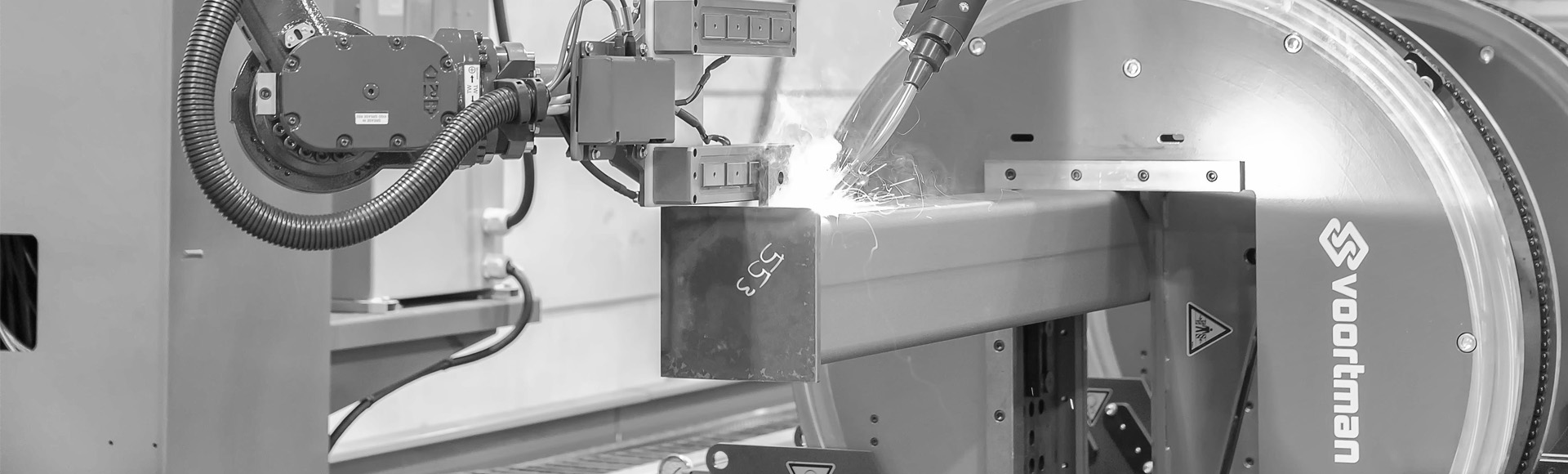
Profile Welding Machines are purpose-built for structural components such as beams, pipes, and thick-walled profiles. They integrate Column & Boom manipulators, Heavy-Duty Welding Rotators and Positioners, and Seam Tracking Systems to maintain weld accuracy across long sections. A robust, reliable power source specifically designed for automation is essential in these systems to ensure consistent weld quality and seamless integration with communication protocols. By combining these with Submerged Arc Welding (SAW), they achieve high deposition rates, deep penetration, and uniform fusion even on beams, pressure vessels, and pipelines.
To boost productivity on high production applications, machines are configured for controlled welding speeds, synchronized travel, and coordinated power sources and wire feeders.
Benefits:
- Deep penetration and consistent weld metal properties on thick sections
- Stable, repeatable seam quality supported by advanced manipulators and rotators
- High productivity in heavy fabrication with minimized manual handling
Welding Automation Systems
Welding Automation Systems extend beyond simple mechanization to a complete Automation Pyramid. At the foundation, PLC and CNC control systems govern movement and deposition. Above this, laser vision seam tracking sensors ensure precise positioning, while real-time weld data monitoring and closed-loop feedback manage arc stability, interpass temperatures, and heat input (J/inch). Automatic processes, such as continuous electrode wire feeding and automated welding cycles, play a crucial role in increasing efficiency and consistency in industrial welding applications.
These systems support advanced processes such as Pulsed GMAW for controlled metal transfer, High-Speed TIG (GTAW) for thin materials, and Hybrid Laser-Arc welding for minimal heat affected zones. Laser beam welding, in particular, is easily automated and well-suited for high-volume manufacturing environments like the automotive industry due to its fast welding speed and compatibility with automation.
Benefits:
- Integration of robotics, PLC/CNC controls, and seam tracking for repeatability
- Automated control of weld pool dynamics, shielding gas, and filler metal feed
- Traceable, documented weld records aligned with international codes
Understanding Joint Types in Industrial Welding
The correct joint design ensures both weld quality and efficiency:
- A butt joint is used in pipelines and plates, where the root pass quality is critical for structural integrity.
- A corner joint is applied in enclosures and box beams, providing an angular connection between two parts.
- A lap joint is essential for thin materials, as it involves overlapping parts welded together at their edges to increase the weld area.
- T-joints are used in steel frameworks, where angular distortion must be minimized.
- An edge joint is typical in sheet metal and panel structures, joining two parts at their edges and requiring proper edge preparation for strength.
Proper joint selection at first contact with design and production teams helps align the welding system with downstream inspection and quality plans.
Optimizing Welding Parameters with Weld Data Monitoring
Industrial weld quality depends on precise management of parameters:
- Welding speeds and arc length consistency
- Current and voltage stability per joint design
- Control of interpass temperature and total heat input
Maintaining a stable electric arc is crucial for consistent weld quality, as fluctuations can lead to defects and irregular penetration.
Modern automation integrates Weld Data Monitoring Systems for continuous logging, enabling compliance with WPS (Welding Procedure Specification). Parameter dashboards document each welding process and welding system setting for auditability and continuous improvement.
Welding Processes and Techniques in Modern Industry
- Arc welding: GMAW, SMAW, GTAW, PAW for general fabrication. In many arc welding methods, a consumable electrode serves as both the electrode and the filler material, melting to form the weld and sometimes generating shielding gases or slag.
- Submerged Arc Welding (SAW): For pipelines, pressure vessels, and beams.
- Laser Beam Welding (LBW) and Electron Beam Welding (EBW): For critical aerospace, energy, and automotive components.
- Friction Welding: Solid-state for dissimilar metals.
- Gas Welding and Gas Flame Methods: For repair and on-site applications.
- Resistance Spot Welding (RSW): Automotive body and rail fabrication. This process uses two electrodes, typically made of copper, to press and pass current through the workpieces, generating heat to create the weld.
- Orbital Welding: Automated pipe welding for API 1104 and ASME B31.3 compliance.
- Forge Welding: Applied in select heavy fabrication projects.
- Weld Cladding and Hardfacing: For corrosion resistance in shipbuilding and offshore components.
Strategic Benefits for Industry
- Superior weld quality aligned with AWS, ASME, and API standards
- Real-time parameter monitoring and traceable weld documentation
- Improved safety by limiting exposure to toxic fumes and high temperature arcs
- Cost control through optimized filler metals, labor savings, reduced rework, and careful management of material costs as a significant component of overall welding expenses
- Adaptability from semi-automatic setups to fully robotic production cells
- Industry-wide applicability: shipbuilding, steel construction, automotive, energy, with certain welding methods—such as energy beam welding—being especially suitable for high production applications due to their speed and automation capabilities
Practical Advice for Selecting the Right System
- Choose Profile Welding Machines with manipulators and rotators for beams, pipelines, and heavy structural assemblies.
- Select Welding Automation Systems with PLC/CNC integration for high-volume, high-speed welding.
- Combine both approaches for hybrid setups in shipyards, fabrication shops, and infrastructure projects.
- Consider floor space, training, long-term ROI, and high equipment costs—especially for advanced systems like energy beam welding—not just equipment cost.
Customized Welding Systems for Unique Industrial Needs
In today’s diverse industrial sectors, a one-size-fits-all approach to welding is rarely sufficient. Customized welding systems are engineered to address the specific requirements of industries such as automotive, aerospace, and construction, where each application may demand unique solutions. By leveraging advanced welding processes—including gas metal arc welding, shielded metal arc welding, and gas tungsten arc welding—manufacturers can achieve superior weld quality tailored to their production needs.
Whether the goal is to optimize metal arc welding for high-mix production or to ensure repeatable results in complex assemblies, customized welding systems provide the flexibility and performance needed to meet the evolving demands of modern industry.
Key Applications Across Sectors
Shipbuilding & Offshore: Mastering the Elements
Shipbuilding demands welds that withstand extreme mechanical stress, vibration, and corrosion. Profile Welding Machines with SAW are applied for hull plating, web-to-flange joints, and thick-plate assembly. Automation systems accelerate block fabrication and minimize downtime in large shipyards.
Critical requirements include compliance with AWS D3.5 (Underwater Welding Code) for offshore work, the welding of high-tensile steels for hull integrity, and the application of weld cladding and hardfacing to resist seawater corrosion. Process control ensures consistent long seams, balanced heat input, and weld face uniformity.
Automotive & Rail: Production at Scale
The automotive industry relies heavily on advanced welding processes for mass production and assembly, ensuring rapid and reliable construction of vehicle bodies and parts. Automotive and rail sectors rely on automated resistance spot welding (RSW) for high-volume assembly of body frames. Robotic cells integrate seam tracking, current monitoring, and weld record traceability. For aluminum components, advanced seam tracking systems manage distortion and prevent porosity.
Processes like Pulsed GMAW and GTAW are used for visible welds and safety-critical joints, while laser beam welding achieves minimal HAZ on thin roof panels. Automated inspection ensures compliance with quality systems such as IATF 16949, reducing rework and scrap while conserving floor space.
Energy & Infrastructure: Reliability Under Pressure
Pipelines, pressure vessels, and power plants require welds compliant with API 1104 and ASME B31.3 standards. Orbital welding systems are applied for pipes, ensuring root pass quality with GTAW and GMAW before high-productivity SAW fill passes.
Chrome-moly alloys in power plant applications demand strict heat input control, while pressure vessels and storage tanks require consistent weld metal properties across thick sections. Automated systems guarantee traceable weld records and certification compliance. EBW and friction welding are used for high-integrity turbine and critical infrastructure components.
Safety, Compliance & Workspace Planning
Welding introduces high temperature, toxic fumes, and arc flash hazards. Automated cells should include fume extraction, interlocks, and protective enclosures. It is essential to protect the welder from hazards such as UV light, fumes, and noise by providing proper personal protective equipment and safety measures. Layout planning must consider access aisles, fixture handling, and consumable storage, balancing productivity with operator safety. Compliance with ATEX, OSHA, and ISO standards ensures safe operation in regulated sectors.
Integration, Controls & Footprint Considerations
A complete welding system integrates power sources, feeders, manipulators, fixtures, seam tracking, and PLC/CNC control. Closed-loop feedback adjusts parameters in real time, while modular layouts reduce floor space requirements. Automated systems can be scaled from pilot lines to full-rate production while maintaining consistent weld data logging for traceability.
Implementation and Maintenance of Industrial Welding Solutions
Successful deployment of industrial welding solutions hinges on careful implementation and ongoing maintenance. Selecting the appropriate welding process—whether plasma arc welding for precision work, laser beam welding for high-speed applications, or submerged arc welding for deep penetration—ensures that each welding job meets the required standards for quality and efficiency.
Equipping welding systems with robust safety features is essential to protect operators from hazards such as high temperatures and arc flash. Regular maintenance routines, including timely replacement of consumable electrodes and thorough cleaning of the weld pool, help prevent equipment failures and maintain consistent weld quality.
Continuous training for welders is also a critical component. As new technologies and techniques—such as stick welding and manual welding—are introduced, comprehensive training ensures that welders remain proficient and can adapt to evolving welding processes. By investing in both the implementation and maintenance of advanced welding solutions, companies can enhance productivity, reduce downtime, and control costs related to labor and materials, all while upholding the highest standards of weld quality and safety.
Why Welding Efficiency Matters
Efficiency means consistent compliance, reduced defects, and predictable costs. By adopting automated welding systems with closed-loop monitoring, industries achieve reliable welds, lower labor costs, and extend the service life of critical infrastructure.
Partner with Minex for Expert Welding Solutions
Minex delivers welding machines and automation systems built to support compliance with AWS D1.1, AWS D3.5, API 1104, and ASME B31.3. Our solutions include complete WPS documentation and weld data monitoring to support traceability. With decades of experience in heavy fabrication projects across Europe, Minex provides reliable equipment for shipyards, steel construction, automotive production, and energy infrastructure.
Frequently Asked Questions
Industrial welding automation means machines control the torch movement, speed, and arc parameters — instead of a person doing it by hand. The result is a weld that comes out the same way every single time, regardless of who is on shift.
In manual welding, quality depends entirely on the skill, concentration, and physical steadiness of the individual welder. On a long seam or a high-volume run, that introduces variation — slight differences in travel speed, torch angle, or arc length that show up as inconsistency in the finished weld.
Automated systems remove that variable. A Column & Boom manipulator travels the torch at a programmed speed. Sensors track the seam and correct the torch position in real time. The power source maintains current and voltage within set limits. Every weld is made the same way, documented automatically, and ready for inspection without paperwork chasing.
The practical difference for your operation comes down to three things:
- Fewer defects and less rework — parameters don't drift, so the problems that come from human fatigue or inconsistency simply stop happening.
- Higher throughput — automated systems run at near-continuous arc-on time. Manual welders typically achieve 20–40% arc-on time over a shift. The difference compounds quickly on long production runs.
- Built-in records — every weld is logged automatically. For European fabricators supplying to construction, energy, or industrial clients, that documentation is often a contractual requirement — and generating it manually is time-consuming and error-prone.
When manual welding still makes sense: repair work, short one-off jobs, tight access positions, and site work where bringing a machine is not practical. Automation earns its place on volume, geometry, and documentation demands.
The short answer: Submerged Arc Welding (SAW) for thick plates and beams, GTAW (TIG) orbital for pipe root passes, and Pulsed GMAW for thinner materials or aluminium. The right choice depends on what you're welding, how thick it is, and how fast you need to go.
Here is how the main applications break down:
- Structural beams and box sections: SAW is the industry standard. It burns hot, deposits weld metal fast, and the flux shield means you don't need a separate shielding gas. On web-to-flange joints and long seams, nothing else matches it for productivity on thick material.
- Pressure vessels and heavy plates: SAW again, run on automated positioners so the joint stays in the flat position throughout. The positioner rotates the vessel; the torch stays fixed. This keeps heat input consistent and deposition rate high across the full circumference.
- Pipe root passes: GTAW orbital welding. The root pass is the most critical weld in a pipeline — full penetration, clean internal profile, no defects. Orbital TIG does this reliably and repeatedly in a way that manual root welding cannot match at scale. Fill and cap passes are then completed with GMAW or SAW.
- Thin materials and aluminium: Pulsed GMAW or High-Speed GTAW. Both control heat input carefully to prevent distortion, burn-through, and porosity. Aluminium is unforgiving — too much heat and the HAZ softens irreversibly.
- High-volume automotive and rail production: Resistance Spot Welding (RSW) in robotic cells for body frames and panels. Fast, reliable, and easily automated. For structural and visible joints, Pulsed GMAW in robotic cells with seam tracking.
A practical rule of thumb: if maximising deposition rate is the priority, SAW wins on thick material. If controlling heat input is the priority — thin sections, heat-sensitive alloys, or precision joints — go pulsed or orbital. If you're not sure, the joint thickness and material type will usually make the decision for you.
A profile welding machine is a fixed production system built specifically for welding long structural profiles — I-beams, H-beams, box sections, and pipe spools. It combines a torch carrier, a workpiece positioner, and a seam tracking system into one integrated setup.
The key components work together:
- Column & Boom manipulator carries the welding head along the seam at a controlled, consistent speed. You set the parameters once; the machine repeats them across the full length of the joint without variation.
- Heavy-duty rotators or positioners hold the beam or vessel and rotate it so the weld is always in the downhand position — the most productive and easiest-to-control welding position. This alone eliminates the need to reposition the workpiece between passes.
- Laser seam tracking sensors follow the joint in real time and correct the torch if the seam drifts. On rolled steel beams, the root gap and fit-up are never perfectly uniform — seam tracking compensates for this automatically.
- SAW power source with flux recovery handles the high deposition rates that make the system productive. Flux is recovered and recycled, reducing consumable waste and keeping the process running with minimal stops.
A profile welding machine is the right choice when your work is dominated by long, repetitive seams on large structural components — beam fabrication, pressure vessel shells, pipe spools. It is not the right choice for short welds, complex multi-pass joints in varied positions, or high-mix low-volume work. For those applications, a robotic GMAW cell with 6-axis movement gives you the flexibility a fixed profile machine cannot.
The business case is straightforward: if you are welding the same type of beam or section day after day, a profile machine reduces labour cost per metre of weld, increases throughput, and produces consistent quality that is easy to document and inspect.
Automation improves all three — but not for the same reasons. Repeatability comes from removing human variation. Productivity comes from running longer without stopping. Traceability comes from the fact that the system records everything as it goes.
Repeatability is the most direct benefit. A programmed system runs the same current, voltage, travel speed, and torch position on weld number 500 as it did on weld number one. Manual welding cannot do this — concentration drops, posture shifts, and small inconsistencies accumulate over a shift. On safety-critical joints or high-specification fabrication, that variation is the source of most rework.
Productivity gains are larger than most operators expect. Manual welders typically achieve 20–40% arc-on time over a shift — the rest is repositioning, checking, waiting, and resting. Automated systems run at 70–90% arc-on time. On top of that, processes like SAW deposit weld metal at rates that GMAW and manual SMAW cannot approach. The combination of higher duty cycle and higher deposition rate means significantly more metres of completed weld per shift, per machine.
Traceability is where automation solves a problem that most fabricators underestimate until they are sitting in front of a client audit. Every weld made on an automated system is logged automatically — current, voltage, travel speed, heat input, interpass temperature, time and date, operator ID. That record is produced as a by-product of welding. On a manually welded project, producing the equivalent record requires someone to write it down accurately, every time, under production pressure. The gap between those two situations is where documentation failures occur.
For European fabricators specifically: clients in construction, energy, and industrial sectors increasingly require documented weld records as a condition of contract — not just as a quality preference. Automated logging makes compliance with this requirement a standard output of your production process rather than an administrative burden added on top of it.
The five joint types used in industrial welding are butt, T, corner, lap, and edge. Which one you use depends on how the parts meet and what structural load the joint needs to carry. The design of the joint — groove angle, gap, preparation — directly determines whether a good weld is even possible.
- Butt joint: Two pieces joined edge to edge. Used in pipelines, vessel shells, and structural plate work. The most demanding joint type to weld well — the root pass must fully penetrate with no gaps or voids, and that quality cannot be recovered after the joint is closed. Fit-up before welding is everything: root gap and alignment must be within tolerance before the arc starts.
- T-joint: One piece meeting another at a right angle, like a web welded to a flange. The most common joint in structural steelwork. The main production challenge is angular distortion — the heat pulls the web out of square. Fixture restraint or a programmed balanced weld sequence keeps it straight.
- Corner joint: Two pieces meeting at an outer corner, common in box sections. The access for inspection after welding is limited — which makes getting the preparation and root fusion right the first time more important than on any other joint type.
- Lap joint: One piece overlapping another, welded at the edges. Used in thin sheet, reinforcement plates, and overlay cladding. The common failure mode is lack of fusion at the upper plate edge — the arc needs to travel into both pieces fully, not just run along the surface of one.
- Edge joint: Two pieces joined at their edges, side by side. Used in sheet metal and light panel work. Edge preparation quality controls the outcome — burn-through on thin material and incomplete fusion on thicker material are both products of poor fit-up before welding starts.
The most overlooked quality factor: joint design affects not just weld quality but also inspection cost. A full-penetration butt weld typically requires volumetric non-destructive testing — ultrasonic or radiographic. A fillet weld at the same location, if structurally acceptable, requires only visual inspection. Getting your welding engineer involved at the design stage, before drawings are issued, can reduce both welding and inspection cost significantly.
Welding parameters are controlled through a combination of pre-set limits programmed into the machine and real-time feedback that keeps the arc within those limits throughout the weld. The system adjusts continuously — you don't have to watch every joint.
Here is what each parameter does and how it is managed in an automated setup:
- Current (amperage): Controls penetration depth. Too low and the weld doesn't fuse into the base material; too high and you burn through or create a large, uncontrolled weld pool. Automated systems hold current within a set range and alarm if it drifts outside — the power source servo adjusts the wire feed rate to compensate in real time.
- Voltage: Controls arc length and bead width. Low voltage produces a narrow, convex bead; high voltage produces a wide, flat one. Together with current, it determines the energy going into the joint. Both are logged continuously against the weld record.
- Heat input: The combined effect of current, voltage, and travel speed — expressed in kilojoules per millimetre. It determines how much heat goes into the base material and the surrounding zone. Too much heat on high-strength steel degrades toughness in the heat-affected zone; too little leaves poor fusion. In automated systems, heat input is calculated in real time and compared against the qualified limit. If it goes out of range, the system flags it before the joint is completed — not after.
- Travel speed: The speed at which the torch moves along the joint. Faster travel reduces heat input and deposition; slower travel increases both. Automated systems hold travel speed constant with a servo drive — no variation from the welder's hand or pace.
- Interpass temperature: The temperature of the workpiece between weld passes. If it is too cold, hydrogen cracking can initiate in high-strength steels. If it is too hot, the heat-affected zone grows and material properties degrade. Thermocouples or contact probes measure the surface temperature, and the system gates the next pass until the reading is within the correct range.
What this looks like in practice: the operator sets the parameters at the start of a job, the system welds within those limits and logs every value, and the weld record is ready for inspection without any additional paperwork. Deviations are flagged as they happen — not discovered during a client audit weeks later.
The documentation required depends on what you are manufacturing and who you are selling to. For most industrial fabrication in Europe, the baseline is a qualified welding procedure, certified welders, and production records that show each weld was made within the specified parameters.
In practice, European clients and inspectors look for three things:
- A qualified Welding Procedure Specification (WPS): A documented, tested description of exactly how a specific joint is to be welded — process, material, thickness, groove geometry, parameters, preheat, and post-weld treatment. The WPS must be qualified by testing before you use it in production. This is the foundation document that everything else refers back to.
- Certified welders and operators: Each person welding in production must hold a valid qualification certificate for the process and material they are working with. Certificates have defined validity periods and must be kept on file and current.
- Production weld records: For every completed joint, a record showing that the actual welding parameters matched the WPS, that preheat and interpass temperatures were within limits, and that any non-conformances were identified and resolved. This is the document a client, inspector, or auditor will ask to see first.
Beyond this baseline, the specific standards that apply depend on your sector:
- Structural steelwork for the EU market requires CE marking under EN 1090-1, which means your quality system must be certified to ISO 3834 and you must have a qualified Responsible Welding Coordinator on staff.
- Pressure vessels and industrial piping fall under the Pressure Equipment Directive (PED). Higher-category equipment requires a Notified Body to approve your procedures and audit your quality system before production begins.
- Pipelines are governed by EN ISO 13847 for transmission lines and EN 12732 for gas distribution — the European equivalents of API 1104.
- Railway vehicles require EN 15085 certification, which sits on top of ISO 3834 and adds sector-specific testing and coordinator requirements.
- Automotive production works within IATF 16949, with weld process control plans and parameter traceability down to the individual vehicle.
The simplest way to think about it: your WPS tells everyone how the weld should be made, your welder certificates confirm the people making it are qualified to do so, and your production records prove that it was actually made that way. Get those three things right and you have the foundation for any EU compliance requirement in welding.