Profile Welding Machines
A Technical Consultancy Guide for Engineers and Procurement Specialists
Profile welding machines are not interchangeable capital equipment. A seam welder cannot substitute for a beam welding line. A column and boom manipulator cannot do what a robotic fabricator does. And within each category, the difference between a machine rated for a standard web height and one rated for extreme structural dimensions is not a spec sheet footnote - it is the difference between a machine that handles your heaviest offshore contract and one that creates a manual bottleneck every time that contract comes through the door.
The consequence of a misspecified machine is not simply a purchase you regret. It is a production constraint embedded into your facility for the next ten to fifteen years, affecting throughput, labour planning, quality consistency, and your ability to bid competitively on projects at the upper end of your capability range. That is the real cost that rarely appears in procurement calculations.
This guide is written for engineers, procurement managers, and operations leads who already know their way around a welding specification. It does not explain what submerged arc welding is. What it does is give you a structured way to interrogate your own production requirements so that by the time you reach the portfolio comparison at the end, you are choosing between two or three genuinely viable options - not scanning a catalogue cold.
Profile Geometry Comes First - Everything Else Follows From It
The single most important question in profile welding machine selection is deceptively simple: what shape are you welding, and how does that shape move through production?
This matters because profile welding machines are fundamentally divided by geometry. They are not generalist tools that happen to excel in certain areas - they are purpose-engineered around specific joint configurations, and the physics of how they achieve alignment, clamping, and heat input is different in each category. Trying to use one category to do the job of another is not a workaround; it is a failure mode.
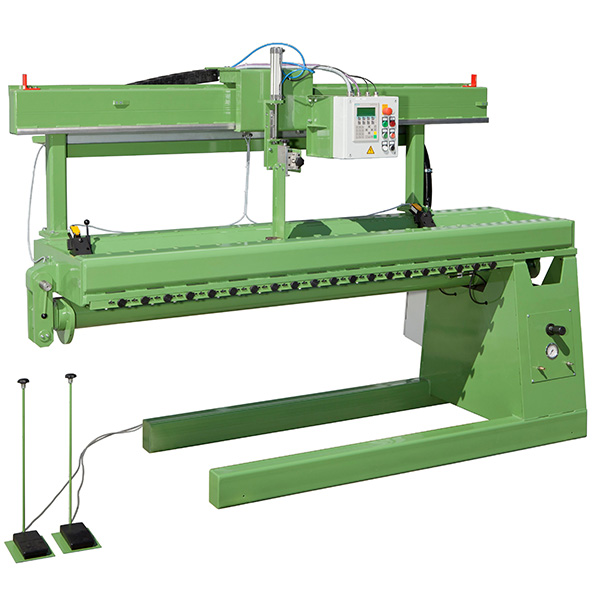
If your production centres on pressure vessels, storage tanks, pipeline systems, or any closed-form geometry component - cylindrical, conical, rectangular - you are in seam welding territory. The defining characteristic of these components is a longitudinal joint that must be held in precise alignment under continuous clamping pressure for the full weld length, with no tack welding, no repositioning, and no tolerance for distortion that would compromise the vessel's structural or pressure-bearing integrity. Nothing else on the market is engineered to do this as precisely as a dedicated seam welding machine.
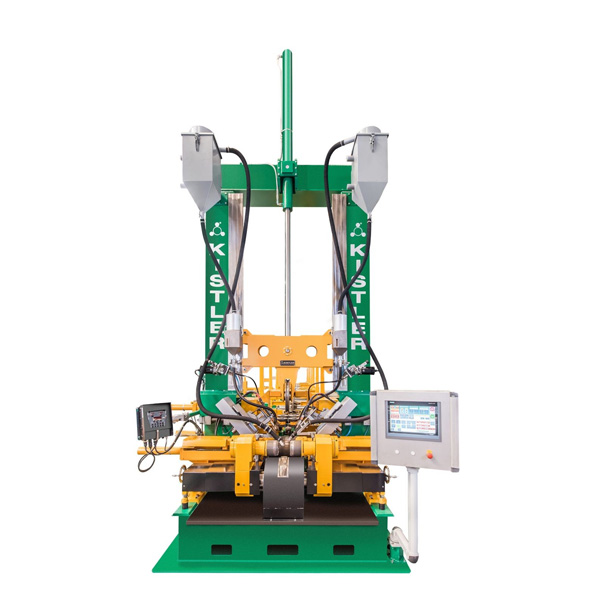
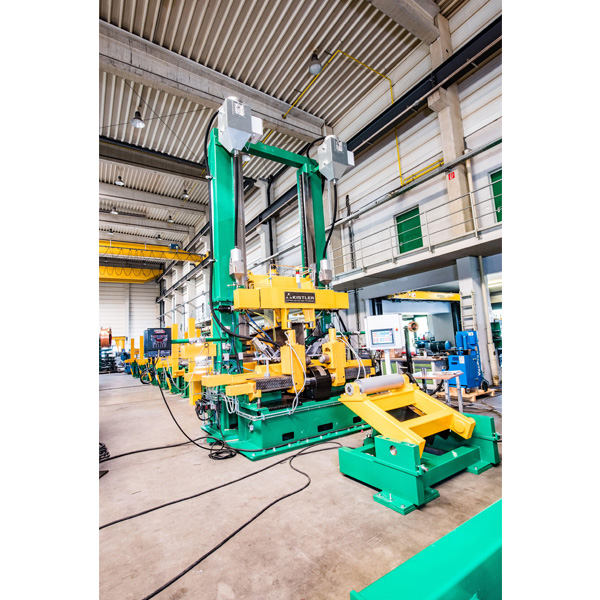
If your production is dominated by structural steel - I-beams, H-beams, T-beams feeding construction, bridge, or shipbuilding programmes - you are in beam welding line territory. Here the geometry challenge is different: you are assembling and welding flanges to webs at high volume, continuously, and the critical performance metric is throughput combined with dimensional consistency across long beam lengths. The relevant question then becomes one of scale, which the portfolio table addresses directly.
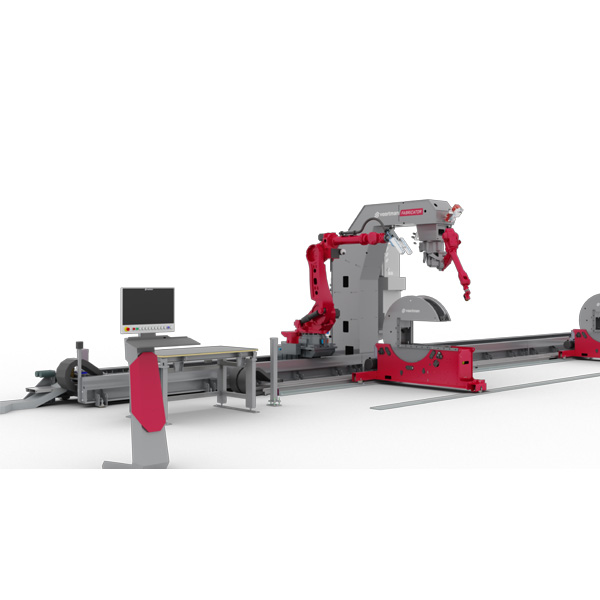
If your operation fabricates complex structural assemblies - components that combine multiple profile types, require fitting and welding of add-ons, brackets, stiffeners, or gussets, and vary significantly from job to job - neither a seam welder nor a beam line is the right answer. You need a machine capable of adaptive robotic fabrication, one that can read a job from a 3D model and reconfigure its approach without requiring you to reprogram it manually between runs.
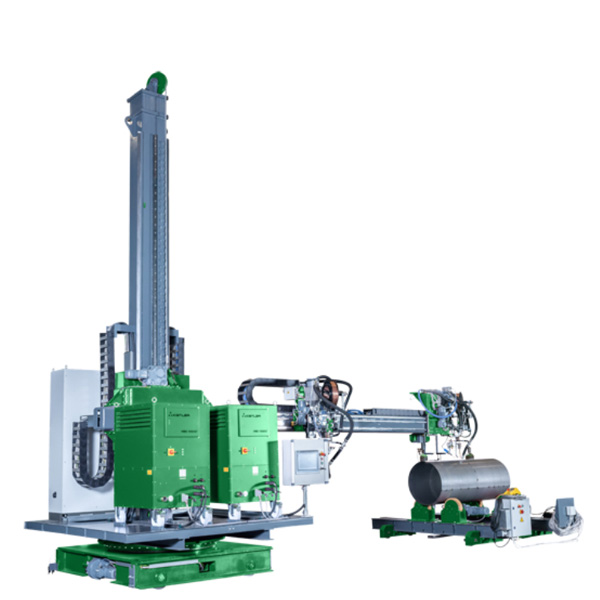
Finally, if your challenge is not moving the profile through the machine but moving the welding system to the profile - because the component is too large, too heavy, or too awkward to be manipulated - then a column and boom manipulator is the correct category. These systems are designed precisely for the situation where the workpiece is stationary and the torch must travel.
Getting this geometry classification right before you evaluate any other factor saves significant time. It also prevents the common mistake of specifying a machine based on the majority of your current production while ignoring the minority that will cause operational problems.
Dimensional Capacity: Specify to Your Largest Project, Not Your Average One
Once geometry establishes the machine category, dimensional capacity determines which specific solution within that category is viable. This is a hard engineering boundary - rated limits on web height, beam length, and weight per metre are structural constraints, not conservative estimates.
The practical error most procurement teams make is specifying to average production rather than peak production. If the majority of your beam output falls within a comfortable mid-range, it is tempting to specify to that range and treat the outliers as manageable by other means. In practice, those outliers either become a manual handling problem, get subcontracted at a margin penalty, or are declined at the bidding stage - none of which are acceptable outcomes if they represent your highest-value contracts.
The same logic applies to lower limits. Machines designed for large structural sections have minimum dimensional thresholds that matter for shops running a mixed production programme. A beam welding line that cannot process smaller connecting sections without a separate setup is a hidden constraint that compounds over time.
For complex assemblies, the relevant limits extend beyond the primary profile dimensions to the handling capacity of the robotic subsystems responsible for fitting add-on components. A machine's overall assembly weight rating and its robot's individual component payload are two different numbers, and both matter for workflow planning.
The discipline required here is straightforward: map your full production range - not just the typical jobs, but the largest, the smallest, and the most complex - against the machine's rated limits before the specification is finalised. The portfolio table at the end of this guide provides the specific figures for each solution.
Automation Level Is a Workforce Strategy Decision, Not Just a Productivity One
Automation in profile welding is often discussed purely as a cycle time question - how much faster does the machine run compared to manual or semi-manual alternatives? That is the right question to ask, but it is only half the picture. The more strategically significant question is what skills the machine eliminates dependency on, and what that means for your labour planning over the next decade.
There are two distinct layers of automation that are often treated as one. The first is process automation: does the machine eliminate manual tack welding, manual layout marking, and manual fixture repositioning between operations? This directly affects cycle time, material handling costs, and the number of operators required per shift. Any modern dedicated beam welding line provides this level of automation - simultaneous double-sided welding with automatic clamping removes the tack welding step entirely, and that alone represents a substantial throughput improvement over conventional methods.
The second layer is programming automation: does the machine generate its own weld paths from imported 3D models, or does it require a skilled programmer to define each job before production can begin? This is where the distinction between machine categories becomes strategically significant. A robotic fabricator that integrates 3D laser scanning with work preparation software can receive a model from your design office, autonomously identify the profile geometry, and generate weld paths without operator programming input. In environments where job variety is high and skilled programming talent is scarce - which describes most structural fabrication shops operating in competitive markets today - this capability directly determines how quickly you can respond to new orders and how exposed you are to personnel dependency.
It is also worth being explicit about what automation does not do. A high-automation machine does not reduce the demand for engineering judgement in process qualification, WPS management, or quality control. What it does is concentrate your skilled workforce on those higher-value activities rather than deploying them on layout marking and manual tacking that a machine can handle more consistently and at lower cost.
The practical test: calculate what percentage of your total production labour is currently spent on layout, tacking, and pre-weld fixture work. If that figure is above 15 to 20 percent, the productivity case for high-automation equipment is compelling. If your operation runs high-volume, low-variety beam production where the same profile repeats across long runs, dedicated line automation will recover cost more efficiently than a flexible robotic system that brings capability you do not need.
Welding Process Compatibility Is a Compliance Requirement, Not a Preference
Material specifications and applicable welding codes dictate which welding processes are permissible on your components. This is not a performance discussion - it is a compliance one, and it needs to be settled before any other technical evaluation proceeds.
For heavy structural steel, offshore infrastructure, and shipbuilding applications, Submerged Arc Welding is frequently the required or preferred process. The deposition rates, penetration depth, and weld quality achievable with SAW configurations are not replicated by other processes at equivalent productivity levels, and many structural codes specify SAW for primary load-bearing joints. Any machine under evaluation for these applications must support the SAW configuration referenced in your active Welding Procedure Specifications.
For pressure vessels and components fabricated from stainless steel, titanium, copper, or aluminium, TIG welding is often mandatory - either for the full weld sequence or for root passes - because of its precision heat control and the protection it provides against oxidation in reactive materials. A seam welding machine that does not support TIG, or that cannot switch between processes depending on the material being processed, creates a significant constraint in any operation that works across multiple material families.
MIG and GMAW cover the broad middle ground of structural fabrication. For automated robotic systems, the specific power source configuration - including its rated output and the processes it supports - is a fixed parameter that determines which joint geometries and material thicknesses can be handled without supplementary equipment.
The practical instruction is straightforward: do not begin machine evaluation without a complete list of the welding process codes specified in your active WPS documents. Map every process code against the machine's confirmed capability. If the machine requires you to maintain a separate manual or semi-manual station to handle processes it cannot support, that is a gap in the specification that must be resolved or accepted explicitly as an operational constraint.
Clamping and Alignment Technology: The Factor That Determines Your Rework Rate
Of all the technical factors in profile welding machine selection, clamping and alignment technology is the one most frequently underweighted in procurement decisions and most frequently cited in post-installation operational complaints. The reason is that it is less visible in a specification sheet than welding process or dimensional capacity, but its impact on weld quality and dimensional conformance is direct and measurable.
The core question is not whether a machine has a clamping system - all of them do - but whether that system eliminates the conditions that cause distortion and misalignment, or merely reduces them. For longitudinal seam welding, the challenge is holding a joint in precise positional registration along its entire length while heat from the welding process is simultaneously working to distort the material. Clamping systems that apply pressure at fixed points do not solve this problem fully. A patented finger clamping mechanism that applies multi-directional pressure at close intervals along the seam - what the Kistler HSW Range describes as a "rock and roll" movement - holds the joint in alignment through the full thermal cycle without creating the stress concentrations that fixed clamping introduces. The specific clamping pressure varies by model and is a critical matching criterion for wall thickness and joint geometry; the relevant figures are in the portfolio table.
For beam welding lines, the equivalent concern is angular distortion in the flange-to-web joint and dimensional deviation across long beam lengths. Simultaneous double-sided welding addresses this by balancing heat input symmetrically, which significantly reduces net distortion compared to sequential single-sided welding. Controlled rotation for the largest sections adds a further layer of dimensional accuracy where distortion forces are greatest.
In offshore, structural, and pressure vessel applications, dimensional tolerance and weld quality are not preferences - they are code requirements with inspection and sign-off implications. The question to ask any equipment supplier is not "does your machine minimise distortion?" but "what distortion data do you have from production environments comparable to mine, and against which dimensional standards?" If that data is not available, it should inform your confidence in the specification.
Software Integration and Remote Data Flow: Where Machine Uptime Is Actually Won or Lost
In most heavy fabrication environments, machine downtime is reported and tracked carefully. Programming downtime - the time a machine sits idle while a new job is being configured, a weld path is being manually defined, or a work preparation check is being completed - is frequently not tracked with the same rigour, even though it consumes equivalent productive capacity.
Modern profile welding machines are manufacturing nodes in a digital production workflow, and their value is substantially determined by how seamlessly they receive and act on data from your engineering and work preparation systems. The gap between a machine that requires a skilled operator to manually programme each new job and one that ingests a 3D model and self-generates weld paths is not just a cycle time difference - it is a structural difference in how your production responds to order variation and how dependent your throughput is on programming personnel availability.
The VACAM work preparation software integrated with the Voortman Fabricator exemplifies what full software integration looks like in practice. Work preparers in the engineering office can load a 3D model, validate the weld programme, and transmit it to the machine without interrupting the current production run. The machine's 3D laser scanning system then performs autonomous product recognition at the point of production, confirming the component geometry before welding begins. The practical effect is that machine operators are running production rather than programming it, and the next job is ready before the current one is complete.
DIGI-WELD and comparable work preparation interfaces used across the Kistler range provide similar data flow benefits for beam welding lines - enabling pre-production validation and parameter management off-machine, which protects uptime during shifts.
When evaluating software integration, the useful exercise is to map your current data flow from engineering model to completed weld programme and count every manual step, translation, and approval gate in that chain. Each one represents a delay, an error risk, and a labour cost. The value of software integration is proportional to how many of those steps it removes - and that calculation is specific to your production environment, not a generic productivity claim.
Facility Footprint and Integration: What the Spec Sheet Does Not Tell You
A machine that cannot be physically integrated into your facility within the available capital and civil works budget is not a viable specification, regardless of how well it meets every other criterion. This seems obvious, but it is a consideration that is frequently deferred too late in the procurement process, by which point the preferred machine has already been specified and alternatives carry a change-management cost.
Beam welding lines require significant dedicated floor space with unobstructed infeed and outfeed zones at both ends proportional to the maximum beam length being processed. This is not a refinement to plan around - it is a fundamental facility requirement that must be confirmed against your floor plan before the machine reaches the shortlist.
Column and boom manipulators offer significantly more flexibility in terms of spatial integration. Fixed column systems can often be introduced into existing shop layouts with modest civil works. Traversing systems on rail tracks provide the mobility to cover large stationary workpieces but require rail track installation and the structural capacity to support it. The advantage of this configuration is that the machine moves to the work, which reverses the usual logic of facility planning around the machine.
Robotic fabricators designed for complex structural assemblies are generally built for integration into existing workflows rather than requiring a dedicated isolated production zone, but their infeed and outfeed requirements, robot working envelopes, and safety guarding footprints still need to be mapped against your available floor space before specification is finalised.
The practical recommendation is to complete a dimensioned floor plan overlay - including machine footprint, material infeed and outfeed zones, crane coverage radius, and service access clearances - before finalising any specification. The cost of discovering a facility conflict after contract signature is substantially higher than the cost of completing that drawing exercise before it.
The Minex Group Portfolio of Profile Welding Machines
Minex Group acts as the specialist distributor for welding equipment, providing technical specification support, installation coordination, and ongoing operational advisory - giving you access to manufacturer expertise without managing the complexity of direct international procurement.
| Machine | Best Suited For | Profile Types | Key Dimensional Range | Welding Processes | Automation Level | Primary Technical Advantage |
| Voortman Fabricator - Automated Fitting and Full-Welding Machine | Structural steel fabrication; complex multi-component assemblies; varied job mix with multiple add-ons and profile types per order | H, I, U, RHS - varied combinations processed in a single automated workflow | Profile length 2,600 mm–24 m; assemblies up to 6,000 kg; handling robot payload up to 200 kg; max. weld size per layer 6 mm | MIG/GMAW with built-in 450A power source (SP-Mag / Hyper Dip) | High - autonomous 3D laser scanning, weld path self-generation via VACAM, unmanned workflow capable | Switches between fit-only and full-welding mode without manual re-setup; eliminates layout marking; generates weld paths directly from 3D models without operator programming |
| KISTLER VBL RANGE - H Beam Welding Lines | Large-scale construction, bridges, shipbuilding, offshore structural frameworks; continuous production of exceptionally large I and T beams | Parallel and tapered I-beams and T-beams at extreme dimensional scale | Web height min. 180 mm (VBL-S), 200 mm (VBL-M), 250 mm (VBL-L) to 5,000 mm max.; beam length up to 25 m (VBL-S), up to 45 m (VBL-M and VBL-L); weight capacity 1,000 kg/m (VBL-S), 2,000 kg/m (VBL-M), 3,000 kg/m (VBL-L) | SAW (primary); configurable | High for volume - simultaneous double-sided welding, no tack welding required, controlled 180° rotation | Maximum beam capacity in the portfolio; tiered length, weight-per-metre, and minimum web height ratings across VBL-S, VBL-M, and VBL-L allow precise matching to section demands in offshore and bridge fabrication |
| KISTLER LBL RANGE - H Beam Welding Lines | Standard infrastructure, heavy-duty frames, load-bearing components; high-volume continuous production of medium-to-large I and T beams | I-beams and T-beams at medium-to-large scale | Web height 200 mm min. to 2,000 mm max.; beam length 6 m min. to 12 m max.; maximum weight 1,000 kg/m | SAW (primary); configurable | High for volume - simultaneous double-sided welding, continuous process | Cost-efficient throughput for consistent, high-volume beam production; lower facility footprint than VBL where dimensional requirements allow |
| KISTLER TRC/F RANGE - Column & Fixed Boom Manipulator | Pipeline construction, heavy machinery, internal and external vessel welding; applications where the component is stationary and the welding system must travel to it | Open geometry - torch travels to the workpiece rather than the profile moving through the machine | Height under boom 1.0 m min. to 4.0–6.0 m max.; horizontal arc travel 3.0–5.0 m; traversing rail options for maximum coverage | TIG, SAW (single/twin/tandem/multi-arc), GMAW, cladding | Medium - operator-guided with motorised axes; smooth variable-speed control across all movements | The only portfolio solution designed for the torch-to-work operating model; essential when component size or weight makes positioning through a fixed machine impractical or impossible |
| KISTLER HSW RANGE - Seamwelding Machine | Pressure vessels, storage tanks, pipeline systems, HVAC sheet metal; closed-form geometry components requiring full-length longitudinal seam welding | Straight, cylindrical, conical, and rectangular cross-sections - any longitudinal seam geometry | Model-dependent for length; material thickness 0.5 mm–6.0 mm (5HSW Range), 0.3 mm–1.2 mm (7HSW Range); consult Minex Group technical advisers for specific length requirements relative to your application | TIG, MIG, SAW; compatible with stainless steel, titanium, copper, and aluminium | Medium-High - patented finger clamping with automatic alignment, precision variable-speed carriage throughout the weld cycle | Patented "rock and roll" clamping mechanism - 35 kg/cm on the 5HSW Range, 9 kg/cm on the 7HSW Range - engineered specifically for closed-form pressure-critical joints; eliminates tack welding and maintains full-length joint alignment through the complete thermal cycle |
Your Specification Has Variables That a Guide Cannot Resolve - Talk to Someone Who Has Seen Your Application Before
The framework above significantly narrows the decision. But the final specification - process configuration, dimensional setup, software integration architecture, facility layout, and the phasing of capital investment if you are considering more than one machine - requires a conversation grounded in your specific production environment, not in generalised criteria.
Minex Group's technical advisers work directly with engineers and procurement teams at the specification stage, before contracts are placed. That means validating your requirements against real machine capability, identifying constraints you may not have mapped yet, and recommending configurations based on comparable production environments - not catalogue descriptions.
To arrange a technical consultation, contact the Minex Group team. Bring your active WPS documentation, production drawings for your most demanding current and projected contracts, and a dimensioned facility layout. The more specific your inputs, the more precise and actionable the recommendation.
Frequently Asked Questions
Start with workpiece geometry - it determines the machine category, and no other factor overrides it. A seam welder, a beam welding line, a robotic fabricator, and a column and boom manipulator are purpose-engineered for fundamentally different joint configurations. They are not interchangeable options at different price points.
Once geometry establishes the category, apply dimensional limits against your largest projected work - not your average throughput. Then confirm welding process compatibility against your active WPS documents, assess automation level relative to your job variety and workforce model, and evaluate clamping technology, software integration, and facility footprint in that order. Each of these factors is addressed in detail in the selection guide above.
The process is rarely a free choice - it is largely dictated by your material specifications and applicable codes. Start with your WPS documents and work backwards.
For heavy structural steel, offshore frameworks, and shipbuilding, SAW dominates because of its deposition rates, penetration depth, and code acceptance for primary load-bearing joints. For pressure vessels and reactive materials - stainless steel, titanium, aluminium - TIG is frequently mandatory for heat control and oxidation protection. MIG and GMAW cover standard structural fabrication across the board. The critical discipline: every process code in your active WPS documents must be supported by the machine you specify. A 90% process match still leaves a manual handling problem.
Web height, beam length, and weight per metre are the hard dimensional limits - evaluate all three against your largest projected contracts, not your average beam. Beyond those, simultaneous double-sided welding is the specification that most directly determines production value: it eliminates tack welding, balances heat input symmetrically, and controls distortion across the full beam length.
For medium-to-large sections, the Kistler LBL Range covers most standard structural applications efficiently. When projects push into heavy offshore, bridge, or shipbuilding territory, the Kistler VBL Range is the correct specification - with beam length, weight capacity, and minimum web height all scaling by model across the VBL-S, VBL-M, and VBL-L. The specific figures for each model are in the portfolio table. Throughput is further protected by software integration that allows work preparation to run in parallel with production, keeping the machine running rather than waiting for programming.
The clamping system is the most consequential specification. The question is not whether it reduces manual setup - it is whether it eliminates tack welding entirely and maintains joint alignment through the complete thermal cycle. The Kistler HSW Seamwelding Machine addresses this through a patented finger clamping mechanism applying multi-directional pressure along the full seam length. Clamping pressure and material thickness range vary by model - the specific figures for the 5HSW and 7HSW ranges are in the portfolio table - and must be matched to your wall thickness and joint geometry before specification is finalised.
For material compatibility, the HSW Range supports TIG, MIG, and SAW across stainless steel, titanium, copper, and aluminium. For specific model selection relative to your component dimensions and clamping requirements, a technical consultation with Minex Group's advisers is the right next step.
The column and boom manipulator is the right category when the workpiece cannot practically move through a fixed machine. The working envelope - defined by the height range under boom and horizontal arc travel - must be mapped against your largest and smallest components alike, including internal vessel welds where the boom must extend inside the component. The Kistler TRC/F Range provides 360° column rotation with variable-speed boom movement, and traversing rail configurations extend coverage to very large or multiple sequential workpieces. The specific height and arc travel dimensions for the range are in the portfolio table.
Process flexibility matters here more than in any other category, because manipulators typically serve the most varied applications in a fabrication shop. The TRC/F Range supports TIG, SAW in single, twin, tandem, and multi-arc configurations, GMAW, and cladding. Stability under load - confirmed through counter-balancing and anti-fall devices - is both a safety requirement and a weld quality requirement when running heavy SAW heads.
The gains are real but operate differently depending on the machine. For beam welding lines, the primary gain is eliminating tack welding and manual layout marking - replacing a multi-step manual sequence with a continuous automated process. For the Voortman Fabricator, the more significant gain is eliminating the programming step entirely: the machine self-generates weld paths from 3D models, removing a skilled resource from the critical path between order receipt and production start.
On quality, automation removes the process variability that comes from operator fatigue, shift changes, and manual torch inconsistency across long weld lengths. Lower defect rates have a direct and measurable impact on rework costs and inspection schedule reliability - both of which compound significantly over the service life of the equipment.
Compliance operates at two levels. For the welded component, the applicable codes - AWS D1.1, EN 1090, relevant ASME sections for pressure vessels, or classification society rules for shipbuilding and offshore - specify permissible processes, procedure and personnel qualification requirements, dimensional tolerances, and inspection criteria. The machine must be capable of meeting every code your contracts reference.
At the equipment level, CE marking confirms conformity with the Machinery Directive's health and safety requirements for European deployments. For facilities operating under ISO 9001 or sector-specific quality frameworks, the machine's data logging and process traceability capabilities are also within scope. Minex Group's technical advisers can provide guidance on compliance documentation for specific machines and applications.
Facility layout is consistently underestimated. Beam welding lines require unobstructed run-out space proportional to maximum beam length, plus crane coverage at those distances. Discovering this constraint after contract signature is substantially more expensive than resolving it during specification.
Data flow integration is the second major challenge. A machine that self-generates weld paths is only as effective as the data it receives. If your engineering office uses CAD formats the machine's software does not natively support, or if manual handoff steps remain in your work preparation workflow, the automation capability is only partially realised. Map the full data flow from engineering model to production programme before finalising the specification.
Workforce preparation is the third. High-automation equipment requires differently skilled operators - people who can manage automated workflows, interpret software interfaces, and recognise when autonomous processes are producing unexpected results. Planning training timelines in parallel with commissioning planning is essential, not optional.
Purchase price is rarely the largest number in a fifteen-year TCO calculation. The line items that most significantly shift the comparison between options are rework and scrap reduction - a machine with superior clamping, process control, and dimensional accuracy is generating value on every component it produces, while a machine that introduces distortion or inconsistency is generating a hidden cost on every component - and labour reallocation, where automation frees skilled workers from tack welding and layout marking for higher-value activities.
Energy consumption, consumables, planned maintenance intervals, spare parts availability through Minex Group's distribution network, and training investment complete the TCO picture. Quantifying your current rework rate as a percentage of production value, and the realistic reduction a specific machine would deliver, typically produces the most compelling financial justification for higher-specification equipment.
For beam welding lines, clamping and rotation systems are the highest-wear elements and their condition directly determines dimensional accuracy output. Treating maintenance intervals on these components as production-critical - not discretionary - prevents the downstream inspection failures that result from calibration drift.
For the Voortman Fabricator, regular calibration of the 3D laser scanning system and robotic axes is essential. Drift that is invisible to an operator can produce systematic positioning errors across a full production run. For the Kistler HSW Seamwelding Machine, clamping finger wear and pressure consistency across the seam length are the primary parameters to monitor.
On training, the manufacturers whose equipment Minex Group distributes provide programmes calibrated to each machine's operational complexity. For high-automation systems, training should cover fault recognition and intervention - not just normal operation. Refresher training when software is updated, and structured onboarding for new operators, should be built into your operational model from commissioning onwards.