Welding Automation Systems
How to Choose the Right Welding Automation System
Welding automation is one of the most consequential capital decisions a production facility makes. Get it right, and you compress cycle times, hit compliance targets, and remove operator-dependent variability from your most structurally critical joints. Get it wrong, and you've built a bottleneck in a different location - or committed significant capital to a welding system that saturates at 50% of its theoretical capacity because the application never matched the architecture.
This guide is written for engineers and procurement managers who are past the introductory stage. You already know why automation matters. What you need is a structured, practical framework for making the right call on welding automation systems - one that holds up under engineering scrutiny, procurement review, and the reality of your shop floor.
Component Size and Geometry: The First Filter That Eliminates Half Your Options
Before evaluating welding processes, software, or integration capability, define the physical boundaries of what you're actually producing. This sounds obvious, but it's the step most frequently compressed in procurement timelines - and it's the one that determines machine architecture more than anything else.
Map your component range across two distinct axes. The first is scale: what is the largest workpiece your line will regularly process in terms of plate length, panel area, and material thickness? The second is geometric complexity: are you running long, continuous, relatively uniform welds - hull plating, bridge deck panels, structural floor sections - or are you dealing with intricate structural components where internal corner joints, variable stiffener positions, and multi-piece configurations define the challenge?
These two axes point toward fundamentally different system architectures. Large-scale continuous plate production requires heavy-duty panel lines equipped with turnover stations that can handle the physical mass and dimensional span of those workpieces without creating repositioning delays that eat into your cycle time advantage. Intricate, smaller subassemblies require a different approach entirely - robotic welding systems with dual-robot configurations and multi-workpiece platforms, built for precision maneuvering in confined weld geometry rather than linear throughput on long seams.
The practical mistake to avoid here is specifying a system against your average component rather than your full production range. A welding machine optimized for your most common workpiece will underperform - sometimes severely - on the outliers at both ends of your size and complexity spectrum. Define the full envelope first, then specify.
Welding Process Compatibility: Why the Wrong Process Specification Costs You More Than the Machine
Welding process selection inside an automation system is not a procurement variable to be resolved later. It is a core engineering decision that directly governs weld quality, structural integrity, distortion behavior, and long-term compliance. The three primary process technologies relevant to industrial welding automation - Submerged Arc Welding (SAW), MIG/MAG (Gas Metal Arc Welding), and Laser-Arc Hybrid Welding (LAHW) - are not interchangeable. Each carries a distinct heat input profile, deposition rate, and distortion consequence that makes it the right or wrong answer depending on your application.
Submerged arc welding remains the standard for high-deposition, thick-plate applications where penetration depth and weld consistency across long, repetitive welds are the primary requirements. Hull plating, pressure vessel fabrication, and structural infrastructure panels are natural SAW territory. The process delivers, but it carries heat input that demands careful management in distortion-sensitive applications.
LAHW - laser welding combined with arc deposition - changes the equation for applications where distortion tolerance is tight. By combining laser precision with arc gap-bridging, it achieves high welding speed with significantly reduced thermal input. This is the critical distinction for bridge panels, offshore platform components, and any structural application where post-weld deformation creates downstream fit-up or compliance problems. If you're specifying automated systems for these applications and thermal distortion is not explicitly addressed in the process selection, the specification has a gap.
The procurement implication here is process flexibility. Robotic welding solutions that lock you into a single welding process constrain your production mix for their entire operational lifetime. For facilities running varied material grades, thicknesses, or application types across shifts, process-switching capability - ideally across SAW, MIG/MAG, and LAHW within the same platform - is not a premium feature. It is a baseline requirement for any welding system expected to remain operationally relevant across a realistic asset lifecycle.
Software Automation and Adaptive Vision: Where Setup Time Is Won or Lost
The gap between a competent automated welding system and an operationally agile one is most visible at changeover. A system that requires offline programming to define parameters for each new part configuration is still an automated welding system - but it transfers the bottleneck from the weld head to the programming station. In high-mix production environments, this is not a minor inefficiency. It is a structural constraint on your responsiveness.
Advanced robotic welding systems equipped with 3D visual scanning and adaptive software - such as DIG Magic software - eliminate offline programming as a requirement for each new component. Workpieces can be placed freely on the platform, the system scans and orients the geometry autonomously, and adaptive multipass software adjusts in real time to part tolerances and dimensional variation. The result is programming-free operation that removes both the time cost and the skill dependency of conventional setup, boosting productivity precisely where high-mix production lines lose it most.
The practical question to answer before specifying this capability is how variable your production actually is. High-volume, low-variation production - running the same panel configuration across extended runs - may not justify the premium associated with full adaptive vision. But assess that question honestly, and over the right time horizon. Production mix tends to expand over a system's operational life as customers diversify requirements and facilities take on new contract types. A system that suits your current mix may become a constraint in year four.
For facilities already managing frequent changeovers, the ROI calculation on adaptive vision is straightforward: quantify your current setup time per batch, multiply it by your changeover frequency, and you have the number that adaptive software directly attacks. Increasing throughput in high-mix environments is rarely about making the welding torch move faster - it's about reducing the time the torch isn't moving at all.
Process Integration: The Throughput Calculation Your Line Speed Numbers Are Hiding
A welding automation system's rated throughput is only meaningful in the context of what happens immediately before and after the weld station. A panel line that welds at high speed and then waits for manual plasma cutting, marking, or turnover has not delivered throughput - it has relocated the production constraint. Reducing rework and increasing throughput are the two metrics most cited when justifying automation investment, but neither is achievable if the weld station sits idle between manual process steps.
The correct unit of analysis is total cycle time from raw plate to finished section, not weld cycle time in isolation. A fully integrated line - one that connects plasma cutting, marking, edge milling, stiffener mounting, welding, and panel turnover in a continuous, automated workflow - eliminates inter-process dwell time as a variable. Material flows. A partially integrated line leaves gaps between welding operations, and those gaps accumulate into cycle time that no amount of weld speed can recover.
When evaluating any system, trace the full production sequence and identify where material currently waits between process steps. Calculate the cumulative dwell time across those gaps. That number is what a fully integrated line is competing against, and it is almost always larger than initial estimates suggest because inter-process waiting is rarely measured with the same rigor as active machining time.
The capital implication is that a more comprehensively integrated welding system - which carries a higher upfront cost - often delivers faster payback than a faster but standalone weld station, precisely because the value it captures exists outside the weld arc. The production lines that reduce downtime most effectively are those that treat the entire plate-to-section cycle as the unit of optimization, not the individual welding task.
Weld Quality, Consistency, and Compliance Traceability: Non-Negotiable in Regulated Production Environments
For production environments operating under API 1104, ASME B31.3, AWS D3.5, IATF 16949, or equivalent maritime and infrastructure safety standards, weld quality is not a performance metric - it is a compliance obligation. The distinction matters when specifying automated welding systems, because not all platforms handle multipass operations, long continuous seams, and compliance documentation with equal capability.
Robotic welding systems eliminate the operator-dependent variability that is the primary source of quality fluctuation in manual welding. Standardized weld procedures, collision-free path planning, and real-time seam tracking - which compensates for incoming plate variation rather than propagating it into the weld - produce consistent results across extended production runs in ways that manual welding operations structurally cannot. Where skilled welder shortages are a production reality, this consistency advantage compounds: automated systems maintain weld quality independent of workforce availability or experience variability across shifts.
The compliance-critical capability to verify during system evaluation is parameter logging and weld traceability. Many regulated welding operations require documented evidence that specific joints were produced within defined parameter windows - current, voltage, travel speed, heat input. A system that executes consistently but cannot produce that documentation does not satisfy the compliance requirement, regardless of weld quality. Confirm that the systems under evaluation generate auditable, joint-level traceability records before they reach your shortlist.
When requesting reference data from equipment distributors, ask specifically for rework rate reduction figures from comparable production environments. This is a more honest performance indicator than theoretical throughput claims, and reputable distributors working in regulated sectors will have it.
Minex Group Welding Automation Systems Portfolio
The welding automation systems below are distributed by Minex Group. The table is structured to allow direct comparison against your application requirements across the decision factors covered in this guide.
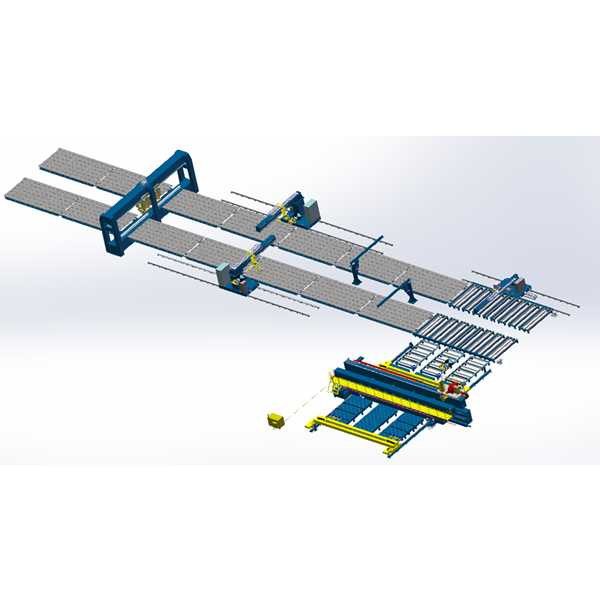
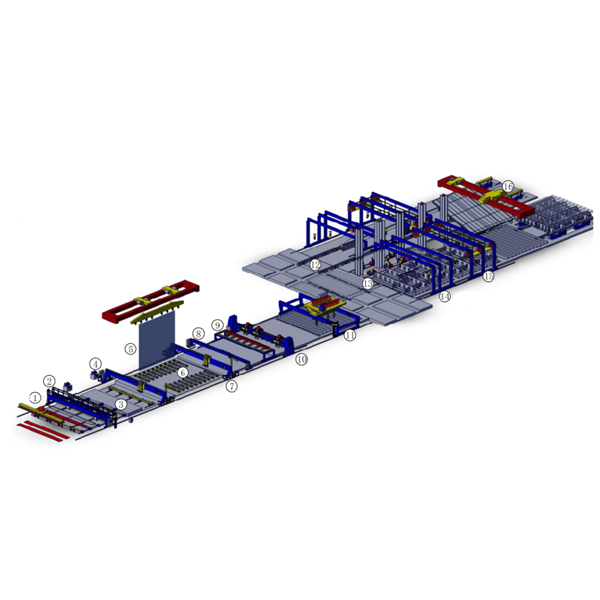
| DIG Automation Engineering Panel Line for Panel Welding | DIG Automation Engineering Micropanel Welding Line | |
| Designed For | Large-scale continuous panel production: hull sections, bridge panels, structural infrastructure steel | High-precision fabrication of micropanels and intricate subassemblies with complex geometry |
| Welding Technologies | SAW, MIG/MAG (FCB), Laser-Arc Hybrid Welding (LAHW) | Laser-Arc Hybrid Welding (LAHW) with integrated edge milling - an industry-first configuration |
| Automation Architecture | Fully integrated line: plate butt welding → automatic stiffener mounting → plasma cutting → marking → panel turnover | Dual welding robots + mobile device for corner stiffener welding; 3D visual scanning for programming-free operation |
| Adaptive Capability | Standardized automated workflow across full plate-to-section cycle | Adaptive multipass software adjusts automatically to part tolerances; free workpiece placement on platform |
| Operator Dependency | Low - workflow standardization reduces intervention requirements | Very low - autonomous geometry recognition eliminates manual programming per part |
| Cycle Time Impact | Eliminates inter-process dwell time by connecting every production step in a single continuous line | Significantly reduced cycle times through automated tolerance adaptation and simultaneous dual-robot operation |
| Target Sectors | Shipbuilding & Offshore, Energy & Infrastructure | Shipbuilding (micropanels), Automotive, General Industrial |
| Compliance Fit | Maritime and structural infrastructure safety standards | High-precision manufacturing quality systems requiring minimal dimensional variation |
Still Defining Your Requirements? Our Technical Team Can Help You Specify with Confidence.
The framework above covers the primary decision variables, but every production environment carries its own combination of constraints - floor layout, material specification, shift structure, existing upstream equipment, and compliance obligations specific to your end markets. These variables interact in ways that a general guide cannot fully anticipate.
Minex Group works directly with engineering and procurement teams to translate application requirements into verified system recommendations. If you're in the early stages of specification, we can help you define the brief. If you're further along and need a technical second opinion on a shortlist, we can provide that too. Describe your application, your production volume, and your primary constraints. We'll give you a direct, technically grounded recommendation.
Frequently Asked Questions
The starting point is always your production envelope, and it has to be defined with engineering precision rather than approximated. That means documenting your maximum and typical plate dimensions, material thickness range, joint geometries, and the welding processes those joints require. Alongside the technical parameters, you need clear figures on production volume and target takt time, because these determine whether your application justifies a standalone robotic welding system, a dual-robot station, or a fully integrated panel line with upstream and downstream process integration.
Quality and compliance requirements belong in this initial definition, not in a later evaluation stage. If your output must meet shipbuilding classification rules, pressure vessel codes, or structural infrastructure standards, those requirements shape system architecture from the outset - including traceability and parameter logging capability. Finally, floor space and facility constraints need to be on the table early. A system that is technically correct but physically incompatible with your production bay is not a viable option, regardless of its specification.
The Minex portfolio covers the range from fully integrated heavy plate panel lines to precision micropanel configurations with dual welding robots. Defining these parameters up front is what allows a meaningful, application-specific recommendation to be made.
Laser-Arc Hybrid Welding (LAHW) makes most sense when three requirements converge simultaneously: high travel speed, deep single-pass penetration on thick plate, and strict control of thermal distortion on the finished panel. In isolation, any one of those requirements can often be addressed with conventional submerged arc welding or MIG/MAG. When all three are present together - as they typically are in shipbuilding hull and deck panel production, large-scale infrastructure steel, and transport sector fabrication - LAHW becomes the technically correct answer rather than simply a premium option.
The core advantage is the combination of laser deep penetration with arc gap-bridging capability. This allows LAHW to achieve what multi-pass arc welding cannot: high deposition in a single pass, at speed, with a heat input profile that significantly reduces distortion compared to conventional submerged arc welding on the same joint. The consequence for production is less post-weld straightening, less rework, and panels that arrive at the next production stage within dimensional tolerance rather than requiring correction.
The higher equipment cost of LAHW is justified when distortion-related rework cost in your current welding operations is measurable and significant, or when throughput on long seams is a genuine production constraint. Both the DIG Automation Engineering Panel Line for Panel Welding and the DIG Automation Engineering Micropanel Welding Line distributed by Minex Group incorporate LAHW as a core process capability - in the case of the Micropanel Welding Line, combined with integrated edge milling in a configuration that is an industry first.
The geometry of your workpiece is one of the most reliable early filters in system selection, because different component types create fundamentally different production challenges that require different machine architectures to solve efficiently.
Large flat plates with long, predominantly straight seams - hull sections, bridge deck panels, structural floor plates - are the natural application domain for dedicated panel lines. These systems are built to maximise arc-on time across extended seam lengths, integrate handling for heavy plate, and connect upstream and downstream welding processes into a continuous workflow. The economics of a panel line depend on the seam being long enough and the production volume being sufficient to justify the integrated architecture. Where those conditions exist, a panel line outperforms any robotic welding system configuration on throughput and cycle time.
Smaller, three-dimensional, or geometrically variable structural components present a different challenge. When joint geometry changes frequently, when internal corners need to be reached, or when the component mix varies significantly across production runs, a dual-robot station with multi-workpiece capability is the appropriate architecture. It can adapt to changing geometry, reach joints that a linear panel system cannot access, and handle the variability that defines complex subassembly fabrication. The DIG Automation Engineering Micropanel Welding Line in the Minex portfolio addresses precisely this application space, with dual welding robots and a dedicated mobile device for corner stiffener welding.
This is one of the most practically important questions to answer honestly during specification, because the gap between what is genuinely necessary and what is commercially promoted as standard can represent significant capital cost. The right level of automation intelligence depends directly on the variability of your production mix.
If your line processes many different part variants, changes weld configurations frequently, or receives incoming material with dimensional variability that exceeds what fixed-fixture tolerance allows, then 3D scanning, real-time seam tracking, and adaptive path correction deliver measurable operational value. In high-mix production conditions, adaptive capability is what maintains system utilisation when conditions deviate from ideal - which in most real welding operations happens regularly. Without it, variability becomes a programming bottleneck that halts production while operators intervene.
For stable, high-volume production with repeatable fixtures and tight incoming material tolerances, simpler automated welding without full adaptive vision can be entirely sufficient and may offer better ROI by reducing system complexity and capital expenditure. The DIG Automation Engineering Micropanel Welding Line distributed by Minex employs 3D visual scanning and adaptive multipass software that enables programming-free operation, which is directly relevant for facilities running variable subassembly configurations. The diagnostic question is simple: how many distinct part configurations does your line process per month, and how much of your current setup time is consumed by reprogramming between them?
Automated welding systems eliminate the operator-dependent variability that is the primary source of quality fluctuation in manual welding, but they don't replace the procedural qualification work that regulated applications require. The foundation is qualified welding procedures established before production begins, with the system then executing and - critically - documenting those procedures at joint level across every production run.
For welding operations governed by shipbuilding classification rules, pressure vessel codes, or pipeline and infrastructure standards, the compliance requirement is not just consistent weld quality. It is documented proof that specific joints were produced within defined parameter windows - current, voltage, travel speed, and heat input - stored in a format that survives audit. Automated systems with parameter logging and weld data storage make this tractable at production scale in a way that manual welding structurally cannot.
When evaluating any system, the question to put directly to the distributor is whether the platform generates joint-level traceability records compatible with your compliance reporting requirements, and whether reference examples from regulated production environments are available. Minex Group works with engineering teams in shipbuilding, energy, and infrastructure - sectors where these requirements are non-negotiable - and can address traceability capability at application level rather than in general terms.
This is the question that receives the least attention during procurement and causes the most difficulty after commissioning. The skills required to operate robotic welding systems span two distinct domains: welding metallurgy and robotic system operation. A gap in either creates operational fragility - an operator who understands welding but not robot programming cannot resolve path deviation issues, and one who understands the robot but not the metallurgy cannot diagnose weld quality problems at their root cause.
Successful implementations are consistently those where operator training covers programming, fixture setup and management, basic maintenance routines, and fault diagnosis - before the system goes live, not reactively when something stops. Structured training as part of commissioning is standard practice among reputable distributors, and it should be treated as a contractual deliverable rather than an optional service. In environments already affected by skilled welder shortages, this training investment also de-risks the transition from manual welding tasks to automated operations more broadly.
Beyond initial training, the long-term support structure matters as much as the system itself: spare parts availability, technical support response time, and periodic optimisation reviews to recover productivity that drifts over time as production conditions change. When comparing distributors, these are the service questions to ask with the same rigor you apply to technical specification.
The most common error in automation ROI modelling is framing it as a direct labor replacement calculation. Labor saving is one input, but a complete model needs to account for cycle time reduction, quality-related rework and scrap savings, lower consumable consumption through process optimization, and the throughput value of additional capacity unlocked by the system. In regulated production environments, rework cost is consistently underestimated because the true cost of a non-conforming weld includes not just remediation labor but inspection, documentation, and potential schedule impact to downstream welding operations.
Modelling utilisation accurately is equally important. A welding system that delivers strong ROI at 80% utilisation may not recover its capital cost at 50% utilisation within a reasonable planning horizon. Build your model from your own measured baseline data - current cycle times, rework rates, inter-process dwell time, and scrap costs - rather than from vendor benchmarks that may not reflect your production conditions or labor cost structure.
Payback timelines for robotic welding systems and panel line installations vary considerably depending on utilisation, baseline rework levels, and production volume. Rather than anchoring to an industry average that may not apply to your situation, the more reliable approach is to model the specific cost elements that your current process handles most inefficiently. That is where automation investment recovers capital fastest, and it is the basis on which Minex Group's technical team can provide application-specific guidance rather than generic projections.