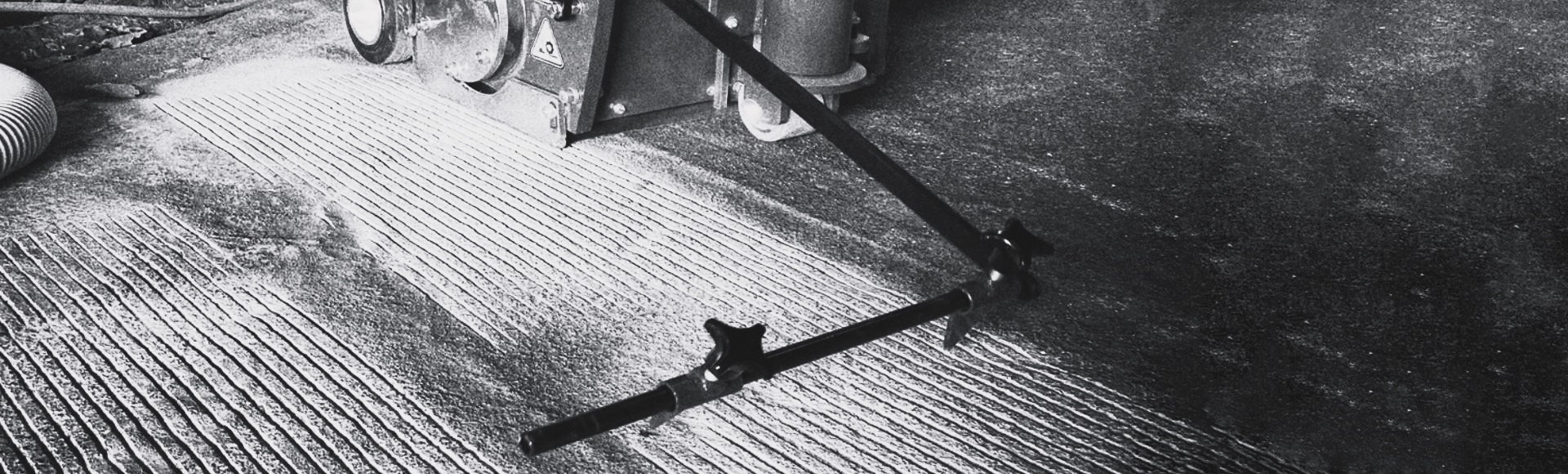
Scarifying Machines
Scarifying Machines: Choosing the Right Equipment for Professional Surface Preparation
Scarifying looks straightforward from the outside. A rotating drum removes material from a surface, and the job moves on. In practice, the difference between a controlled, efficient operation and a problematic one becomes visible within the first few meters of work.
Uneven texture, excessive dust, surfaces that need to be corrected again, or operators constantly stopping to adjust the machine—these are the situations that typically signal a poor equipment choice. Not because the machine is defective, but because it does not fully match the environment, the surface, or the level of control the application actually requires.
Understanding how these elements interact is the key to choosing the right scarifying machine.
Recognizing the main differences between scarifying machines and other surface preparation equipment—such as grinders or shot blasters —helps ensure you select the most suitable tool for your project requirements. Scarifying machines offer specific advantages, including the ability to create defined surface textures and efficiently level uneven concrete, making them ideal for certain preparation tasks.
Surface Preparation: Where Execution Quality Is Decided
Surface preparation is the foundation of any successful construction, flooring, or pavement repair project. Whether you are resurfacing concrete, installing new flooring, or performing routine maintenance, preparing the concrete surface properly is essential for achieving long-lasting results. This process involves removing old coatings, dirt, oil stains, and other contaminants to create a clean, even base that ensures strong adhesion for new coatings or overlays. Selecting the right equipment for surface preparation—such as concrete scarifiers or grinders —can make a significant difference in the quality and durability of the finished project. Each type of machine is designed to handle specific challenges, from heavy-duty removal to fine grinding, making it crucial to match the equipment to the needs of your project, whether it’s a large-scale pavement repair or a smaller flooring job.
Concrete Scarification for Heavy-Duty Surface Preparation
Concrete scarification is a robust surface preparation technique that utilizes a concrete scarifier to tackle tough jobs like removing thick coatings, leveling uneven surfaces, and eliminating stubborn oil stains or dirt. The heart of a concrete scarifier is its rotating drum, fitted with spinning blades that aggressively chip away at the surface material. This action produces a rough, uniform surface profile, making it ideal for applications where strong mechanical bonding is required for new coatings or overlays. Concrete scarification is commonly used in high-traffic areas such as parking lots and sidewalks, where durability and slip resistance are critical. The aggressive action of the scarifier not only removes unwanted material efficiently but also ensures that the underlying concrete is properly prepared for the next stage of treatment.
The Working Environment Sets the First Boundary
Before power, width, or tooling are considered, the working environment already limits the available options.
In enclosed spaces—industrial halls, warehouses, parking structures, renovation projects inside existing buildings—the choice is effectively made: the machine must be electrically driven. These environments often involve medium-sized surfaces, which influences the selection of a scarifying machine to ensure efficient coverage and maneuverability. Exhaust gases are not a theoretical concern; they quickly become a real operational problem, forcing work interruptions or complex ventilation measures that slow the project down.
Outdoor applications allow more flexibility, including petrol-driven machines, but even then the environment influences everything that follows. Access to power, dust containment requirements, and proximity to other trades all affect which machine will actually work efficiently on site.
Choosing a scarifier without first anchoring the decision in the real working conditions often leads to compromises that surface later, when the job is already underway.
Surface Behavior Matters More Than Surface Type
Concrete, asphalt, and industrial floors are often treated as broad categories, but in reality their behavior varies significantly. Hard concrete reacts very differently from softer mixes. A coated industrial floor introduces different stresses on tooling than bare concrete. Asphalt responds differently again under aggressive cutting. Scarifying machines are capable of making deep cuts into concrete or asphalt, which is important for projects requiring significant material removal.
What matters in practice is not just what the surface is, but how it reacts to removal: how brittle it is, how quickly it heats up, and how consistent it is across the working area.
A scarifying machine must be able to handle these variations without forcing the operator to slow down excessively or accept inconsistent results. This is where both motor power and mechanical stability become decisive.
Tooling Defines the Outcome, Not the Machine Alone
One of the most common sources of dissatisfaction in scarifying work comes from expecting a single configuration to solve every task. In reality, there are different types of floor scarifiers—such as mechanical and hydraulic models—each designed for specific applications and tooling options.
When roughening concrete or removing coatings, carbide cutters provide the necessary aggressiveness and durability. For thick layers such as thermoplastic road markings, milling cutters allow controlled removal without tearing the surface underneath. Precision work—leveling, planing, correcting uneven areas—often requires diamond tooling, which behaves very differently from impact-based cutters.
The machine must be able to accept these different tools without sacrificing stability or control. Otherwise, operators are forced to compensate manually, which almost always results in uneven surfaces and unnecessary fatigue.
Control Is What Separates Rough Removal from Professional Results
Scarifying is often described as aggressive work, but many professional applications demand consistency more than force.
This becomes particularly visible when planing or leveling surfaces. Without controlled forward movement, even a powerful machine can produce an irregular finish. Speed fluctuations translate directly into depth variations, which then require corrective work.
A speed-controlled drive unit is not an accessory for comfort—it is a functional requirement for applications where uniformity matters. Especially when working with diamond blades, controlled movement is the difference between a surface that is ready for the next process and one that needs to be redone. Using the right control features is essential for achieving great results in surface preparation.
Dust Is a Process Issue, Not a Cleanup Task
Dust problems do not start after scarifying; they start during it.
Poor dust control affects visibility, increases tool wear, and exposes operators to health risks—particularly in indoor environments or when removing older coatings. Once dust fills the working area, productivity drops, and safety concerns escalate.
Professional scarifying machines are designed to work as part of a system, allowing direct connection to industrial dust collectors. Effective dust extraction keeps the working area clear, supports compliance requirements, and allows operators to focus on precision instead of survival.
Aggressiveness Must Be Sustainable
Heavy renovation work places continuous stress on both the machine and the tooling. Removing hard concrete or thick layers over large areas requires more than short bursts of power—it requires sustained aggressiveness without overheating, excessive wear, or constant maintenance stops.
Machines designed for this level of work use robust cutter drum assemblies and industrial-grade components that maintain performance over time. This is not just about durability, but about predictability: knowing that the machine will perform the same way at the end of the day as it did at the beginning. Properly maintaining the machine is crucial for ensuring long-term performance and reliability.
Ergonomics Influence Accuracy More Than Comfort
Fatigue is not just a comfort issue; it directly affects accuracy and safety.
Machines with high vibration levels or awkward adjustment mechanisms force operators into constant micro-corrections. Over time, this leads to inconsistent results and increased risk of error. Features such as vibration-dampened handles and intuitive height adjustment systems allow operators to maintain control and precision over long working periods.
In practice, ergonomic design is one of the most effective ways to improve surface quality without increasing machine power.
Equipment Cost and Efficiency
When evaluating surface preparation equipment, both cost and efficiency are key considerations. Concrete scarifiers are generally more cost-effective than grinders for large-scale projects, as they can remove substantial amounts of material in a single pass. This makes them ideal for jobs that require aggressive removal of thick coatings or uneven concrete. On the other hand, grinders may be a better investment for smaller projects or when a polished finish is required, as they offer greater control and precision. The efficiency of each machine depends on the specific project requirements—scarifiers excel in rapid material removal, while grinders are preferred for detailed work and achieving a smooth, polished finish. Ultimately, choosing the right equipment can help control project costs and deliver efficient, high-quality results.
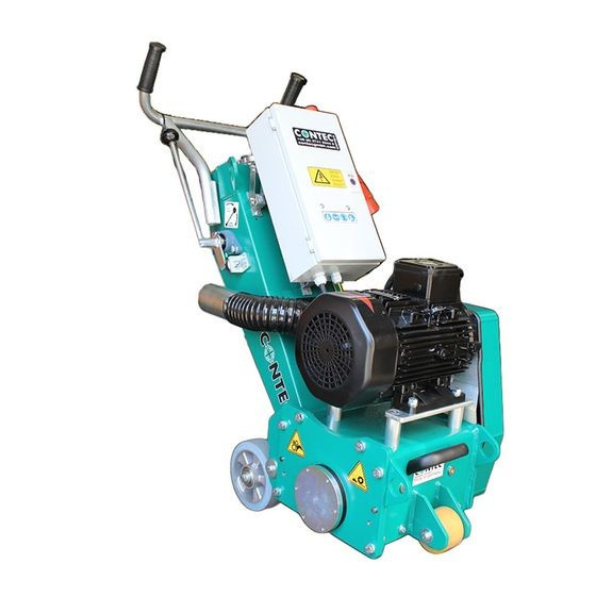
A Practical Reference: The Contec CT 250 E
The Contec CT 250 E illustrates how these considerations come together in a professional scarifying solution.
Designed for concrete repair and renovation, it combines high aggressiveness with the level of control required for demanding applications. Its 7.5 kW electric motor (400 V) provides sufficient power for heavy material removal while remaining suitable for indoor environments where exhaust emissions are not acceptable.
The machine’s versatility lies in its ability to work with different tooling configurations, including carbide cutters, milling cutters, and diamond discs. This allows it to move between rough removal and precision work without changing machines. The CT 250 E can be used to prepare surfaces for epoxy coatings or to remove existing epoxy layers, making it suitable for a wide range of industrial flooring projects.
For applications where uniformity is critical, the optional drive unit enables controlled speed operation, which is essential when using diamond tooling or performing leveling tasks.
The CT 250 E is also designed for dust-free operation, featuring a 70 mm dust extraction port that allows effective connection to industrial dust collectors. This supports safe, clean operation even in enclosed spaces.
Durability and ergonomics are addressed through robust construction, long-life cutter drum assemblies, a vibration-dampened handle, and a quick-lift height adjustment system, all of which contribute to consistent performance and operator control. The drum assembly includes a central shaft that supports the cutting tools and requires regular inspection to ensure optimal performance.
When removing material, the CT 250 E typically achieves a cutting depth of up to 1/8 inch per pass, depending on the surface and tooling used. The machine's weight contributes to its stability and effective cutting performance, allowing for consistent results during milling and scarifying tasks.
In addition to concrete and asphalt resurfacing, the CT 250 E can be used to remove thermoplastic line markings from pavement surfaces.
A technical specification table is available to compare different models, helping users select the right machine for their needs. Minex Group can supply the CT 250 E and related accessories upon request.
How This Translates into Real Applications
In practice, machines like the CT 250 E are used for surface texturing and roughening, removal of heavy coatings and adhesives, elimination of thermoplastic road markings, and creation of grooved anti-slip surfaces. Scarifying machines are ideal for cutting grooves into concrete to improve traction and safety.
They are equally suited for renovation tasks such as removing hard concrete, correcting uneven surfaces, shaving gutters, or leveling joints in parking structures. The machine can also be used to remove thin layers of material for surface smoothing or preparation. Its design minimizes chipping, resulting in a smoother finish compared to more aggressive removal methods. Industrial cleaning and descaling are additional applications where controlled aggressiveness and effective dust management are essential.
Smaller jobs, such as detailed surface corrections or confined area preparation, can be efficiently handled with compact scarifying machines.
Future Developments in Surface Preparation
The field of surface preparation is rapidly advancing, with new technologies and equipment designed to boost efficiency, speed, and sustainability. One major trend is the adoption of advanced diamond tooling, which offers improved cutting performance and longer tool life, reducing downtime and maintenance costs. Automation is also making its mark, with automated surface preparation machines delivering greater accuracy and consistency across large areas. Additionally, there is a growing emphasis on environmentally friendly solutions, such as electric and hydraulic equipment that minimize emissions and energy consumption compared to traditional gas-powered machines. These innovations are shaping the future of surface preparation, enabling contractors and industrial businesses to achieve superior results while meeting evolving environmental and operational standards.
Making the Right Choice
Choosing a scarifying machine is less about specifications on paper and more about understanding how the machine will behave once the work starts. The environment, surface behavior, tooling, control, dust management, and operator interaction all shape the final result.
When these elements are aligned, scarifying becomes a predictable, efficient process rather than a series of adjustments and corrections. That alignment—not maximum power—is what defines a professional solution.
Need expert input?
Discuss your application with our surface preparation specialists.
Frequently Asked Questions
A concrete scarifier, also referred to as a floor planer or milling machine, removes material through an impact-based cutting process. A rotating drum equipped with cutting tools strikes the surface at high speed, breaking away concrete, coatings, or surface contaminants. This method produces a clearly defined, textured surface profile that is particularly suitable when strong mechanical bonding is required for subsequent systems such as industrial coatings, overlays, or repair mortars.
A scarifier should be used when the application requires aggressive material removal rather than surface refinement. Typical situations include removing thick coatings, reducing concrete height, eliminating trip hazards, or creating defined grooves and textures. Grinders are more appropriate for light material removal, surface smoothing, or preparation for polished finishes. In practice, the decision is driven by required removal depth and surface profile, not by machine size or power alone.
Scarifiers are best suited for leveling uneven concrete, removing thick coatings and adhesives, cleaning heavily contaminated surfaces, and preparing high-traffic areas such as parking decks, ramps, sidewalks, and industrial floors. They are also widely used for thermoplastic line removal, anti-slip grooving, and heavy-duty renovation projects where consistent, high-volume material removal is required.
Most walk-behind scarifiers typically remove approximately 3 to 6 mm per pass, depending on machine design, tooling configuration, and concrete hardness. While heavier machines can achieve greater removal rates, multiple controlled passes are generally preferred to ensure uniform results, reduce tool wear, and maintain surface integrity.
Electric scarifying machines are generally selected for indoor or enclosed environments where exhaust emissions and ventilation are limiting factors. Petrol-driven machines are more commonly used outdoors, where mobility and independence from power supply are important and exhaust gases can safely dissipate. The working environment should always be assessed before considering power output or aggressiveness.
Key considerations include the working environment, required removal depth, surface behavior (such as hard concrete, asphalt, or coated substrates), and dust-control requirements. Machine stability, motor power, and compatibility with different tooling types also play a critical role in achieving consistent surface preparation without excessive operator intervention.
Carbide cutters are used for aggressive removal of coatings, laitance, and for general surface roughening on concrete and asphalt. Milling cutters are preferred for controlled removal of thicker layers, such as thermoplastic road markings. Diamond tooling is used for precision leveling and planing applications where tighter tolerances and a more uniform surface finish are required.
Scarifiers remove material through impact cutting and leave a visibly textured or grooved surface. Grinders use rotating diamond tools to abrade the surface, producing smoother and more refined finishes. Shot blasters clean and texture surfaces by propelling steel shot at high velocity, creating a uniform surface profile with minimal airborne dust. Each method serves a distinct purpose and is selected based on the required outcome.
Concrete dust is best controlled by connecting the scarifier directly to a suitable industrial dust collector via the machine’s dust extraction port. Capturing dust at the source improves visibility, reduces health risks, and supports compliance with safety regulations. Effective dust control should be considered an integral part of the scarifying process.
Yes. Scarifying machines are widely used on asphalt and concrete pavements for surface texturing, leveling, and removal of thermoplastic markings, rubber residues, and weathered surface layers. Their impact-based cutting action makes them particularly effective for outdoor infrastructure and pavement maintenance applications.
Machine ergonomics have a direct impact on surface consistency. Low-vibration handles, stable machine balance, and intuitive depth adjustment reduce operator fatigue and allow longer, more controlled passes. Improved ergonomics help maintain consistent cutting depth and reduce the need for corrective work.
Long-term performance depends on regular inspection and maintenance of key components such as the cutter drum, central shaft, and cutting tools. Worn tooling should be replaced promptly, and bearings, drive components, and fasteners should be serviced according to the manufacturer’s recommendations. Proper maintenance helps ensure consistent cutting performance and minimizes unplanned downtime.
For large areas requiring heavy material removal, scarifiers are generally more cost-efficient because they remove more material per pass. Grinders tend to be more economical for smaller projects or applications where a smooth or polished finish is required. Cost efficiency is determined by how well the machine matches the scope and objective of the work.
Yes. Scarifiers are commonly used to create a roughened surface profile that supports strong mechanical adhesion for epoxy and other industrial coating systems. After scarification and effective dust removal, the surface is typically ready for primers, mortars, or high-build coatings, provided moisture levels and contamination are within specification.