Industrial Fuel Heaters
References
Why Fuel Heating Decisions Deserve More Than a Power Rating
Industrial heating systems encompass a wide range of technologies and equipment designed to meet diverse heating requirements across industrial environments.
Fuel-fired heaters, however, do more than simply generate heat. They introduce combustion into the environment, which fundamentally changes the selection criteria. Choosing the right heating equipment is therefore critical—not only to meet heating demand, but also to ensure efficiency, safety, and regulatory compliance. Once combustion is involved, air quality, moisture levels, ventilation, airflow behavior, ducting feasibility, and safety regulations all become part of the decision-making process. In many industrial applications, these factors prove far more decisive than the nominal heat output stated on a datasheet.
This guide has been written from a consulting perspective. Its goal is to help engineers, operations managers, and procurement teams understand how to select the right fuel-fired heater for their specific industrial context—safely, efficiently, and without costly design or operational mistakes.
Why Combustion Method Determines Heater Suitability
Every fuel-fired heater operates on one of two fundamental principles: direct firing or indirect firing. This distinction is more than a technical detail—it determines whether a heater is suitable for a specific application and directly influences safety, air quality, and overall system performance. Selecting the correct heater type and heat source is therefore a foundational decision in any industrial heating project.
A direct-fired heater introduces combustion gases directly into the heated airflow. These units use an open flame, allowing the flame and air to come into direct contact. From a thermal standpoint, this results in extremely high efficiency, as almost all the energy released by the fuel is converted into usable heat. Direct-fired heaters can typically operate on natural gas or propane, offering flexibility in fuel selection and making them a powerful and cost-effective solution for certain industrial applications.
That efficiency, however, comes with important trade-offs. Combustion generates carbon dioxide and water vapor, both of which enter the supply air. Depending on operating conditions, trace combustion by-products such as carbon monoxide may also be present. For this reason, direct-fired heaters are suitable only for well-ventilated environments where continuous air exchange is guaranteed and where added moisture or exhaust gases do not negatively affect people, products, or processes. Construction drying and shell heating are typical examples, as these applications often benefit from both heat and moisture and involve limited or controlled human presence.
Indirect-fired heaters operate on a fundamentally different principle. Combustion takes place in a sealed chamber, and heat is transferred to the supply air through a heat exchanger. This design prevents combustion gases from entering the heated space, delivering air that is clean, dry, and completely separated from exhaust emissions. As a result, indirect-fired heaters are the preferred choice for enclosed or continuously occupied environments, including production halls, warehouses, paint booths, and temporary structures where air quality and safety are critical.
While indirect-fired heaters are slightly less efficient from a purely thermal perspective, their operational advantages are decisive in most industrial settings. The ability to supply clean air improves safety, stabilizes process conditions, and simplifies regulatory compliance. Over time, these benefits often translate into lower overall operating costs, reduced risk, and more predictable energy performance.
Selecting the right heater type and heat source is therefore essential for achieving reliable heating, long-term energy efficiency, and a safe working environment in industrial applications.
Air Quality and Moisture: Often Overlooked, Always Critical
One of the most common causes of incorrect heater selection is underestimating the impact of moisture and air purity.
Fuel combustion always produces water vapor. In a direct-fired system, that moisture becomes part of the heated air. In applications such as painting, coating, or storage of sensitive materials, this can cause serious quality issues. Paint finishes can be compromised, drying times become unpredictable, and condensation may form in unexpected areas.
Indirect-fired heaters avoid this entirely by delivering dry air. This is why they are standard in paint booths, production halls, storage facilities, and any environment where product quality or human comfort is a concern.
Understanding this distinction early in the selection process prevents expensive retrofits and operational disruptions later.
Why Heat Output Alone Does Not Define Performance
In industrial heating, more kilowatts do not automatically mean better results.
Effective heating depends on how heat is distributed. A heater with a high output but insufficient airflow will create hot spots near the unit while leaving distant areas underheated. Conversely, a well-balanced system with adequate airflow and throw can deliver uniform temperatures with a lower nominal output.
This is why airflow volume, discharge temperature, and air throw distance must always be evaluated together with heat output. Especially in large halls, warehouses, or temporary structures, air movement is what determines whether heat actually reaches the working zone. Efficient heat distribution is particularly important in commercial and industrial spaces such as distribution centers and large warehouses, where ductwork may be required to deliver heat evenly throughout the facility.
Airflow Behavior and Fan Technology: Moving Heat Where It Is Needed
Fuel heaters rely on fans to transport heat, and the type of fan used has a direct impact on how the system behaves.
Axial fans move large volumes of air but generate relatively low pressure. They are ideal for open spaces where air can flow freely, and where ducting is minimal or not required. Many direct-fired heaters use axial fans for this reason.
Radial, or centrifugal, fans generate much higher static pressure. This allows heated air to be pushed through ducts, around obstacles, and into specific zones. Whenever air needs to be distributed over long distances, through flexible ducts, or into enclosed spaces from outside, radial fans become essential.
Selecting the wrong fan type is one of the most common technical mismatches seen in industrial heating projects.
Static Pressure and Ducting: The Invisible Limiting Factor
Static pressure is rarely discussed outside engineering teams, yet it often defines whether a heating solution will work in practice.
Every meter of ducting, every bend, and every air outlet creates resistance. If a heater cannot overcome that resistance, airflow collapses. The result is a system that looks correct on paper but fails to deliver heat where it is needed.
Short duct runs require relatively little pressure. Complex layouts, long distances, or multiple outlets require significantly more. In large industrial or temporary installations, pressure capability becomes a decisive selection criterion, not a secondary detail.
Fuel Supply and Operational Logistics
Unlike electric heaters, fuel-fired systems require ongoing operational planning.
Some heaters rely on integrated fuel tanks, offering flexibility and autonomy for mobile applications. Others are designed to operate from external or bulk fuel supplies, which makes them better suited for long-term or high-capacity use.
Fuel consumption rates directly affect refueling frequency, logistics planning, and operational cost. In remote locations, emergency scenarios, or military deployments, these factors are often as important as thermal performance.
Safety and Occupancy: Non-Negotiable Considerations
The presence of people in the heated space is a defining constraint.
Direct-fired heaters must never be used in enclosed or continuously occupied environments. In such settings, make-up air systems are often required to supply fresh outside air and maintain proper ventilation and air quality. Even with ventilation, their use must be carefully controlled and monitored.
Indirect-fired heaters, by contrast, are designed for exactly these situations. They allow continuous operation in workshops, warehouses, tents, and temporary structures without compromising safety or comfort.
This distinction is not merely a recommendation; it is a fundamental safety requirement.
Matching Technology to Reality
Once the technical framework is understood, selecting from a product portfolio becomes straightforward. The range includes both direct-fired and indirect heaters, and choosing the right heating equipment depends on the specific requirements of the application.
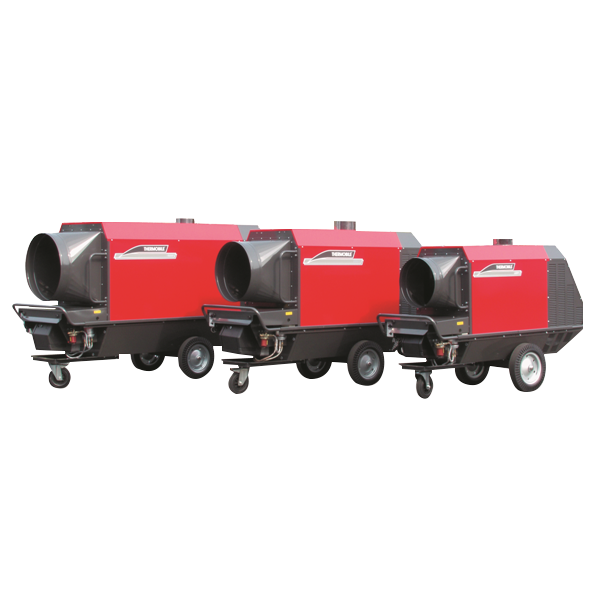
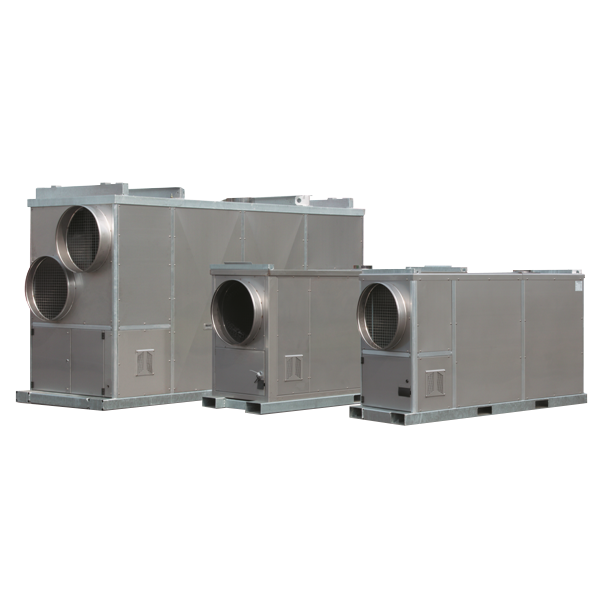
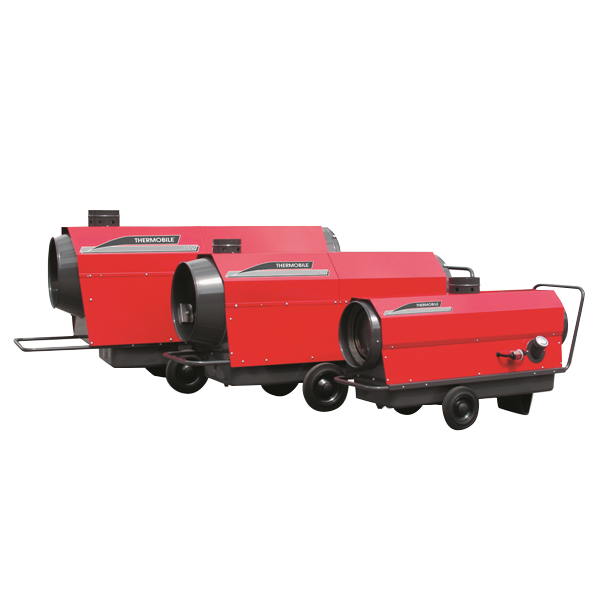
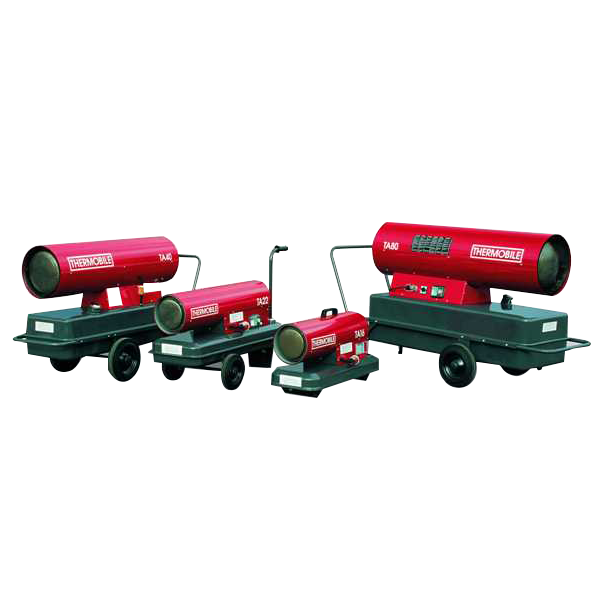
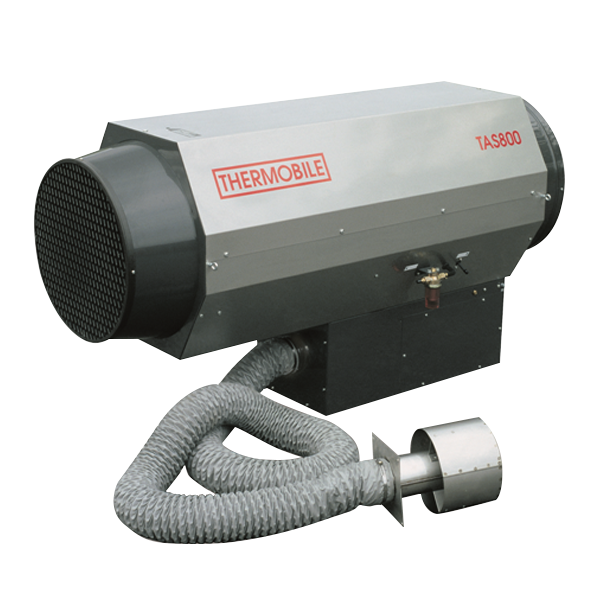
The table below summarizes the Thermobile fuel heater range available at Minex Group and highlights where each solution fits best in real-world industrial applications.
| Series | Combustion Type | Heat Output (kW) | Airflow (m³/h) | Static Pressure (Pa) | Fuel Supply | Best-Fit Applications |
| Thermobile TA / TAS | Direct-Fired | 25–93 | 600–2,150 | N/A | Internal tank | Construction drying, shell heating |
| Thermobile TAS 800 E | Direct-Fired (Suspended) | 95 | 7,000 | N/A | Bulk fuel | High-ceiling warehouses |
| Thermobile ITA | Indirect-Fired | 24.8–70 | 1,500–3,800 | 150–200 | Internal tank | Tents, workshops, hospitals |
| Thermobile IMA | Indirect-Fired | 65–200 | 4,000–13,000 | 100–500 | External supply | Industrial halls, paint booths |
| Thermobile IMAC | Indirect-Fired (Containerized) | 120–383 | 8,500–24,000 | 350–1,000 | Bulk fuel | Military bases, hangars |
A Simple Way to Visualize the Choice
A useful mental model is to think of heater selection like choosing a vehicle.
A direct-fired heater is like a motorcycle: extremely efficient and powerful, but only suitable in open conditions. An indirect-fired heater is like a sedan: enclosed, safe, and comfortable for passengers. A containerized indirect heater is closer to an armored vehicle: designed for scale, logistics, and demanding environments.
Selecting with Confidence
Fuel-fired heating is not a commodity decision.
It requires an understanding of combustion, airflow, safety, and operational constraints.
When these factors are considered early and holistically, the result is a heating solution that performs reliably, protects people and processes, and avoids costly redesigns.
For complex environments or high-risk applications, consulting with a technical specialist is not an extra step — it is part of responsible system design.
Need Support for Your Application?
If you are evaluating fuel-fired heating for an industrial project and want to validate your assumptions, sizing, or configuration, a technical consultation can help ensure the right solution from the start.
A well-chosen heater is not just powerful.
It is appropriate, safe, and operationally efficient.
Frequently Asked Questions
The difference lies in how combustion interacts with the air delivered into the space.
A direct-fired industrial heater burns fuel directly in the airstream. The resulting heat is discharged together with combustion products such as carbon dioxide, water vapor, and trace exhaust components. From an energy perspective, this makes direct-fired heaters extremely efficient, as virtually all generated heat is transferred into the space. However, this also means that air quality and moisture levels are affected, which limits where these heaters can be used safely. This method is known as direct heating and is best suited for well-ventilated areas such as construction sites and large outdoor spaces.
An indirect-fired heater separates combustion from the supply air. In this design, fuel is burned in a burn chamber, and the resulting heat is transferred to the air via a heat exchanger, producing warm air that is safe for indoor use. The flue gases are exhausted outside, while only clean, dry air is supplied indoors. This is why indirect-fired heaters are the standard solution for enclosed or continuously occupied environments such as production halls, paint booths, warehouses, tents, and medical or logistics facilities. Indirect heaters are widely used in applications where direct heating is not suitable due to air quality or safety concerns.
Direct-fired heaters are best suited to environments where air exchange is high and where added moisture and exhaust gases do not pose a risk to people or processes.
Typical examples include construction drying, shell heating during early building phases, or large, well-ventilated industrial spaces that are only intermittently occupied. In these scenarios, the high efficiency and high discharge temperatures of direct-fired heaters make them a practical and cost-effective choice.
Indirect-fired heaters should be selected whenever heating takes place in enclosed spaces, where people are present continuously, or where air quality directly affects products or processes. Painting, coating, storage of sensitive materials, medical or treatment tents, and logistics operations all fall into this category, where clean, dry supply air is mandatory rather than optional.
Fuel combustion always produces water vapor. In direct-fired systems, this moisture becomes part of the heated air and enters the space.
In some applications, such as drying concrete or masonry, this is not a problem and can even be beneficial. In many industrial processes, however, added humidity leads to condensation, inconsistent drying, corrosion risk, or surface defects. Paint finishes, coatings, and hygroscopic materials are particularly sensitive to uncontrolled moisture levels.
Indirect-fired heaters eliminate this risk by separating combustion gases from the supply air. The result is dry, clean air that stabilizes product quality, improves working conditions, and simplifies compliance with health, safety, and insurance requirements in industrial buildings.
Heat output alone does not determine whether a space will actually be heated effectively.
A heater with a high kW rating but insufficient airflow or poor air distribution can create intense heat near the unit while leaving remote zones cold. This is a common issue in large halls, warehouses, and temporary structures, where stratification and poor mixing undermine performance.
Effective industrial heating depends on the relationship between heat output, airflow volume, discharge temperature, and throw distance. In many cases, a heater with a lower nominal output but well-engineered airflow delivers more uniform temperatures and better comfort than an oversized unit with inadequate distribution.
Airflow behavior is governed by fan technology and available static pressure.
Axial fans move large volumes of air but generate relatively low pressure. They are ideal for free-blowing applications or very short duct runs, where air can move without significant resistance.
Centrifugal (radial) fans generate higher static pressure, allowing heated air to be pushed through longer duct systems, bends, filters, and multiple outlets. This makes them essential for indirect-fired applications where heat must be delivered into enclosed spaces from outside or distributed across large or complex layouts.
Every duct, bend, and diffuser adds resistance. If the heater’s fan cannot overcome this cumulative pressure loss, airflow drops, heat delivery becomes uneven, and temperature control suffers. For this reason, duct layouts and fan performance should always be evaluated together during system design.
Proper sizing starts with understanding heat demand, not floor area alone.
For buildings, this typically involves a heat-loss calculation that considers volume, insulation quality, design indoor and outdoor temperatures, infiltration, ventilation rates, and internal heat gains. For process or temporary heating, additional factors such as required warm-up time, air change rate, duct losses, and operational safety margins become important.
Rather than selecting a heater purely by nominal output, these parameters should be translated into both required kW and airflow. This ensures that the chosen heater not only produces enough heat but can also deliver it effectively to the occupied or process zones.
In most cases, direct-fired heaters are not recommended for enclosed or continuously occupied spaces.
Because they introduce combustion products into the air, their indoor use depends on strict ventilation rates, controls, and regulatory limits for exhaust gases. Meeting these conditions consistently can be challenging, particularly in spaces with variable occupancy or changing layouts.
For workshops, warehouses, production areas, treatment tents, and similar environments where people are present regularly, indirect-fired heaters that keep exhaust gases outside and supply clean air are the standard and compliant solution across most industrial sectors.
Beyond technical performance, fuel logistics play a major role in heater selection.
Key considerations include fuel type, consumption at different load levels, tank configuration (integrated, external, or bulk), and refueling intervals. These factors affect operating costs, autonomy, and on-site handling requirements.
In remote locations, military bases, or emergency deployments, heaters designed for bulk fuel supply and high autonomy are often preferred. Containerized or high-capacity indirect-fired units reduce refueling frequency, simplify logistics, and support long duct runs with higher static pressure, which is critical in complex or dispersed installations.
Safety considerations extend well beyond basic installation.
They include adequate combustion air supply, proper ventilation, correct flue routing, safe clearances to combustible materials, flame monitoring, over-temperature protection, and compliance of the fuel or gas train with applicable standards.
For occupied or sensitive environments, regulators and insurers typically require indirect-fired systems that guarantee clean air supply, verified exhaust discharge, and controlled emission levels. Thermostats, safety interlocks, and emergency shut-off systems are usually part of the overall risk assessment and approval process.
Effective selection starts by mapping application requirements to heater characteristics.
This includes choosing the correct combustion principle, determining required heat output and airflow, evaluating static pressure needs for ducting, considering occupancy and air quality constraints, and aligning fuel logistics with operational realities.
In straightforward cases, a single heater type may be sufficient. In more complex environments—such as construction sites with finished and unfinished areas, or logistics hubs combining occupied and unoccupied zones—using a combination of direct- and indirect-fired heaters often provides the safest and most efficient solution.
In these situations, a technical consultation helps ensure that different heater types, fan technologies, and fuel systems work together as a coherent and adaptable heating strategy rather than as isolated components.