Thermal Metallization Systems for Ceramic Materials
References
Thermal Metallization System Selection for Industrial Coating Applications
Thermal metallization, more broadly referred to within the thermal spray industry as thermal spray coating technology, is one of the most effective surface engineering solutions available today for extending component life, restoring worn components, and improving performance in harsh environments. Across most thermal spray processes, the controlled projection of molten or semi-molten particles onto a prepared substrate enables coatings that deliver wear resistance, corrosion protection, thermal insulation, or electrical insulation, depending on the application requirements.
Whether the objective is to increase wear resistance, enhance corrosion resistance, provide thermal insulation for gas turbines, or improve functional surface performance, thermal spray coatings offer a proven and industrially mature route to achieving the desired coating characteristics.
However, thermal spray coating system selection is rarely straightforward.
In practice, engineers and procurement teams are not simply comparing thermal spray equipment or spray torches. They are making a long-term investment decision that directly affects coating quality, coating thickness limits, bond strength, process stability, operating cost, spare parts availability, and ultimately the service life of the coated component.
This guide supports experienced technical decision-makers in navigating thermal spray system selection with clarity. It outlines the key considerations that influence coating performance and provides a structured overview of thermal spray systems available through the Minex portfolio, with Minex acting strictly as an equipment distributor supporting industrial thermal spray applications across Europe.
Defining Coating Performance Requirements Before Thermal Spray System Selection
The starting point for selecting the right thermal spray system is not the spraying process itself, but the functional requirement of the coating and how that coating must perform on the substrate in service.
A coating may be required to resist abrasive wear in steel mill components, provide corrosion protection on hydraulic rods, withstand high temperatures and thermal energy cycling in aerospace or gas turbine applications, or deliver controlled porosity for thermal insulation or thermal barrier coatings. In other cases, electrical insulation or surface roughening may be required to support subsequent coating layers.
Each of these outcomes demands a different balance of coating thickness, coating density, hardness, oxide content, bond strength, temperature control during spraying, and stress behavior within the deposited layer. The thermal spray process that produces an optimal ceramic coating for thermal insulation will not necessarily deliver the coating quality required for carbide wear layers operating under high velocity and mechanical load.
For this reason, careful consideration of the desired coating performance must precede any comparison of thermal spray coating methods or equipment.
Coating Density, Hardness, Porosity, and Stress Behavior as Primary Selection Drivers
One of the most important factors differentiating thermal spray technologies is the coating structure they generate during the spraying process.
When extremely dense coatings with high hardness, low porosity, and minimal oxide content are required—particularly for carbide coatings—High Velocity Oxygen Fuel (HVOF), also referred to as high velocity oxy fuel, is widely considered the most appropriate thermal spray technology. The high velocity and controlled thermal energy of the process result in excellent bond strength, high wear resistance, and consistent coating quality across components.
An additional advantage of HVOF lies in the compressive stress state of the coating. This allows greater coating thickness to be applied without premature failure or spalling, which is a key limitation in some other coating methods.
By contrast, plasma spray processes offer greater flexibility in controlling coating microstructure. Plasma spraying operates at very high temperatures and allows process parameters to be adjusted to achieve specific porosity levels. This makes plasma spray particularly suitable for ceramic coatings, thermal barrier coatings, and applications where thermal insulation performance is more critical than maximum density.
In practical terms, the desired coating properties dictate the right thermal spray process—not the other way around.
Matching Thermal Spray Technology to Coating Material Classes
The choice of coating material immediately narrows the range of applicable thermal spray coating methods.
High-melting-point ceramics such as zirconia and alumina require the extreme thermal energy provided by plasma spray systems. This makes plasma spraying the preferred solution for ceramic coatings used in aerospace components, gas turbines, and other high-temperature industrial applications.
Flame spray systems, while operating at lower temperatures, can still be highly effective for certain ceramic powders, particularly in repair-focused environments. With appropriate spray torch configurations and powder feeders, flame spray allows efficient deposition of ceramic coatings with good surface adhesion and cost-effective operation.
For metallic coatings and metal alloys, flame spray remains one of the most versatile thermal spray processes available. It is commonly used for steels, nickel-based alloys, self-fluxing alloys, and composite materials where corrosion protection, wear resistance, or surface restoration is required.
When tungsten carbide or chrome carbide coatings are involved, HVOF is considered the industrial benchmark. The high velocity of sprayed particles ensures strong adhesion to the substrate, minimal decomposition of carbide phases, and consistently high coating performance.
Material selection is therefore one of the most important factors in thermal spray system selection and should never be treated as an afterthought.
System Selection Based on Repair Scope, Production Volume, and Component Geometry
Thermal spray systems must be evaluated not only on coating performance, but also on how they will be applied operationally.
A system designed for automated, high-volume production may be unsuitable for maintenance and repair work. Handheld flame spray equipment, for example, is widely used for shaft reclamation, worn bearing seats, and general industrial repair because it offers mobility, low cost, and rapid setup.
In contrast, high-volume manufacturing environments—such as automotive, aerospace, or precision industrial components—require automated thermal spray systems with tight process control, robot integration, and repeatable application methods.
Component geometry also plays a decisive role. Complex shapes, internal bores, and difficult-to-access surfaces may require specialized spray torches, extension guns, or compact spraying systems available across plasma spray and flame spray technologies.
Selecting the right thermal spray equipment therefore requires a realistic assessment of application requirements, production conditions, and component geometry.
Throughput, Deposition Rate, and Powder Utilization in Thermal Spray Operations
In industrial thermal spray applications, productivity is inseparable from coating performance.
High spray rates—particularly in HVOF processes—enable faster coating of large components and reduce overall cycle time. This is critical in industries where downtime carries high economic impact, such as oil and gas, power generation, and heavy manufacturing.
Deposit efficiency is equally important. Flame spray processes can achieve very high powder utilization, reducing material waste and lowering the cost per coated component.
Over the life of the system, these factors often have a greater influence on total cost than the initial equipment investment.
Total Cost of Ownership: Fuel, Consumables, and Maintenance Considerations
While procurement decisions often begin with capital cost, experienced engineers understand that total cost of ownership is the more meaningful metric.
Fuel choice is a key example. Liquid-fuel HVOF systems typically offer lower operating costs compared to hydrogen-based systems, particularly in continuous industrial use.
Maintenance requirements also vary significantly between different thermal spray systems. Equipment with simpler designs, fewer consumable parts, and readily available spare parts reduces downtime and maintenance overhead.
A proper evaluation must therefore consider operating cost, maintenance effort, and long-term system reliability—not just purchase price.
Process Control, Repeatability, and Compliance in Critical Applications
Industries such as aerospace, medical technology, and energy infrastructure impose strict requirements on coating consistency and traceability.
In these environments, thermal spray systems equipped with mass flow control, precise temperature control, closed-loop powder feeding, and programmable process parameters are essential. Automation enables consistent coating thickness, repeatable coating quality, and compliance with industry standards.
Here, automation is not simply a productivity feature—it is a requirement to ensure that the coating meets performance specifications across all components.
Thermal Metallization Systems Available Through the Minex Distribution Portfolio
Minex supports the thermal spray industry by distributing a portfolio of proven thermal spray systems designed for different coating methods, materials, and application scales.
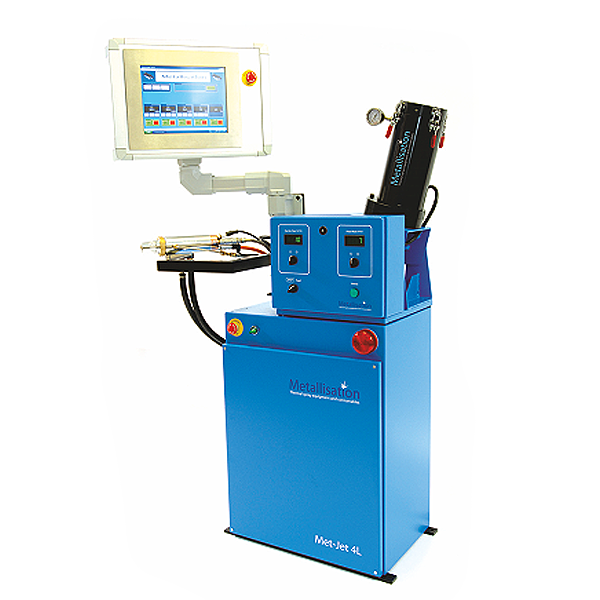
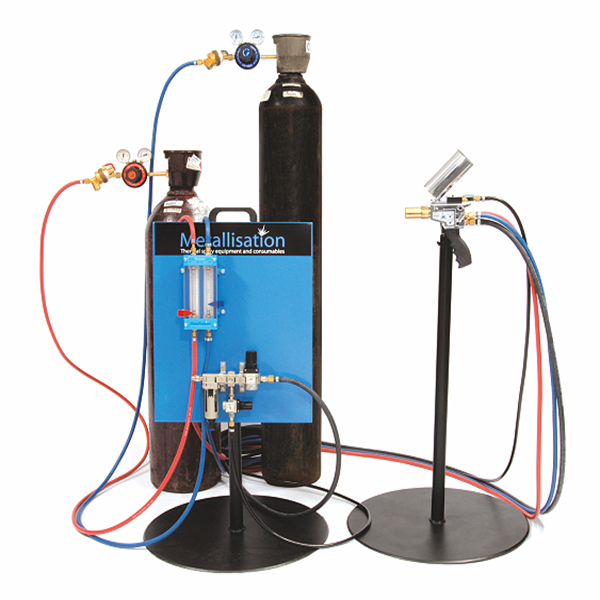
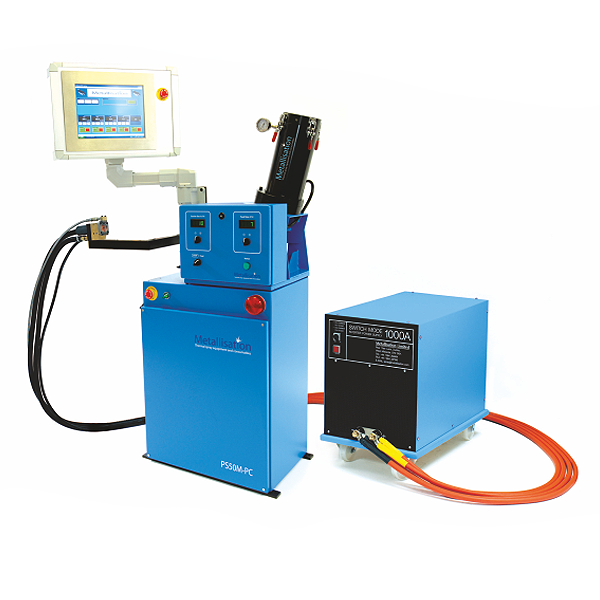
The following table provides a comparative overview of flame spray, HVOF, and plasma spray systems supplied through Minex.
Comparative Overview of Thermal Spray Systems Supplied by Minex
| System Available Through Minex | Technology | Typical Best Use Cases | Key Technical Advantages |
| Metallisation MK74 | Flame Spray (Powder) | Repair applications, shaft reclamation, worn bearing seats, ceramic coatings (alumina, chrome oxide), self-fluxing alloys, spray/fuse coatings, steel mill components | Lightweight spray torch (~1.85 kg), high deposit efficiency, adaptable powder feeders, robust operation, suitable for roughened surface preparation |
| Metallisation Met-Jet 4L | High Velocity Oxygen Fuel (HVOF) | Hard chrome replacement, carbide coatings, wear resistance for oil & gas components, hydraulic systems, turbine parts | Dense coatings with high bond strength, low oxide content, compressive stress state, kerosene fuel for low operating cost, advanced process control |
| Metallisation PS50M-PC / Met-PCC (PLAS) | Plasma Spray | Ceramic coatings, thermal barrier coatings, aerospace components, industrial rolls, complex shapes | Suitable for high temperatures, excellent control of molten particles, scalable power output, precise gas and temperature control |
Practical Selection Logic for Thermal Spray Equipment Investment
In most industrial applications, the right thermal spray system becomes evident once application requirements are evaluated systematically.
- Where maximum wear resistance and carbide performance are critical, HVOF is typically the preferred solution.
- Where ceramic coatings or thermal insulation are central, plasma spray offers the necessary thermal energy and process control.
- Where flexibility, repair capability, and low cost are key drivers, flame spray remains an efficient and proven choice.
The right thermal spray system is not the most complex one, but the one that aligns with coating requirements, production realities, and long-term performance expectations.
Technical Consultation for Thermal Spray System Specification and Deployment
Thermal spray system selection involves balancing materials, process parameters, coating thickness limits, and operational constraints.
For support in specifying the right thermal spray equipment, evaluating different coating methods, or optimizing application processes, Minex experts can provide technical guidance aligned with your application requirements.
Contact the Minex technical team to discuss your thermal spray coating application and system selection needs.
Frequently Asked Questions
Thermal spray coatings are particularly effective in applications where components are exposed to harsh environments and demanding service conditions. Typical use cases include:
- Wear resistance for components subject to abrasion, erosion, or mechanical contact, such as shafts, rolls, and valves
- Corrosion protection in oil and gas, power generation, and heavy industrial environments
- Thermal barrier coatings for aerospace and energy applications, where thermal insulation is required under high temperatures
- Electrical insulation or functional surfaces, depending on the coating material and process configuration
The flexibility of thermal spray technology allows coatings to be tailored to specific performance requirements across a wide range of industries.
The choice between HVOF, plasma spray, and flame spray should be driven by the required coating properties, material type, and application context.
HVOF is typically selected when extremely dense coatings with high bond strength, low oxide content, and superior wear resistance are required, particularly for carbide coatings and hard chrome replacement.
Plasma spray is preferred for ceramic coatings and applications requiring very high thermal energy, such as thermal barrier coatings or high-temperature aerospace components. It also allows controlled porosity when functional insulation properties are required.
Flame spray is widely used for repair and maintenance work, metallic and self-fluxing alloys, and applications where flexibility, portability, and cost-effective operation are key considerations.
Coating microstructure has a direct impact on service life and allowable coating thickness.
Dense coatings with high hardness and strong bond strength generally provide superior wear resistance and longer service life. Low porosity reduces pathways for corrosive media, improving corrosion resistance.
Residual stress plays a critical role in thickness limits. Coatings with compressive residual stress, such as those produced by HVOF, can be applied in thicker layers without spalling. Processes that introduce tensile stress may limit coating thickness and increase the risk of premature failure.
Porosity, while often minimized, can be deliberately controlled in plasma spray coatings to achieve thermal insulation or functional surface properties.
Coating material is one of the most decisive factors in thermal spray system selection.
High-melting-point ceramics such as zirconia and alumina typically require plasma spray systems due to the high thermal energy needed to process these materials effectively.
Metallic coatings and metal alloys are commonly applied using flame spray or plasma spray, depending on performance requirements and production scale.
Carbide coatings, including tungsten carbide and chrome carbide, are most effectively applied using HVOF, where high particle velocity ensures strong adhesion and minimal degradation of the carbide phases.
Matching the thermal spray technology to the coating material class is essential for achieving the desired coating performance.
Production context has a major influence on thermal spray equipment selection.
Repair and maintenance applications often favor handheld or semi-manual flame spray systems, which offer flexibility, portability, and fast setup for small batches or individual components.
High-volume OEM manufacturing typically requires automated thermal spray systems with precise process control, repeatable parameters, and integration with robotic handling.
Part geometry is equally important. Complex shapes, internal bores, or restricted access areas may require specialized spray torches, extension guns, or compact system configurations available in plasma and flame spray technologies.
Throughput and deposition efficiency have a significant impact on operating cost over the life of a thermal spray system.
Higher spray rates allow faster coating of large components and reduced cycle times, improving productivity. Efficient powder utilization reduces material waste and lowers the cost per coated part.
In many cases, these operational factors contribute more to total cost of ownership than the initial purchase price of the equipment, particularly in continuous industrial use.
For critical applications in aerospace, medical technology, and energy infrastructure, process control and compliance are essential.
Systems equipped with mass flow control, closed-loop powder feeding, and programmable process parameters enable consistent coating quality and repeatability. Automation supports traceability and helps ensure compliance with industry standards.
Operator qualification, documented process parameters, and stable process classification are key elements in meeting regulatory and quality requirements for critical thermal spray applications.