Multicomponent Painting Systems
References
Technical Guide: How to Select Multicomponent Painting Systems
Selecting a multicomponent painting system is not about choosing the most advanced machine on the market. It is about selecting the system that consistently protects finish quality, production continuity, and material efficiency under real operating conditions—while controlling material costs, downtime, and waste.
Multicomponent systems tend to fail in very predictable ways when they are mis-specified. Off-ratio mixing leads to curing and adhesion problems that may only appear weeks later. Inconsistent film build results in rework and visual defects. Slow or inefficient changeovers quietly turn production time into downtime. Just as important, when the system is not matched to the coatings and materials, the operation often pays in hidden ways: higher material waste, more clean up solvent, and increased labor costs. Maintaining the correct proportion of components is essential to ensure proper chemical reactions and optimal coating performance, and to prevent these failures or deficiencies in the final coating. None of these issues are caused by “bad equipment”—they are almost always the result of choosing a system that does not match the actual production objective, the desired mix ratio, or the realities of how the process must operate. Choosing the right system can save money by reducing material waste, minimizing labor costs, and eliminating the need for additional equipment.
For that reason, the most reliable selection process does not start with brand, industry, or maximum specifications. It starts with a single clarifying question:
What is the primary industrial objective you must optimize?
Once that objective is clearly defined, the technical variables—such as color change behavior, viscosity range, mixing accuracy, monitoring and reporting needs, flow and high pressure demands, mobility requirements, long hose lengths, and ratio flexibility—naturally guide you toward the correct system category. Only then does it make sense to narrow the choice to a specific solution.
This guide is written for engineers, production managers, maintenance leaders, and technical buyers who need an objective-first framework for selecting multicomponent painting systems that perform reliably across automotive finishing, industrial manufacturing, architectural and contractor applications, and heavy-duty protective coatings.
Start with the Production Objective, Not the Industry
Although different industries often use similar equipment, the objective behind the application is what truly defines the right system. Across industrial environments, four core objectives appear again and again:
When the priority is flawless finish and frequent color changes
This objective is typically found in operations where surface appearance is critical and product variation is high. The challenge is not only achieving a perfect finish, but doing so repeatedly while changing colors often—without wasting time, increasing material waste, or consuming excess clean up solvent during changeovers. In these environments, maintaining consistent material quality and a consistent spray pattern across shifts is often the difference between a stable process and recurring rework. Achieving the correct form or consistency of the coating material before application is essential for optimal finish quality.
When the priority is reliable coatings with process control and traceability
Here, the main risk is not speed, but inconsistency. These environments require strict ratio control, compatibility with different two component materials, and the ability to document what happened during production for quality assurance and audits. The goal is to stay on ratio, protect pot life, and reduce the operational risk that comes from uncontrolled adjustments or repeated hand mixing. Optimal coating performance is only achieved when the correct mixing process is followed.
When the priority is high output in demanding on-site conditions
This objective applies when coatings must be applied quickly, over large areas, often outdoors or in harsh environments. Throughput, pressure stability, mobility, and durability become more important than fine dosing accuracy. In these cases, plural component sprayers are often selected not only for volume, but because they can deliver high performance when jobs require more volume, stable high pressure, and reliable operation with multiple spray guns over long hose lengths.
When the priority is durability with high-solids, fast-curing materials
In heavy equipment and construction machinery applications, coatings are thick, cure fast, and are designed for long-term protection. These high solids coatings behave very differently from low-viscosity paint. The system must handle viscous materials and maintain steady delivery so the process produces a predictable film build without constant intervention. In this objective, simplicity, robustness, and efficiency matter more than flexibility—especially when reducing material waste and using less clean up solvent supports both cost control and a cleaner workflow.
Once one of these objectives is clearly dominant, the technical path forward becomes much clearer.
A Quick Decision Tree (For Fast Orientation)
If you need a fast, high-level orientation before diving into the details, this short decision path often clarifies things immediately:
- Do you change colors often and is finish quality visually critical—down to consistent material quality and a consistent spray pattern?→ You are likely in a precision dosing scenario.
- Is your biggest risk off-ratio mixing, pot life instability, or lack of QA traceability?→ You are likely in a process-controlled proportioning scenario where staying on ratio is the priority.
- Are you coating large structures on site with long hose lengths, high flow, multiple spray guns, and tough conditions?→ You are likely in a high-output plural component scenario.
- Are your coatings thick, fast-curing, and based on fixed ratios where the system must handle high viscosity materials reliably?→ You are likely in a mechanical fixed-ratio scenario.
Two component spraying is an advanced method used in many of these scenarios for efficient and high-quality application of coatings.
With that orientation in mind, the following sections explain how each objective translates into technical requirements—and which system types best support them.
Translating Objectives Into the Right System Strategy
When flawless finish and fast color changes matter most
(Typical example: automotive and vehicle production)
In high-precision finishing environments, quality is judged immediately and visually. Even small deviations in mixing accuracy or incomplete flushing can create visible defects and rejects. At the same time, production efficiency depends heavily on how quickly the system can switch between colors without excessive purge losses. In practice, this is where reducing material waste and using less clean up solvent becomes a measurable productivity driver, not a nice-to-have.
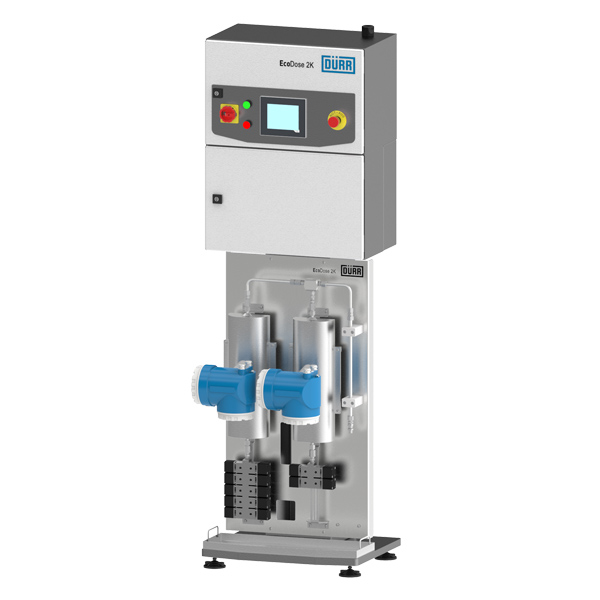
This combination makes electronic dosing systems the most appropriate choice. They are designed to handle low-to-medium viscosity coatings (roughly 20–500 mPa·s), deliver very high mixing accuracy (around 1%), and perform automatic, volume-controlled color changes. Independent flushing circuits allow fast, repeatable changeovers, which supports consistent material quality and helps maintain a consistent spray pattern when color variety is high.
Best-fit strategy:
Choose an electronic dosing system optimized for precision, fast flushing, and integration with automated or robotic production lines.
Recommended Minex solution:
Dürr EcoDose 2K — particularly well suited for high-detail, multicolor environments using 1K and 2K coatings, including water- or solvent-based paint systems.
When consistency, control, and traceability outweigh speed
(Typical example: industrial manufacturing and processing)
In many manufacturing environments, coating performance is functional rather than purely visual. The biggest risks are silent failures: incorrect ratio, unstable pot life, or chemistry mismatches that only become visible later during testing or use. Where processes still rely on hand mixing, variability increases, waste rises, and the root cause of defects becomes harder to trace.
Here, the priority shifts to process control. Systems must handle different material chemistries, monitor ratios in real time, trigger alarms before errors propagate, and generate data that supports quality assurance and audits. Electronic proportioning systems are designed for exactly this purpose. Their strength lies not in fast color changes, but in maintaining stable ratios, keeping the process on ratio, and providing transparency into mixing and spraying.
In this category, the “system” is more than the proportioner alone. Real performance depends on the full configuration—how components are combined in the mix manifold, how the mix ratio is monitored, and how the process is controlled to maintain consistent material quality across jobs and shifts.
Best-fit strategy:
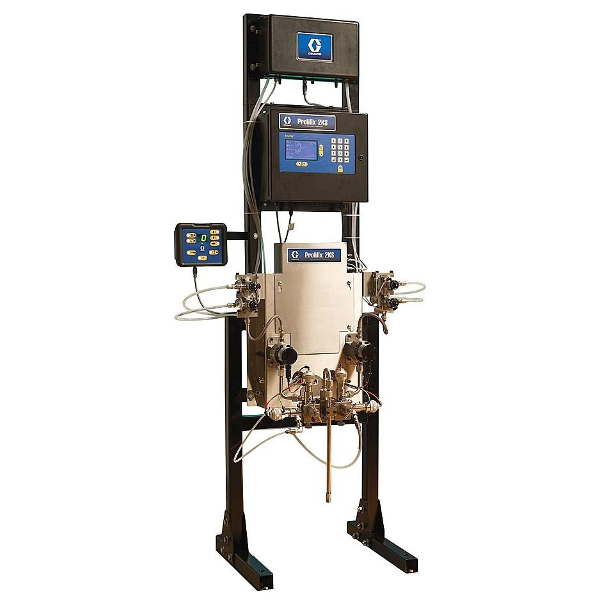
Choose an electronic proportioning system with intuitive programming, real-time ratio monitoring, alarms, and reporting via USB or web interfaces.
Recommended Minex solution:
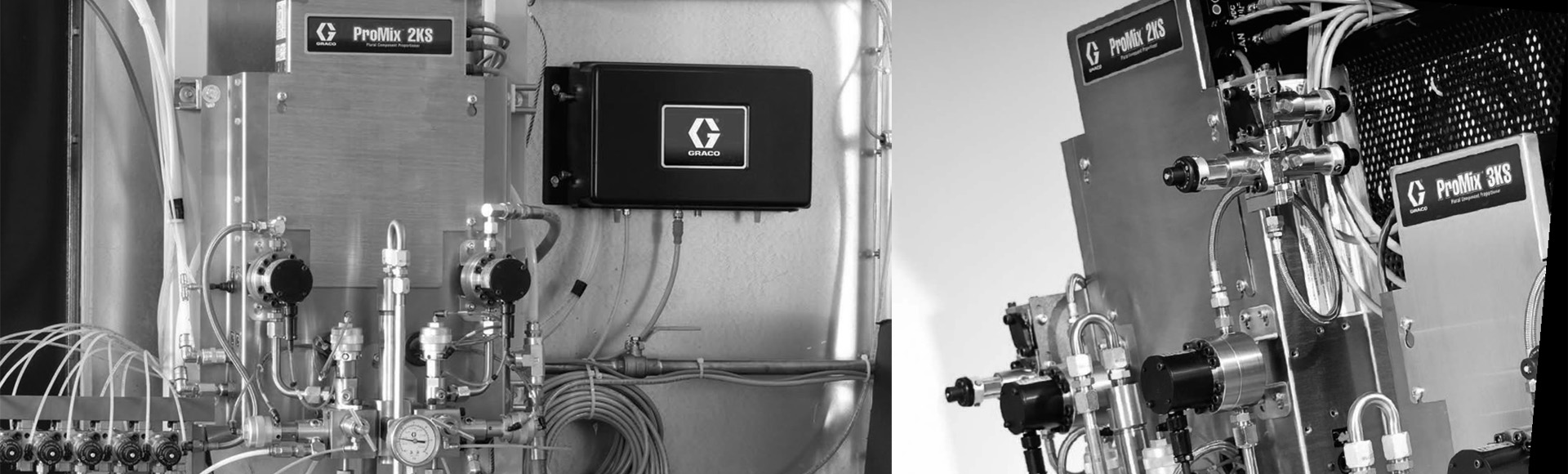
Graco ProMix 2KS — designed for precise ratio control across a wide range of coatings and two component materials, with strong QA and reporting capabilities.
When output, pressure, and mobility define success
(Typical example: contractor services and architectural painting)
On bridges, wind towers, marine structures, and large architectural projects, coating operations face a different reality. Long hose runs, multiple operators, exposure to weather, and tight schedules make throughput and robustness the dominant concerns. In these jobs, the system must operate reliably at high output, maintain pressure stability, and support efficient deployment so crews spend time spraying, not repositioning equipment.
In these environments, systems must deliver high flow rates, maintain stable high pressure for demanding protective coatings, and be physically designed for transport and rough handling. Mobility features such as pallet racks or crane hooks are not conveniences; they are operational necessities. Just as important, the system must support multiple spray guns and long hose lengths without compromising proportioning accuracy or creating an inconsistent spray pattern.
This is the domain of plural component sprayers and high-flow plural component systems engineered for jobsite performance. The goal is to deliver more volume, keep the process reliable, and reduce downtime and material waste on large-scale jobs.
Best-fit strategy: Select a robust, mobile plural component sprayer model designed for high pressure, high flow, and on-site durability.
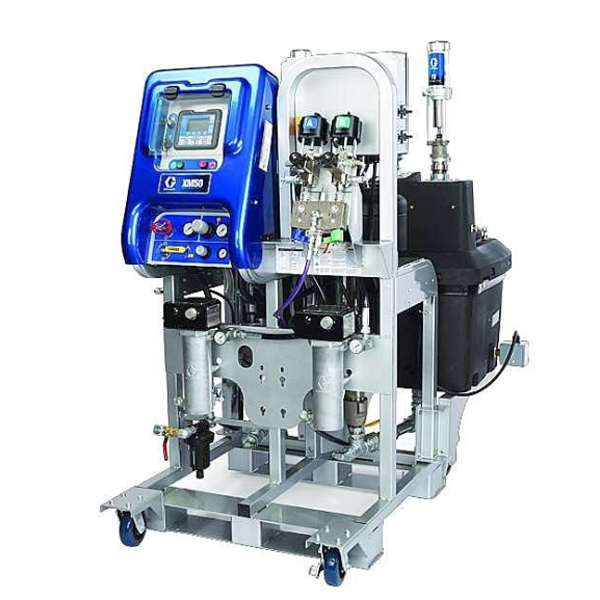
Recommended Minex solution: Graco XM Plural-Component Sprayer — this model is specifically engineered for high-capacity, high-flow applications, making it a proven choice for marine, bridge, wind energy, and infrastructure projects requiring high output and reliable performance.
When durability and simplicity beat flexibility
(Typical example: heavy equipment, agricultural and construction machinery)
In heavy-duty coating environments, materials are often thick, fast-curing, and designed for long-term protection rather than visual perfection. In these cases, system complexity can actually increase risk. Operators need a reliable process that consistently produces the required film build and cures predictably, job after job.
Mechanical fixed-ratio systems excel here. They are built to handle viscous materials, support high-solids operation, and reduce the variability and waste associated with repeated hand mixing. They can handle very high viscosities and up to 100% solids, often allow gravity feed to reduce auxiliary equipment, and rely on fixed ratios that simplify operation and reduce error potential. This is also where the use of a static mix tube and a properly configured mix manifold can help ensure consistent combining of components and repeatable spraying results.
Best-fit strategy:
Choose a mechanical fixed-ratio sprayer optimized for high-solids materials, fast curing, and rugged operation.
Recommended Minex solution:
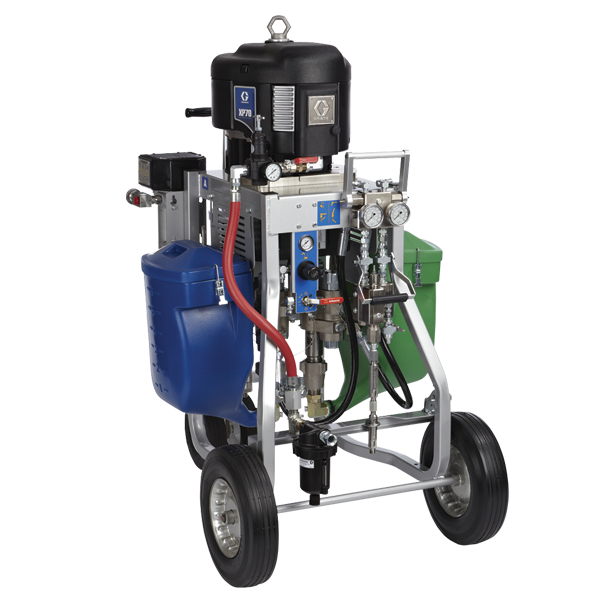
Graco XP70 — ideal for high-viscosity epoxies and urethanes where durability, simplicity, and cost efficiency matter most. In many heavy-duty programs, XP plural component sprayers (and other xp plural configurations) are considered when fixed ratios and robust performance are required and the process must handle high viscosity materials consistently.
Multicomponent System Selection Overview
| Objective you need to optimize | Typical operating reality | Best-fit system type | Recommended Minex product | Why this works |
| High-precision finish & frequent color changes | Many SKUs, visible surfaces, automated lines | Electronic dosing system | Dürr EcoDose 2K | Precision, consistent material quality, reduced waste |
| Process control & traceability | Sensitive chemistries, QA requirements | Electronic proportioning system | Graco ProMix 2KS | Precise ratio control, on ratio monitoring, reporting |
| High output in rugged on-site conditions | Large structures, long hose lengths, harsh environments | High-flow plural component sprayer | Graco XM | High pressure stability, more volume, jobsite reliability |
| High-solids durability & fast curing | High solids coatings, fixed ratios, heavy equipment | Mechanical fixed-ratio sprayer | Graco XP70 | Handles viscous materials, simple operation, reduced waste |
Talk to Our Experts
If you want to confirm that your selection is correctly aligned with your production objective, our technical specialists can help you validate the system configuration and the key setup choices.
Share just four details: • your primary objective (precision finishing, process control, on-site throughput, or high-solids durability) • the coating type • typical color or material change frequency • whether QA reporting or traceability is required
Based on this information, we can confirm the best-fit solution and ensure the system is configured for stable performance from day one.
Validate Your System Choice
For personalized assistance, technical support, or to request a quote, contact our sales team today.
Frequently Asked Questions
The choice depends on what you are optimizing. Electronic dosing systems are best suited for applications where finish quality, color-change speed, and automation are critical. Mechanical systems are more appropriate when coatings are thick, ratios are fixed, and the equipment must handle high viscosity materials reliably.
No. High mixing accuracy is essential for precision finishing and sensitive coating chemistries, where small deviations can affect appearance or curing. In high-solids protective coatings with fixed ratios, mechanical consistency, stable high pressure delivery, and predictable flow to the spray guns are often more important than electronic precision.
The Graco XP70 is specifically designed for high-viscosity and high-solids coatings, including systems up to 100% solids such as epoxies and urethanes. Its design allows for gravity feeding, which can eliminate the need for feed pumps, simplify the setup, and reduce overall system cost in suitable applications.
The Graco XP70 supports several fixed mix ratio configurations, including 1:1, 1.5:1, 2:1, 2.5:1, 3:1, and 4:1. These ratios are configured by changing one or two pump lowers, making the system suitable when the desired mix ratio is stable and repeatable.
For hazardous industrial coating environments, several systems offer appropriate certifications or safety features:
- Dürr EcoDose 2K is explicitly ATEX-certified (Ex II 2G IIA T6), making it suitable for use in regulated zones.
- Graco XP70 is also available with ATEX-rated configurations (Ex II G).
- Graco ProMix 2KS can be equipped with intrinsically safe fluid panels, allowing integration into hazardous-area installations.
The correct choice depends on zone classification, coating chemistry, and integration requirements.
Visual inspection alone does not always reveal ratio errors or curing risks. If coating performance affects compliance, durability, or warranty exposure, reporting and traceability provide valuable process visibility and helps reduce waste, rework, and long-term costs.
In practice, no single system excels equally at everything. Systems optimized for fast color changes are different from those designed for high output on site or for high solids coatings. Optimizing for the dominant objective almost always delivers better long-term results than trying to compromise across conflicting requirements.
Early consultation is especially useful when multiple coating chemistries are involved, when production conditions vary between line-based and on-site work, or when the system is a long-term investment. Clarifying these factors upfront helps avoid misalignment between equipment capability and real-world operation.