Inspection Kits
How to Choose the Right Industrial Inspection Kit for Coatings and Structural Quality Control
In industrial environments, inspection equipment is not a secondary tool—it determines whether your quality control process is complete, defensible, and contractually compliant across the full coating process.
When the wrong industrial inspection kit is specified, the issue rarely appears at the moment of purchase. It emerges later: during consultant audits, coating failures, EN ISO 19840 statistical evaluations, or final handover inspections—precisely when you need accurate readings that stand up to specifications and industry standards. In many cases, the root cause is not application error, but incomplete coating inspection capability or a mismatch between inspection tools and real site conditions.
This guide provides a structured, technically accurate framework to help you select the correct solution from the Elcometer inspection kits distributed by Minex Group.
The objective is not to compare instruments, but to ensure that your inspection scope is fully covered—from surface preparation through coating application and acceptance testing—using non-destructive testing methods and reliable thickness gauges.
Define the Inspection Responsibility Before Selecting the Kit
Selection should always begin with the project specification, because the required inspection tools are determined by the contract, the coating system, the substrate, and the corrosion exposure category.
In EU-based coating and structural steel projects, inspection requirements typically follow the lifecycle of the coating system:
- Surface preparation (EN ISO 8501, 8503, ISO 8502)
- Application control (environmental monitoring, wet film thickness)
- Final acceptance (EN ISO 19840 DFT statistics, EN ISO 4624 adhesion testing)
- Structural validation where required
If your responsibility is limited to verifying climate conditions, surface profile, and dry film thickness, your needs differ significantly from a contractor responsible for full structural acceptance in a C5-M marine environment.
That distinction determines which of the three core Elcometer inspection kit families is appropriate—and whether you will need multiple probes or add-on solutions for contamination, blasting, or discontinuity testing.
When Core QA Parameters Are Sufficient: Elcometer Digital Inspection Kits
For projects where coating inspection focuses on the three core quality assurance parameters—the practical baseline across much of the industrial coatings industry—the appropriate starting point is the Elcometer Digital Inspection Kits.
These kits support fast, repeatable non-destructive testing with consistent measurement range control, helping teams reduce uncertainty during coating application.
In this scope, inspection typically concentrates on:
- Climate parameters for environmental monitoring (air temperature, surface temperature, humidity, dew point)
- Surface profile measurement (for example, via Testex replica tape/replica tape methods where applicable)
- Dry film thickness measurement using thickness gauges that produce accurate readings
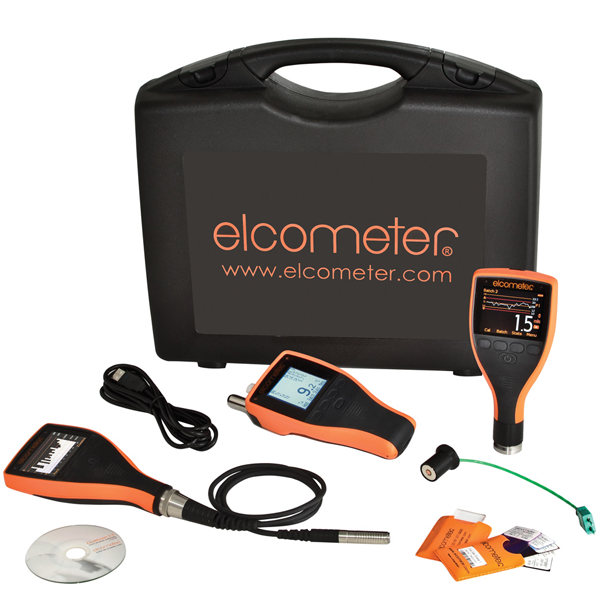
These kits are designed specifically around those three primary coating QA parameters. They are available in Ferrous (F) and Ferrous/Non-Ferrous (FNF) configurations, supporting measurement across steel and non-ferrous metals when an FNF probe is selected.
The Top version integrates:
- Large internal memory (up to 150,000 readings)
- Bluetooth connectivity
- ElcoMaster™ software compatibility
This allows statistical evaluation aligned with EN ISO 19840, secure batching of readings, and professional report generation. For contractors working under EN 1090 execution classes or large infrastructure contracts, digital traceability helps ensure compliance by improving data integrity and reducing manual transcription risks.
If your inspection scope does not extend beyond environmental monitoring, surface profile, and DFT, the Elcometer Digital Inspection Kits provide a technically sound and efficient solution for coatings quality control.
When Inspection Extends Beyond Thickness: Elcometer Protective Coating Inspection Kits
If your inspection responsibility includes more advanced verification tasks—such as adhesion testing, weld inspection, material thickness verification, or discontinuity detection—you move into the domain of the Elcometer Protective Coating Inspection Kits.
These kits are designed for deeper coatings inspection across demanding sites, especially where structural steel, corrosion risk, and strict specifications converge.
These kits are progressive in capability and must be understood accurately:
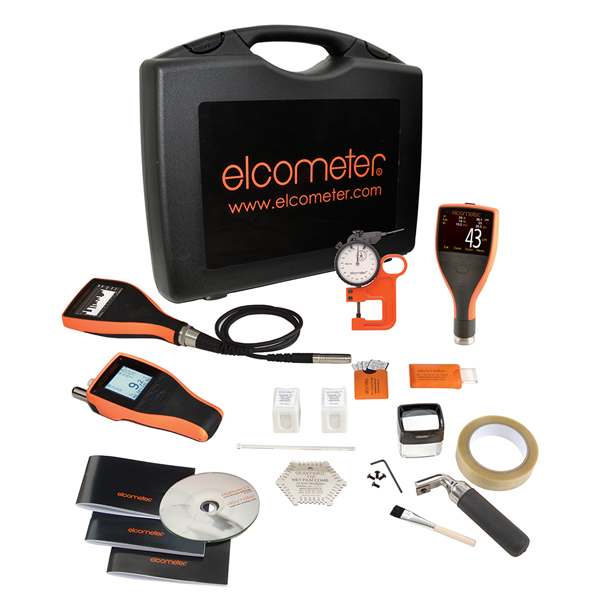
- Protective Coating Inspection Kit 1–2: Core inspection tools including surface profile, climate, and wet/dry film thickness measurement
- Protective Coating Inspection Kit 3: Introduces pull-off adhesion testing in accordance with EN ISO 4624
- Protective Coating Inspection Kit 4: Adds weld inspection capability for more complex structural steel assessment
- Protective Coating Inspection Kit 5: Includes advanced structural verification tools such as material thickness measurement, supporting broader testing requirements beyond coatings alone
- Protective Coating Inspection Kit 6: Includes all of the above and introduces pinhole detection (coating discontinuity testing) to identify imperfections such as pinholes that can compromise corrosion protection
It is important to clarify:
- Adhesion testing begins at Kit 3
- Weld inspection begins at Kit 4
- Pinhole detection is exclusive to Kit 6
This progression matters. Selecting Kit 2 when your specification requires adhesion testing creates a contractual gap. Selecting Kit 5 when discontinuity testing is required leaves you exposed during final inspection and acceptance testing.
For marine, offshore, heavy industry, and high-corrosion environments under EN ISO 12944 C4–C5 classifications, Elcometer Protective Coating Inspection Kits are often the appropriate framework because they support broader inspection and testing across the coating process.
Automotive and Body Shop Applications: Elcometer Automotive Inspection Kit
Industrial coating inspection and automotive evaluation are technically different environments, even though both rely on thickness measurement.
For vehicle assessment, body shop inspection, and insurance verification, the correct solution is the Elcometer Automotive Inspection Kit—a purpose-built industrial inspection kit for automotive surfaces where speed, access, and consistent gauge readings matter.
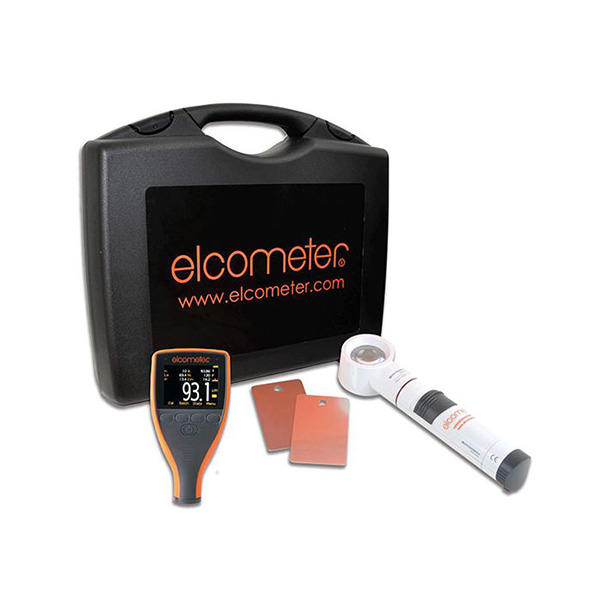
This kit includes the Elcometer 311 paint thickness gauge and Elcometer 137 illuminated magnifier as standard components, enabling quick measurement and inspection of coatings and surface condition.
The Elcometer 214L Infrared Thermometer is included in specific kit versions (e.g., Kit 2), but not in all configurations. This distinction matters when users expect environmental monitoring or temperature control as part of their workflow.
For process-controlled environments, additional solutions such as Paint Booth Kits and Spot Repair Kits are available within the broader portfolio, but the Automotive Inspection Kit remains the relevant choice when your work centers on vehicle paint systems rather than protective coatings for structural steel.
Surface Preparation and Contamination: When Additional Kits Are Required
Certain project specifications extend beyond surface profile measurement alone. In high-risk corrosion environments, the surface preparation stage can determine coating performance long before thickness is measured.
Under ISO 8502, chloride contamination testing (Bresle method) may be required prior to coating application. In such cases, dedicated Salt Contamination or Surface Contamination Kits are necessary because contamination can cause early failure even when thickness gauges show compliant readings.
Similarly, abrasive blasting operations may require Blasting Kits configured specifically for surface preparation verification. These solutions complement, but do not replace, the core three inspection kit families, and they should be considered when the project specification defines explicit contamination limits or blasting quality control requirements.
Powder Coating and Specialized Applications
For powder coating quality control environments, the portfolio includes:
- Powder Coatings Kit (ASTM)
- Top Qualicoat Powder Coatings Kit
For HVAC environments, the Duct Deposit Measuring System is available.
These kits serve specialized industrial segments and should be evaluated separately from liquid industrial coating inspection kits, because the testing methods, standards, and process controls differ from conventional protective coatings.
Ferrous vs. FNF Configuration: Avoiding Measurement Errors
Dry film thickness measurement depends on substrate type.
- Ferrous gauges measure coatings on steel.
- Non-Ferrous gauges measure coatings on aluminium or similar substrates.
- FNF probes automatically detect substrate type.
In mixed-metal industrial structures, FNF configuration ensures accuracy and simplifies logistics, especially where structural steel interfaces with non ferrous metals. Under EN ISO 19840 statistical acceptance rules (including the 90/10 rule), inaccurate measurement due to incorrect probe selection can invalidate results and damage reliability in audit scenarios.
Always confirm substrate composition before specifying configuration, including any changes in materials across forming processes, components, or supplier batches.
Hazardous Environments and ATEX
In ATEX-classified zones under Directive 2014/34/EU, standard electronic equipment may be prohibited. The Hazardous Area Inspection Kit provides non-electronic inspection tools for explosive environments.
If your site includes refineries, petrochemical plants or gas storage facilities, ATEX compliance becomes the primary selection criterion because safety requirements override convenience, price, or data workflow preferences.
Portfolio Overview – Structured for Clear Customer Navigation
Below is the clean structure aligned with your website architecture:
| Product Family | Primary Use Case | When to Choose It |
| Elcometer Automotive Inspection Kit | Vehicle and body shop inspection | When inspection concerns automotive paint thickness and surface evaluation. |
| Elcometer Digital Inspection Kits | Core coating QA (climate, profile, DFT) | When inspection scope is limited to essential coating control parameters. |
| Elcometer Protective Coating Inspection Kits | Full structural and coating verification | When adhesion testing, weld inspection, material thickness or discontinuity detection is required. |
Specialized kits (Blasting, Salt Contamination, Powder, Paint Booth, Duct Deposit) support specific operational requirements and complement the main three product families.
Making a Confident, Defensible Selection
The correct inspection kit is determined by:
- The full scope of inspection responsibility
- The corrosion classification of the environment
- The regulatory framework (EN ISO standards, ATEX)
- The need for digital traceability
- The substrate types involved
If your responsibility is limited and clearly defined, the Digital Inspection Kits provide efficiency and compliance. If your responsibility extends to structural validation, consultant oversight or high-risk environments, the Protective Coating Inspection Kits provide the necessary depth. If your inspection environment is automotive, the Automotive Inspection Kit ensures relevance and practicality.
Selecting correctly ensures that your inspection capability matches your contractual exposure, supports accurate readings, and provides dependable evidence of coatings quality.
Frequently Asked Questions
For most European industrial projects, inspection activities align with:
- EN ISO 12944 – Corrosion protection of steel structures
- EN ISO 8501 / 8503 – Surface cleanliness and profile
- EN ISO 19840 – Dry film thickness measurement on rough surfaces
- EN ISO 4624 – Pull-off adhesion testing
- EN ISO 2808 – Coating thickness measurement methods
- EN 1090 – Execution of steel structures
If your inspection responsibility is limited to environmental monitoring, surface profile and DFT under EN ISO 19840, the Elcometer Digital Inspection Kits provide the required measurement capability and statistical evaluation tools. If your specification includes adhesion testing or structural validation under EN ISO 4624 or related standards, you should evaluate the Elcometer Protective Coating Inspection Kits, beginning at Kit 3 where adhesion testing is introduced.
The 90/10 rule is an acceptance criterion for dry film thickness:
- 90% of measurements must be equal to or above the Nominal Dry Film Thickness (NDFT).
- No single reading may fall below 80% of NDFT.
Manual calculations increase the risk of reporting errors.
The Elcometer Digital Inspection Kits – Top Version include data batching and statistical analysis features that automatically calculate compliance values, significantly reducing contractual risk in EU projects. If your projects require regular EN ISO 19840 statistical reporting, digital data logging is strongly recommended.
Adhesion testing becomes necessary when:
- The coating system is used in high-corrosion environments (C4–C5 / CX under EN ISO 12944)
- The project specification explicitly references EN ISO 4624
- Consultant oversight requires pull-off testing as part of acceptance
Adhesion testing capability begins with Elcometer Protective Coating Inspection Kit 3 . If adhesion is part of your contractual requirement, selecting Kit 1 or Kit 2 would create a capability gap.
Weld inspection is typically specified in structural steel fabrication projects and under EN 1090 execution requirements.
Weld inspection tools are introduced in Elcometer Protective Coating Inspection Kit 4. If your scope includes inspection of weld seams prior to or after coating application, Kit 4 or above should be considered.
Pinhole detection (coating discontinuity testing) is required in environments where coating integrity is critical, such as:
- Marine infrastructure
- Tanks and pipelines
- Chemical storage environments
Within the portfolio, pinhole detection is available only in Elcometer Protective Coating Inspection Kit 6. If discontinuity testing is part of your acceptance criteria, Kit 6 is the appropriate configuration.
Ferrous (F) gauges measure coatings on steel using magnetic induction.
Non-Ferrous (NF) gauges measure coatings on aluminium or other non-ferrous substrates using eddy current.
FNF (dual) probes automatically detect the substrate and switch measurement principle.
If your site includes mixed-metal structures, the FNF configuration available within both Elcometer Digital Inspection Kits and Elcometer Protective Coating Inspection Kits ensures measurement accuracy across all components and reduces the risk of inaccurate readings when substrates vary.
In marine and offshore environments, ISO 8502 may require chloride contamination testing prior to coating application. Salt contamination testing is not automatically included in all coating kits and may require dedicated Bresle or Surface Contamination Kits.
If your project specification includes contamination limits before coating, this should be evaluated in addition to selecting either the Elcometer Digital Inspection Kits or Elcometer Protective Coating Inspection Kits, because contamination can compromise corrosion performance even when coating thickness is within range.
No.
The Elcometer Automotive Inspection Kit is designed for vehicle paint thickness inspection, insurance evaluation and body shop environments. It is not intended for structural corrosion protection projects under EN ISO 12944.
If your inspection activities relate to industrial steel structures, you should review either the Elcometer Digital Inspection Kits or the Elcometer Protective Coating Inspection Kits, depending on the required measurement scope.
Under ATEX Directive 2014/34/EU, electronic equipment may not be permitted in explosive atmospheres. If your inspection site includes petrochemical plants, refineries or gas storage facilities, you must evaluate whether a Hazardous Area Inspection Kit is required instead of standard digital equipment.
This decision should be made before selecting either the Elcometer Digital Inspection Kits or the Elcometer Protective Coating Inspection Kits, as safety compliance overrides functional preference.
No.
WFT measurement is used during coating application to control coating volume (often with a WFT gauge). Final contractual acceptance under EN ISO 19840 always relies on Dry Film Thickness (DFT) measurement after curing.
Both the Elcometer Digital Inspection Kits and Elcometer Protective Coating Inspection Kits include DFT measurement capability. If adhesion testing, weld inspection, or discontinuity testing is also required, a Protective Coating Kit (3–6 depending on scope) should be selected.