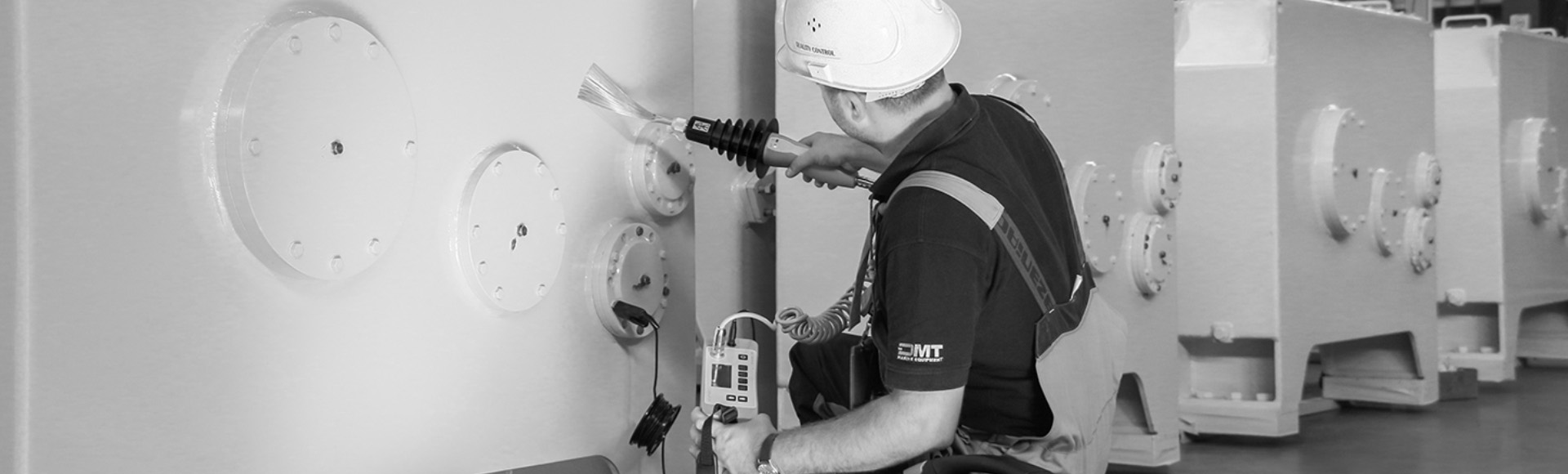
Pinhole & Porosity Detectors
How to Select the Right Holiday Detector for Industrial Coating Inspection in the EU
In industrial materials protection, selecting the correct holiday detector for coating inspection is not a routine equipment purchase. It is a decision that directly affects structural integrity, coating performance, compliance with standard test methods, and long-term asset reliability.
Holiday detection is a form of discontinuity testing performed on protective coatings applied to metallic substrates or other conductive substrates. The objective is simple: detect holidays, detect pinholes, and identify defects before coating failure occurs.
If the wrong technology or incorrect voltage setting is used, the consequences are measurable:
- Undetected discontinuities in new protective coatings
- Premature corrosion on pipeline coatings or tank linings
- Coating damage caused by excessive applied voltage
- Rejected inspection reports under ASTM G62 or EN ISO 29601
- Disputes during project handover
- Safety risks in high voltage testing environments
This guide translates coating thickness values, standard test methods, environmental factors, and voltage-based detection principles into practical decision logic tailored to EU industrial projects.
Minex Group distributes Elcometer holiday detection equipment for professional use. The purpose of this guide is to help you determine which low voltage holiday detector, high voltage holiday detector, or pulsed DC high voltage tester aligns with your coating systems, project specifications, and inspection requirements.
Coating Thickness and Test Voltage: The Critical Relationship
Holiday detection operates on a straightforward principle: apply voltage to a coated surface, and when a defect exposes the underlying substrate, the circuit closes and triggers an alarm.
But here's what matters most—the required test voltage is directly determined by your measured dry film thickness (DFT). This isn't arbitrary; it's a precise relationship that demands careful attention.
The Voltage Dilemma
Set the voltage too low, and holidays slip through undetected. Set it too high, and you risk puncturing the very coating you're trying to protect.
This is why voltage selection must align with EN ISO 29601, ASTM G62, or whichever standard test method your project specifies. The standards exist to eliminate guesswork from a process where precision is non-negotiable.
Matching Technology to Coating Thickness
The right detection method depends entirely on what you're inspecting:
Up to 500 μm (20 mils)
Low voltage testing using a wet sponge method. This is your approach for thin film coatings and delicate applied coating systems where aggressive testing would cause more harm than good.
500 μm to 7.5 mm
High voltage DC holiday detection with continuous DC output. This range covers heavy-duty pipeline coatings, lining systems, and structural steel—applications where coating integrity is critical infrastructure.
Up to 25 mm (coatings greater than 7.5 mm)
Pulsed DC high voltage testing becomes necessary. You're dealing with thick coating systems, concrete substrates, or adverse field conditions that demand this level of penetration.
The rule remains constant: always set voltage according to coating thickness values derived from measured dry film thickness and the relevant standard test method.
Modern detectors have evolved beyond manual voltage tables. Integrated voltage calculators and multiple voltage settings now deliver the correct voltage setting and desired test voltage automatically—removing one more variable from an already complex inspection process.
Low Voltage vs High Voltage: Choosing Your Detection Method
The distinction between low voltage holiday detection and high voltage holiday testing isn't just technical—it defines your entire inspection approach.
Low Voltage Holiday Detector (Wet Sponge Method)
Low voltage detectors are the precision tool for delicate work. Deploy them when you're inspecting:
- Thin film coatings
- New protective coatings below 500 μm
- Situations where surface tension and coating sensitivity demand non-destructive testing
The wet sponge electrode—often used with a wetting agent—is the key here. It maintains consistent contact across the coated surface, revealing pinholes without compromising the applied coating you've worked to protect.
High Voltage Holiday Detector (Spark Tester)
When coatings get serious, so does the equipment. High voltage detectors, commonly called spark testers, become necessary for:
- Coatings thicker than 500 μm
- Pipeline coatings
- Tank linings
- Heavy industrial protective coatings
High voltage testing applies continuous DC voltage across the coating surface. As the electrode passes over a defect, the alarm activates—simple, immediate, definitive.
When Standard High Voltage Isn't Enough
For exceptionally thick coatings or when you're working in adverse environmental conditions, pulsed DC high voltage testers provide the improved stability that continuous DC can't always deliver. They're not just an upgrade—they're often the only reliable option for extreme applications.
Surface Conditions and Field Environments
Holiday testing happens where your projects actually are—in the field, prior to commissioning, often outdoors, and subject to whatever conditions the day brings.
These environmental factors aren't obstacles to work around; they're simply the reality of the inspection environment:
- Surface variations and natural contamination
- Dew point fluctuations throughout the inspection day
- Ambient moisture that comes and goes
- Temperature shifts as work progresses
- Substrate characteristics, particularly porous concrete
Continuous DC: Built for Standard Conditions
Continuous DC systems deliver consistent, reliable results when conditions cooperate. Dry surfaces, straightforward grounding, controlled environments—this is where they shine, and these conditions represent the majority of professional coating inspections.
Pulsed DC: Built for Everything Else
Pulsed DC technology doesn't just work in ideal conditions—it thrives when conditions aren't perfect. Surfaces retain some moisture? Establishing optimal grounding proves logistically complex? The inspection continues without compromise.
Take pipeline work where geometry and sheer length make conventional grounding a puzzle. Pulsed DC systems reduce grounding dependency, allowing you to complete thorough inspections on your schedule rather than waiting for conditions to align perfectly.
This is inspection technology that adapts to field reality—delivering dependable holiday detection regardless of what the environment throws at you.
Proper Grounding and Ground Wire Considerations
Standard high voltage testing requires the system to be properly grounded to the conductive substrate using a ground cable.
In large natural gas pipelines or extended infrastructure projects, ensuring proper grounding may be challenging.
Some pulsed DC high voltage detectors allow effective operation without strict direct grounding, improving inspection efficiency while maintaining test validity.
Ground wire integrity must always be verified before testing coatings to avoid false results or unsafe applied voltage conditions.
Voltage Output Accuracy and Functional Verification
For professional coating inspection in the EU, voltage output must match the selected applied voltage.
High voltage detectors should:
- Provide clear voltage output display
- Allow precise set voltage adjustment
- Enable functional verification of voltage output
- Maintain calibration traceable to an accredited calibration laboratory
Annual calibration and voltage verification are essential for ISO 9001 and contractual compliance.
Incorrect voltage output undermines structural integrity verification and may invalidate holiday testing reports.
Standards Compliance: The Framework for Defensible Results
Holiday detection in Europe operates within a clear standards hierarchy—one that directly shapes which method you choose, how voltage is set, what documentation you produce, and whether your results hold up during contractual acceptance.
Understanding this hierarchy isn't about memorizing reference numbers. It's about knowing which standard governs your specific project and ensuring your detector can deliver compliant results that survive scrutiny.
The Foundation: EN ISO 29601
For general industrial protective paint systems on metallic substrates, EN ISO 29601 is your baseline reference. Use the edition cited in your project specification.
This standard formalizes the two principal approaches used across Europe—low-voltage wet sponge testing for pinholes and high-voltage spark testing for thicker coatings—and establishes the direct link between measured dry film thickness (DFT), method selection, test voltage, and reporting requirements.
It's the framework that makes the rest of the process logical rather than arbitrary.
When Coatings Are Part of the Asset Specification
Here's where many EU projects diverge from the textbook: holiday testing is frequently treated as an acceptance test embedded within the coating specification itself, not a standalone inspection step.
This is particularly true for pipelines and field joints. If your scope includes pipeline coatings, the governing reference may reside in European pipeline coating standards that contain their own holiday detection clauses and annex test procedures. Factory-applied coating standards like EN 10289 and EN 10300, and field joint standards such as EN 10329, are prime examples.
In these cases, treat the pipeline standard as your primary compliance reference and use EN ISO 29601 as supporting context where the pipeline standard defers to it.
For oil and gas pipeline field joints, the ISO/EN ISO 21809 family may specify holiday detection requirements and voltage-setting logic directly within the coating system standard—making the coating spec and the testing method inseparable.
Specialized Coating Families
Some European sectors operate under specialized coating standards. If your assets include vitreous or porcelain enamel components, the ISO/EN ISO enamel standards apply: ISO/EN ISO 2746 addresses high-voltage testing (including DC or pulsed DC), while ISO/EN ISO 8289-1 covers low-voltage defect detection for enamel coatings.
In parts of Europe where national specifications remain influential, you may also encounter standards like DIN 55670 for high-voltage pore and crack testing of paint coatings. These aren't obscure exceptions—they're active references in sectors where national practice still shapes procurement language.
The International Methods That Keep Appearing
EU project contracts frequently reference international methods alongside EN/EN ISO documents. This isn't redundancy—it reflects how the industry actually operates.
You'll commonly see ASTM D5162 (general discontinuity testing on conductive substrates), ASTM G62 (pipeline holiday detection), and AMPP/NACE SP0188 (holiday testing of new protective coatings) specified within European ITPs and QA documentation. For pipeline and tank lining applications, NACE TM0384, SP0274, and SP0490 frequently appear alongside these core references.
Making Compliance Work in Practice
Before selecting a detector, confirm which standards your contract, coating specification, or ITP actually cites. Then ensure the instrument's Declaration of Conformity and calibration documentation explicitly support those references—not through vague compatibility claims, but by name.
In practical terms, this means verifying that your chosen detector:
- Supports the required method (wet sponge vs continuous DC vs pulsed DC)
- Can set and verify the specified test voltage with documented accuracy
- Delivers calibration and conformity documentation that audit teams and handover packs accept without qualification
Global standards such as AS 3894 and JIS K 6766 enter the picture only when your customer specification explicitly requires them—typically in multinational frameworks or when imported specifications carry through to European project execution.
The objective remains consistent: anchor your method to the standards your project requires, equip yourself with a detector whose documentation proves compliance, and maintain records that make acceptance straightforward rather than contentious.
Elcometer Holiday Detectors Distributed by Minex Group
Minex Group distributes professional holiday detection equipment suitable for EU industrial coating inspection.
| Product | Technology Type | Best Use Cases | Key Technical Benefits |
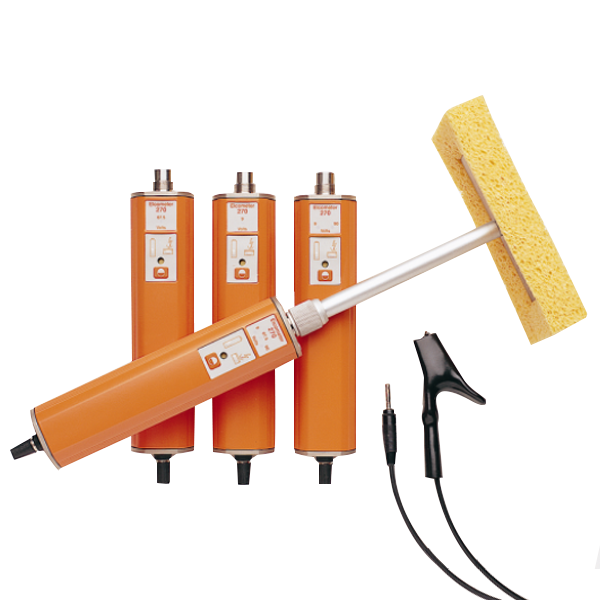
| Elcometer 270 Low Voltage Pinhole Detector | Low Voltage (Wet Sponge) | Thin film coatings up to 500μm on metallic substrates | Non-destructive low voltage testing. Multiple voltage settings (9V, 67.5V, 90V). Up to 200-hour battery life. Wet sponge method with wetting agent improves detect holidays performance. |
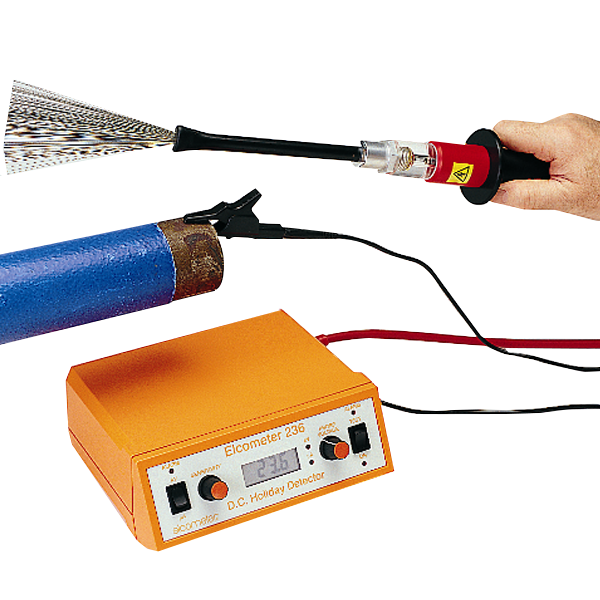
| Elcometer 236 DC Holiday Detector | High Voltage (Continuous DC) | Pipeline coatings, heavy industrial coating systems up to 7.5mm | Adjustable applied voltage in 100V increments. Clear voltage output display. Compatible with multiple electrode passes (band, wire, brush). Optional external battery pack extends operation from approx. 10/12 hours to 20/24 hours. |
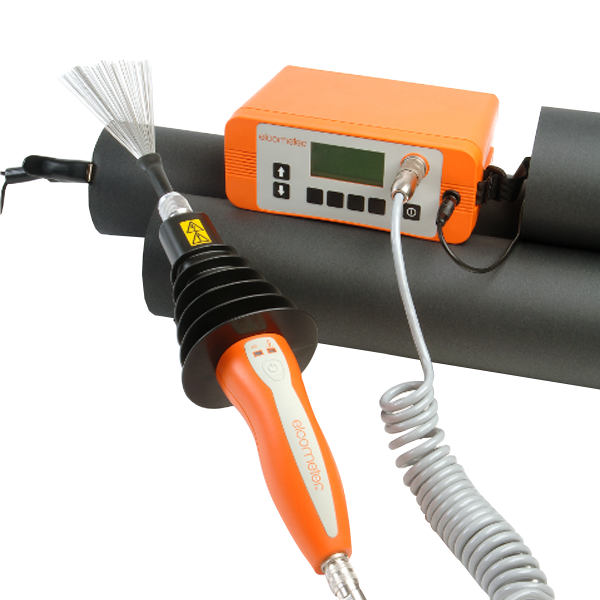
| Elcometer 266 DC Holiday Detector | High Voltage DC (IP65) | Offshore, tank linings, aggressive environments | IP65 rated. Integrated automatic correct voltage calculator. Interchangeable high voltage handles (5kV, 15kV, 30kV, including 30kV Continuous DC handle DC30S). Current limiting. |
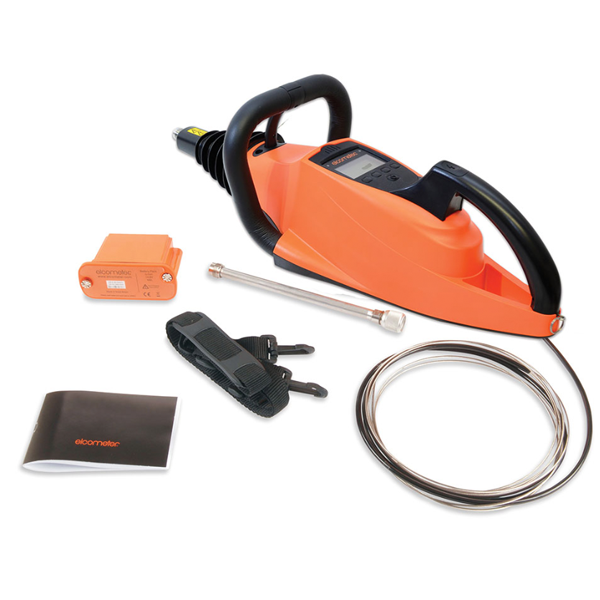
| Elcometer 280 Pulsed DC Holiday Detector | High Voltage (Pulsed DC) | Coatings thicker up to 25mm. Concrete substrates. Adverse environmental factors. Large pipelines | Pulsed high voltage testing (0.5kV – 35kV range). Integrated voltage calculator for correct voltage setting. Reduced grounding dependency. Rugged enclosure. Advanced safety trigger and ribbing. |
Frequently Asked Questions
A holiday detector identifies defects in protective coatings applied over a conductive substrate. Voltage is applied to the coated surface; when a defect exposes the underlying substrate, the circuit closes and the alarm activates.
It is used to detect pinholes, thin spots, and discontinuities in new protective coatings prior to commissioning.
Voltage must be selected according to EN ISO 29601, ASTM G62, or other specified standard test methods.
- Up to 500 μm → Low voltage testing (wet sponge)
- 500 μm–7.5 mm → High voltage DC
- 7.5 mm → Pulsed DC high voltage
Always base voltage on measured dry film thickness.
Continuous DC applies constant high voltage and is suitable for clean, dry surfaces.
Pulsed DC applies voltage in bursts, reducing interference from surface contamination, moisture, or concrete substrates, and easing grounding constraints.
Primary standard:
- EN ISO 29601
Frequently referenced:
- ASTM D5162
- ASTM G62
- NACE SP0188
- NACE TM0384
- NACE SP0274
- NACE SP0490
AS 3894 and JIS K 6766 may apply only in multinational specifications.
Flat surfaces → wire or brush electrodes
Pipeline coatings → rolling springs sized to diameter
Internal linings applied → circular brush probes
Tank floors → roller electrodes
Correct probe selection ensures reliable electrode passes and defect detection.
Two-stage triggers, current limiting, EN 61010 compliance, spark suppression, and stable voltage output are required for safe high voltage testing.
Yes. Dew point proximity, surface contamination, and moisture can affect continuous DC readings. Pulsed DC or proper surface preparation improves reliability.
Annual calibration by an accredited calibration laboratory is recommended. Maintain calibration certificates for ISO 9001 and project specifications.
Standard high voltage testing requires proper grounding. Some pulsed DC systems reduce grounding dependency in large infrastructure projects.
Incorrect applied voltage may:
- Miss defects
- Damage coating systems
- Trigger coating failure
- Lead to contractual disputes
Use correct voltage tables and document applied voltage settings.