Sensors and Measuring Devices for Static Electricity
How to Select the Right Static Electricity Meter, Electrostatic Field Meter, Sensor and Measuring Device for Industrial Production
Static electricity rarely announces itself politely in industrial environments. It shows up as contamination on finished product, adhesion failures on converting lines, erratic web handling, operator shocks, unexpected ESD events, and, in the wrong process conditions, ignition risks that nobody wants to be explaining after the fact. In other situations, the damage is subtler: dust attraction, inconsistent material behaviour, throughput losses that are hard to pin down until someone finally reaches for a meter.
That is precisely why measurement has to come first. There is no credible path to controlling static electricity without knowing where it builds, how strong the electrostatic field is, what electric field strength exists at the point of concern, whether polarity reverses through the process cycle, and whether the ionisation equipment already installed is actually doing what it is supposed to do. A well-chosen static electricity meter, static meter, electrostatic field meter, or continuous sensor system turns static from an invisible process variable into something you can observe, trend, act on, and justify decisions around.
Choosing the right instrument, though, is not simply a procurement exercise. The correct solution depends on a combination of factors:
- the materials being processed
- the expected voltage range
- measurement distance and machine layout
- environmental conditions such as dust or humidity
- whether operators need portable measurement or continuous monitoring
- whether the system must operate in ATEX hazardous areas
This guide is written as a working technical reference, not a product catalogue. It is aimed at engineers, procurement managers, and operations leaders who need to make grounded, defensible decisions about static measurement equipment. The goal is to help you select instruments that genuinely improve process performance, rather than ones that simply occupy a shelf on the control panel.
Why Static Electricity Measurement Matters in Industrial Production
The mechanics behind static buildup in manufacturing are straightforward enough. Whenever materials move, film unwinding, board running through a packaging line, powder dropping through a filling station, charge accumulates. The friction, separation, and contact-break events that define normal process operation are also, unavoidably, the conditions that generate static charges and electrostatic charges.
This occurs across a wide range of industries:
- plastics converting
- printing and packaging
- electronics manufacturing
- automotive coating
- pharmaceutical production
- paper and board processing
Although the materials differ, the physical principle is the same: motion and separation generate charge.
What makes it complicated is that the charge rarely stays where it started. It migrates across webs, transfers through rollers, finds its way onto machine frames and insulating surfaces, and occasionally onto operators or other charged objects nearby. It responds to process variables: line speed increases it, a drop in humidity amplifies it, a material change can shift it entirely. A single measurement taken under one set of conditions tells you something, but rarely enough. What experienced engineers need is measurement that reflects the process as it actually runs, under production speed, at operating temperature, with the real materials in use.
Good measurement data answers the questions that drive practical decisions.
- Where is the charge originating?
- What is the field strength, or electric field strength, at the point of concern?
- Is polarity consistent, or does it reverse through the process cycle?
- Are ionizers neutralising effectively across the full web width, or are there dead zones?
- Is the material properly grounded at the point you think it is, or has the problem simply shifted downstream?
- When a line change is made, is the static behaviour actually improving, or has it worsened in a way that will only become visible later?
These are not abstract questions. They are the difference between a systematic approach to static control and one that relies on instinct and experience alone. Measurement does not replace that experience. It focuses it, gives it references, and gives it something solid to work with.
Choosing Between a Portable Static Meter and a Continuous Sensor System
One of the first technical decisions is whether the application calls for a portable instrument or a fixed sensor system. Both have a clear role, but they solve different problems.
Portable static meters
or electrostatic field meters are primarily used for:
- troubleshooting static problems
- machine setup and verification
- maintenance inspections
- measuring charge on specific objects or surfaces
A technician can move along a production line, take readings at different positions, and compare electrostatic field strength across machine components.
This flexibility is especially useful in:
- electronics assembly
- automotive manufacturing
- aerospace production
- precision component handling
- cleanroom environments
In these applications a portable, battery powered static electricity meter with a clear display allows engineers to quickly measure charge without interrupting production.
Continuous In-Line Static Sensors
In high-speed converting industries such as printing, packaging, plastics, textiles, or film processing, static conditions change constantly.
Charge levels vary with:
- web speed
- material tension
- humidity
- machine operation
Manual measurements provide only snapshots. They cannot capture charge behaviour across time or across the full width of moving materials.
In these environments in-line electrostatic sensors provide continuous monitoring. Installed directly on the machine, they measure the electrostatic field across the production web and transmit measurement data during operation.
This allows operators to detect problems early and understand how static electricity affects process performance over time.
The rule is simple:
- portable static meter → spot measurements and troubleshooting
- in-line sensor system → continuous monitoring of dynamic processes
Static Electricity Measurement in Hazardous ATEX Environments
In some production facilities, static electricity is not only a quality issue but also a safety risk.
When electrostatic discharge occurs in an atmosphere containing flammable dust, vapours, or solvents, the resulting spark can ignite an explosion.
Industries where this risk frequently exists include:
- food powder processing
- pharmaceutical manufacturing
- chemical production
- solvent-based coating operations
- certain aerospace and automotive finishing processes
In these environments, electrostatic measurement devices must comply with ATEX explosion-protection requirements.
ATEX-certified sensors are designed so that the measuring equipment itself cannot become an ignition source. They allow operators to monitor electrostatic charges safely within hazardous zones.
For engineers selecting measurement equipment in these environments, ATEX certification is not optional. It is a primary selection requirement.
How Dust and Contamination Influence Sensor Performance
Industrial production environments are rarely clean. Printing, plastics converting, packaging, and bulk material handling all generate dust, fibres, and airborne debris.
Over time these contaminants can affect sensor performance.
The most common problem is not sudden failure but measurement drift. Dust accumulation near the sensing head may gradually reduce accuracy, producing readings that appear normal but no longer represent the true electrostatic field.
Because this degradation occurs slowly, it can remain unnoticed for long periods.
For dusty applications, modern electrostatic sensor systems often include integrated air purge systems. A small flow of air prevents particles from entering the sensor opening, protecting measurement stability and reducing maintenance.
Considering environmental contamination during equipment selection greatly improves long-term reliability.
Closed-Loop Static Control and Real-Time Monitoring
In some industries, static electricity must be controlled very precisely.
Electronics manufacturing, medical device production, and precision converting processes are particularly sensitive to electrostatic discharge. Even small charge levels can damage components or affect product quality.
In these environments static sensors are often integrated into closed-loop control systems.
In such systems:
- An in-line sensor continuously measures electrostatic field strength on the material.
- Measurement data is sent to a central control platform.
- Ionizers automatically adjust output to neutralise charge.
The result is dynamic static control. Instead of reacting to problems after they occur, the system adjusts ionisation output as conditions change.
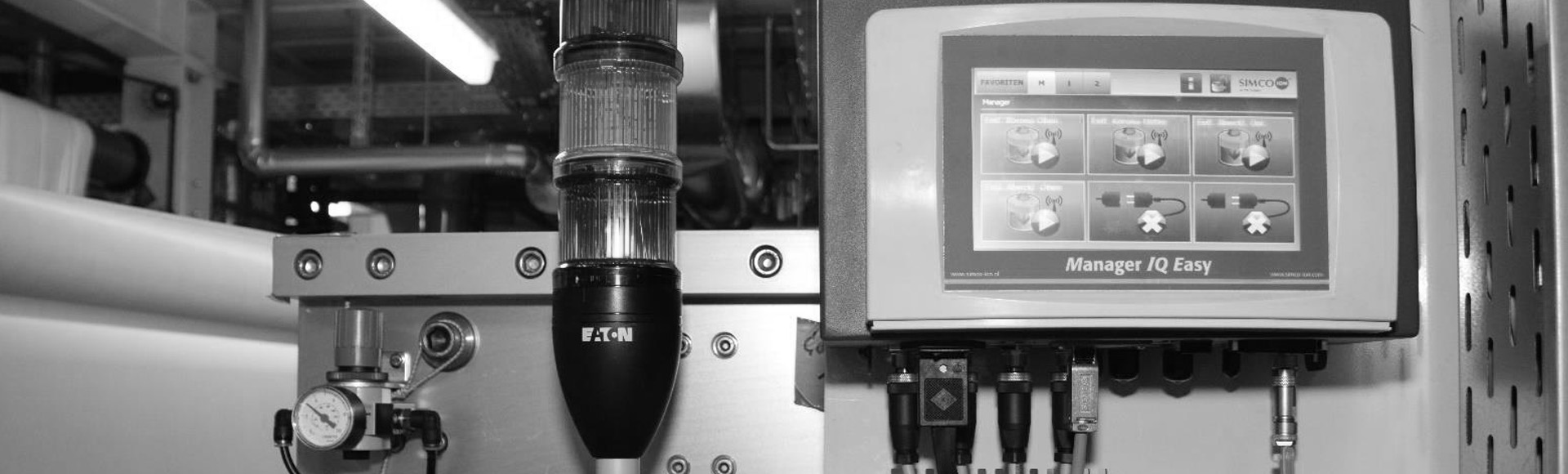
Platforms such as the Manager IQ Easy also allow operators to view measurement data on a display, store readings for analysis, and retrieve data remotely through Ethernet connections.
For modern Industry 4.0 production environments, such integration provides both process stability and valuable operational data.
Measurement Range, Electric Field Strength and Distance
Selecting a static electricity meter requires matching the instrument to the physical and electrical conditions of the process.
Measuring Distance
Electrostatic field meters measure the electric field generated by charged objects without touching the material.
However, the reading depends strongly on distance from the measured surface. Moving the meter closer or further away changes the measured field strength.
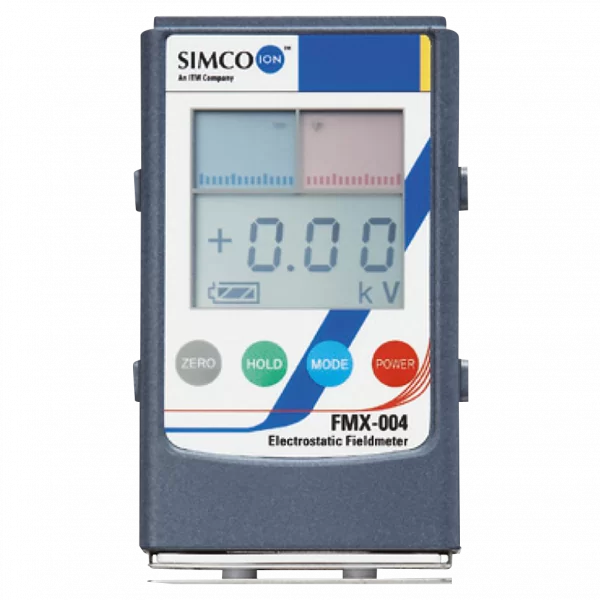
This is why professional instruments include guidance to maintain the correct measuring distance. The FMX-004 static electricity meter, for example, measures electrostatic field strength at a fixed 25 mm distance and uses LED indicators to help the person holding the meter maintain the correct position.
Consistent positioning is essential for repeatable readings.
Voltage Range
Portable electrostatic field meters used for troubleshooting typically measure charges up to 30 kV, which covers most common industrial situations.
Fixed in-line sensors designed for industrial processes may measure significantly higher levels.
Examples include:
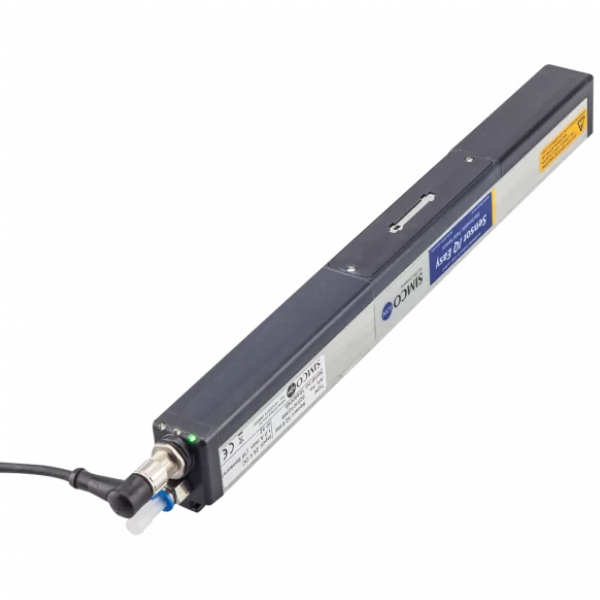
- Sensor IQ Easy: measuring electrostatic charges up to 80 kV at a working distance of 25–60 mm
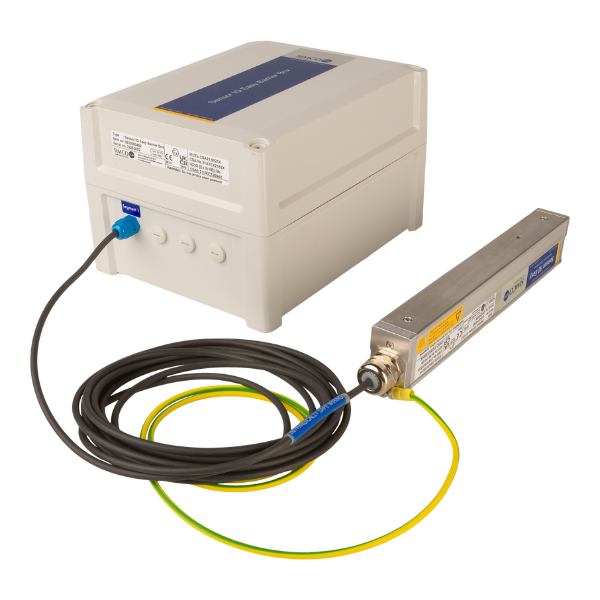
- Sensor IQ Easy 2.0 Ex: measuring charges up to 50 kV at 100 mm with a working distance of 10–300 mm
These ranges allow sensors to monitor large industrial charge levels safely from practical distances.
Polarity Detection
Electrostatic measurement must also identify charge polarity.
Knowing whether electrostatic charges are positive or negative helps engineers optimise ionisation systems and better understand process behaviour.
A meter that shows magnitude but not polarity provides only partial diagnostic information.
Why Proper Grounding Still Matters
Even the most accurate static electricity meter cannot compensate for incorrect measurement conditions.
Reliable electrostatic measurement depends on:
- proper grounding of machine components
- conductive paths for charge dissipation
- consistent measuring position and distance
- stable operator technique
If a machine component assumed to be grounded is actually insulated, the measurement may show symptoms rather than the root cause.
For this reason experienced engineers treat electrostatic measurement as a repeatable method, not simply a device reading.
Baseline measurements should be recorded and updated whenever materials, line speed, or environmental conditions change.
Fast Verification of Ionizers and High-Voltage Equipment
Sometimes static problems are caused not by materials but by the static control equipment itself.
Ionizers, charging bars, or high-voltage generators may appear operational while their output has decreased.
Maintenance teams therefore need a quick way to verify whether a high-voltage field is present.
Compact contactless static system checkers provide this capability. These small instruments detect the presence of an electrostatic field within seconds without touching the equipment.
Such tools do not replace a full electrostatic field meter, but they are extremely useful for rapid testing and maintenance checks.
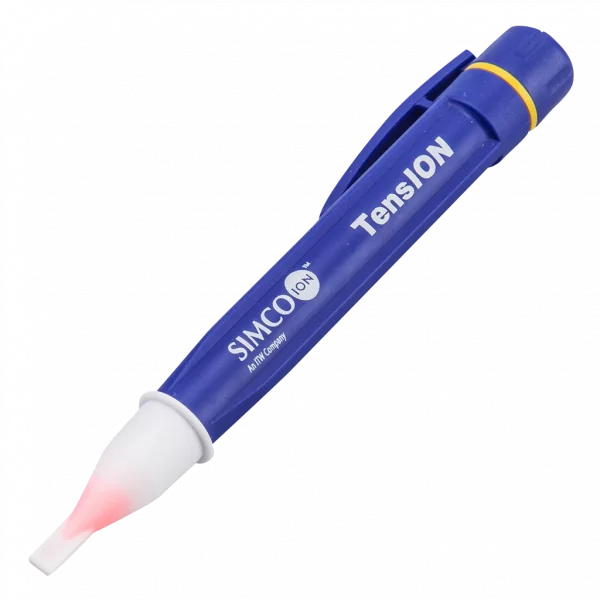
One example is the Static System Checker TensION, designed specifically for testing AC/DC Simco-Ion charging and discharging equipment.
Static Electricity Sensors and Measuring Devices Available Through Minex
Minex acts as a distributor and technical partner, helping industrial companies select the right static electricity measurement technologies for their production environment.
| Product | Typical Industrial Applications | Key Advantages |
| Static Electricity Meter FMX-004 | Electronics manufacturing, precision assembly, automotive production, aerospace manufacturing, maintenance inspections | A portable, battery-powered static electricity meter and electrostatic field meter for spot measurement of static charges up to 30 kV. The instrument detects polarity, provides a clear display, and uses integrated LED guidance to help the operator maintain the correct 25 mm measuring distance. Its lightweight design makes it ideal for engineers who need to measure electrostatic field strength quickly in different machine positions during troubleshooting or setup. |
| Sensor IQ Easy | Printing, plastics converting, packaging production, textile manufacturing, electronics material handling | An in-line sensor system designed for continuous measurement of electrostatic charges across wide moving materials. The system can hold up to 16 individual sensor heads along a bar to monitor charge distribution across the web width. It offers a working distance of 25–60 mm and can measure charges of up to 80 kV. When connected to the Manager IQ Easy, the system supports closed-loop control, allowing ionizers to automatically adjust output based on real-time readings. Measurement data can also be retrieved via Ethernet for remote monitoring and Industry 4.0 integration. |
| Sensor IQ Easy 2.0 Ex | Food packaging with powders, pharmaceutical production, chemical processing, hazardous coating operations, solvent-based manufacturing | An ATEX-certified in-line sensor solution designed for hazardous areas where electrostatic discharge risk must be monitored safely. The system supports up to 8 sensors, providing up to 48 measurement locations on a maximum 6070 mm bar length. It offers a working distance of 10–300 mm and measures charges of up to 50 kV at 100 mm, enabling reliable monitoring in explosion-hazardous environments. Warning functions and Ethernet-based data retrieval via the Manager IQ Easy support stable and connected operation. |
| Static System Checker TensION | Maintenance and troubleshooting across all industrial sectors | A compact contactless checker for rapid test and verification of AC/DC Simco-Ion discharging and charging equipment. It allows technicians to confirm within seconds whether a high-voltage field is present without touching equipment or interrupting production. Ideal for routine inspections before deeper measurement with a static meter or electrostatic field meter. |
When Specialist Support Makes the Difference
A meter provides a reading. What that reading means for your specific process is a different question, and often a harder one.
Complex production lines involve more than a single variable. Materials change, humidity shifts, motion conditions vary across the line, grounding may not be where it is assumed to be, and multiple electrostatic sources can interact in ways that are not immediately obvious. Interpreting measurement data in that context requires experience, not just instruments.
Specialist support is where that experience is applied. An electrostatic consultant can help identify the root cause rather than the symptom, determine the most effective measurement position, verify whether grounding is performing as expected, and ensure the instrument selected will actually improve process performance rather than simply add data. In ESD-sensitive production, hazardous environments, or high-speed wide-web applications, the cost of an incorrectly specified instrument is not just the purchase price. It is the troubleshooting time lost and the corrective action delayed.
Speak with a Static Electricity Control Expert
If you are evaluating a static electricity meter, electrostatic field meter, field meter, or in-line sensor system, Minex specialists can help you identify the most suitable solution for your application.
Their support covers electrostatic risk assessment, instrument selection, grounding and ionisation advice, and guidance on integrating measurement into stable daily operation.
Talk to our experts to discuss your process, compare the available options, and choose a solution that fits your materials, line conditions, and safety requirements.
Frequently Asked Questions
A static electricity meter measures electrostatic field strength on charged surfaces and materials. It helps engineers identify static buildup, assess charge intensity, and verify whether corrective measures are working — across printing, packaging, plastics, electronics, and precision manufacturing.
An electrostatic field meter is a non-contact instrument that detects the electric field around a charged surface, displaying readings in volts or kilovolts. In industrial settings, the terms "static meter" and "field meter" are often used interchangeably.
Measurement reveals where charge is generated, identifies hotspots, and confirms whether ionizers and grounding are effective. Without it, teams risk contamination, misfeeds, operator shocks, ESD damage, and yield loss.
Inline sensors are permanently mounted on the production line to monitor charge on moving materials in real time. Unlike handheld tools, they detect variation continuously — essential in high-speed packaging, film converting, and printing where manual spot checks are insufficient.
Use a portable meter for troubleshooting, setup checks, and flexible spot measurements. Use continuous inline sensors when charge varies constantly during production due to speed, material, or humidity changes.
ATEX-certified sensors are designed for hazardous areas where flammable dusts, vapours, or solvents may create explosive atmospheres — common in food, pharma, chemicals, and coatings. In these zones, ATEX compliance is a mandatory selection criterion, not an optional feature.
Low humidity causes materials to retain charge longer, increasing static buildup. Charge levels can shift even when the process is unchanged, so baseline references may need updating when humidity varies significantly.
Yes. In closed-loop systems, sensors continuously measure charge and automatically adjust ionizer output in response. This delivers more precise neutralisation than fixed settings — critical where product quality or ESD protection is tightly controlled.
Use a contactless static system checker. It confirms in seconds whether ionizers, anti-static bars, or HV generators are active — without touching equipment or stopping production. Ideal for routine maintenance before deeper fault-finding.
In dusty environments like plastics, print, and packaging, debris accumulates around sensors and degrades accuracy. Dust-resistant sensors — especially those with integrated air purge — maintain reliable long-term readings and reduce maintenance downtime.