
Industrial Mobile Pneumatic Vacuum Cleaner
References
How to Select the Right Industrial Mobile Pneumatic Vacuum Cleaner
Industrial vacuum recovery systems are often treated as auxiliary equipment. In reality, they are operational infrastructure. The wrong selection does not simply reduce cleaning efficiency; it can slow production, create safety risks in explosive environments, increase maintenance cycles, and significantly raise material handling costs.
Experienced engineers know that vacuum systems operate as material transport systems, not simple cleaning tools. An industrial pneumatic vacuum cleaner functions as a recovery and transfer system engineered to move dust, debris, powders, liquids, or abrasive media through hoses and separators under varying distances, pressures, and environmental constraints.
Unlike traditional electric motor vacuum cleaner systems, air powered industrial vacuums rely on compressed air as their power source. These pneumatic industrial vacuums contain fewer moving parts, which makes them particularly suitable for hazardous environments where ignition risks must be minimized.
The design therefore needs to match the physical characteristics of the recovered materials, the safety classification of the environment, and the operational logistics of the facility.
This guide translates those engineering considerations into a practical decision framework that technical teams can use when evaluating an industrial vacuum cleaner designed for heavy duty industrial recovery. The goal is straightforward: ensure the equipment integrates smoothly into the operational workflow while meeting safety, performance, and lifecycle cost expectations.
ATEX Safety Requirements When Selecting an Industrial Pneumatic Vacuum Cleaner
Before performance specifications or operational convenience are considered, the explosion safety classification of the environment must be assessed. Many industrial sectors generate combustible dust that can become explosive when suspended in air.
Typical sources include:
- Composite materials
- Chemical powders
- Metal dust
- Biomass particles
- Fine organic powders
If these materials accumulate and are disturbed during cleaning or maintenance operations, they can create explosive atmospheres in hazardous locations.
In such environments, an industrial vacuum system itself can become an ignition source. Static electricity, friction, heat, or a small spark generated by moving particles can trigger ignition if the vacuum equipment is not properly certified.
For this reason, facilities operating under explosive dust conditions require ATEX certified industrial vacuum cleaners or explosion proof compressed air vacuums specifically engineered for hazardous environments.
An example certification commonly encountered in industrial equipment is:
EX II 2GD c IIC 60°C / T6
This classification indicates that the equipment is approved for use in gas and dust explosive atmospheres and that its surface temperature will not exceed levels that could ignite surrounding materials.
For procurement and operational engineers, the practical question is not whether ATEX certification is desirable but whether it is legally required.
If the plant operates within hazardous Class II environments, the vacuum equipment must comply with applicable directives and safety standards.
Selecting a non-certified vacuum cleaner in such an environment can lead to serious safety risks, regulatory violations, and operational shutdowns.
Matching Pneumatic Industrial Vacuums to the Materials Being Recovered
Industrial vacuum cleaners rarely handle a single material type. Facilities often deal with mixtures of powders, granulates, liquids, sludge, and abrasive debris.
Each of these materials behaves differently under vacuum transport conditions.
Fine dust requires advanced filters to prevent environmental contamination and protect the vacuum system itself. Liquids require containment systems that prevent overflow and allow quick discharge. Abrasive materials such as steel shot, metal chips, or shavings can cause severe wear on internal components if the equipment is engineered for abrasive recovery.
This is why the material profile should always be evaluated before selecting an industrial vacuum.
In wet environments, the vacuum cleaner should include features such as:
- Bottom drain valves to empty liquids from the drum or container
- Float ball mechanisms that automatically stop suction when the unit reaches full capacity
These features prevent operational interruptions and eliminate the need for manual monitoring during fluid recovery.
Dry abrasive materials introduce a different challenge. In blasting or heavy manufacturing operations, the vacuum cleaner must handle high volumes of dense debris without clogging or causing excessive wear on internal surfaces.
From an engineering standpoint, pneumatic vacuum systems must be treated as material recovery machines, not simply cleaning devices.
Vacuum Pressure vs Airflow: Performance Factors in Industrial Pneumatic Vacuums
One of the most common selection mistakes occurs when engineers focus only on suction power without considering material transport distance.
Industrial vacuum performance is defined primarily by two parameters:
- Maximum vacuum pressure
- Airflow capacity
Vacuum pressure determines how effectively heavy materials can be lifted and transported. Airflow determines how quickly material moves through the hose system.
In smaller workshops, a moderate industrial vacuum cleaner may be sufficient. However, in sectors such as shipbuilding, power generation, or heavy fabrication, materials often need to be transported over long horizontal distances or vertical elevations.
In these environments, high performance pneumatic vacuums powered by compressed air supply may require pressures approaching 78 kPa (≈ 7800 mmCA) to maintain continuous recovery.
Insufficient vacuum pressure leads to problems such as:
- Dust accumulation inside hoses
- Reduced transport speed
- Frequent interruptions during operation
Selecting the correct vacuum capacity therefore requires evaluating transport distance, elevation changes, and material density.
Filtration Systems, HEPA Standards and Operator Safety
Filtration systems determine how well industrial vacuum cleaners protect both operators and the equipment itself.
Industrial environments generate large quantities of dust and airborne contaminants that can be hazardous if released into the air. Effective filtration ensures that recovered material is properly contained and that exhaust air meets industrial HEPA standards or equivalent filtration requirements.
Traditional filter systems require periodic manual cleaning, which interrupts operation and exposes personnel to hazardous dust.
Modern pneumatic industrial vacuums often incorporate self-cleaning filtration technology, such as NCF filters. These systems automatically clean the filters during operation, allowing the vacuum cleaner to operate continuously.
Mobility and Industrial Site Logistics
Industrial vacuum cleaners are frequently used across large facilities or dynamic work environments such as shipyards, infrastructure projects, and heavy manufacturing plants.
The ability to move the vacuum unit easily can therefore become a critical operational factor.
Engineers should evaluate whether the vacuum cleaner must be moved regularly or lifted using forklifts or cranes.
Mobility features that improve operational efficiency include:
- Large industrial wheels designed for rough environments
- Forklift slots allowing the unit to be transported easily
- Lifting lugs for crane handling
- Large recovery containers capable of handling high material volume
Recovering Valuable Materials with Industrial Vacuum Recovery Systems
In several industries, recovered materials are not waste but valuable process inputs.
Surface preparation and blasting operations are a good example. Steel shot, abrasive grit, and blasting media are often reused multiple times during blasting processes.
Industrial vacuum recovery systems equipped with pre-separators can separate reusable abrasive materials from fine dust before the debris reaches the main vacuum filters.
This enables the system to return clean abrasive material directly back into the blasting process while isolating waste particles.
Durability and Wear Resistance in Heavy Duty Industrial Vacuums
Industrial vacuum cleaners operate in demanding environments where corrosion, abrasion, heat, and mechanical stress are common.
Construction materials therefore play a critical role in determining the lifespan of the equipment.
Standard industrial environments may allow carbon steel components. More aggressive environments—such as marine or chemical facilities—require corrosion-resistant construction materials.
Selecting a vacuum system designed and engineered for these environments reduces maintenance requirements and ensures reliable long-term operation.
Industrial Mobile Pneumatic Vacuum Cleaners Available Through Minex
Minex Group acts as a distributor of industrial vacuum recovery solutions designed for demanding industrial environments. These pneumatic industrial vacuum cleaner models are engineered by their manufacturers to perform reliably in hazardous and heavy-duty applications.
The systems available through the Minex portfolio cover a wide range of industrial cleaning and material recovery requirements.
| Product Model | Best Use Cases & Target Sectors | Key Benefits & Technical Features |
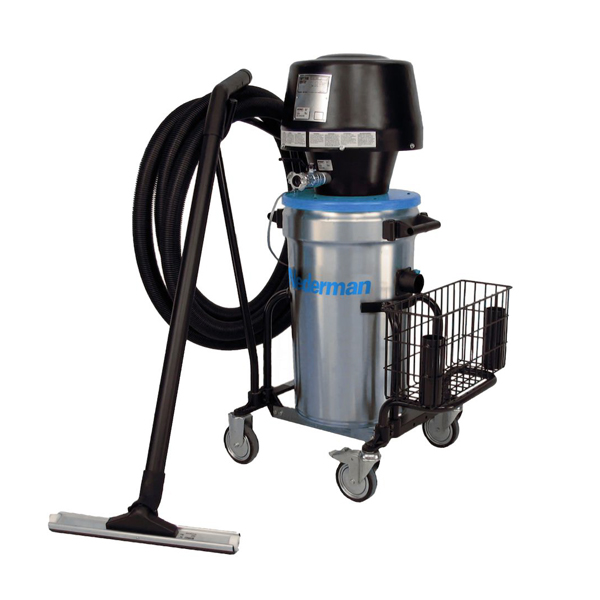
| Nederman 105 A EX | Manufacturing facilities, composite processing, chemical plants and hazardous locations where combustible dust is present | ATEX-certified pneumatic vacuum cleaner designed for explosive environments. Maximum vacuum: 21 kPa. Maximum airflow: 306 Nm³/h. Weight: 67 kg. Equipped with lightweight suction accessories and PEC antistatic hose designed for temperatures from –40°C to +60°C and safe static dissipation. Disposable dust bag allows safe containment of hazardous dust. |
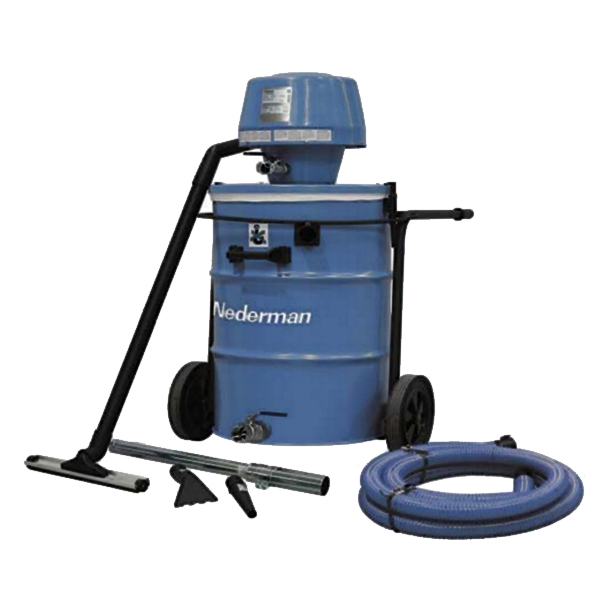
| Nederman 500A | Construction sites, infrastructure maintenance, manufacturing plants requiring wet and dry recovery | ATEX-approved industrial vacuum cleaner designed for liquids and debris recovery. Maximum vacuum: 5200 mmCA (≈52 kPa). Maximum airflow: 342 Nm³/h. Compressed air consumption: 3 Nm³/min at 7 bar. Container capacity: 213 liters. Stainless steel AISI 304 construction with bottom drain valve for fast liquid discharge and float ball protection preventing overfilling. |
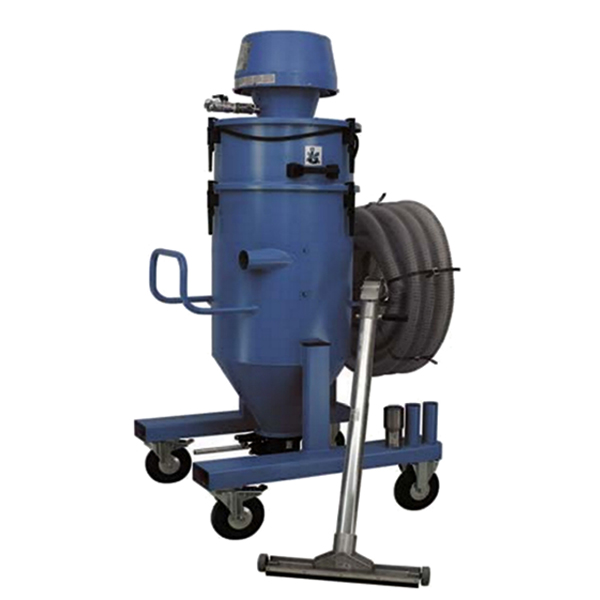
| Nederman 570A | Power plants, steel processing facilities, and heavy manufacturing operations requiring recovery of granulates, sand, and steel grit | High-performance pneumatic industrial vacuum cleaner engineered for heavy-duty material recovery. Maximum vacuum: 6800 mmCA (≈68 kPa). Maximum airflow: 330 Nm³/h. Compressed air consumption: 4.3 Nm³/min at 7 bar. Container capacity: 146 liters. Silo-based design with forklift slots and automatic self-cleaning NCF filtration allowing continuous operation. |
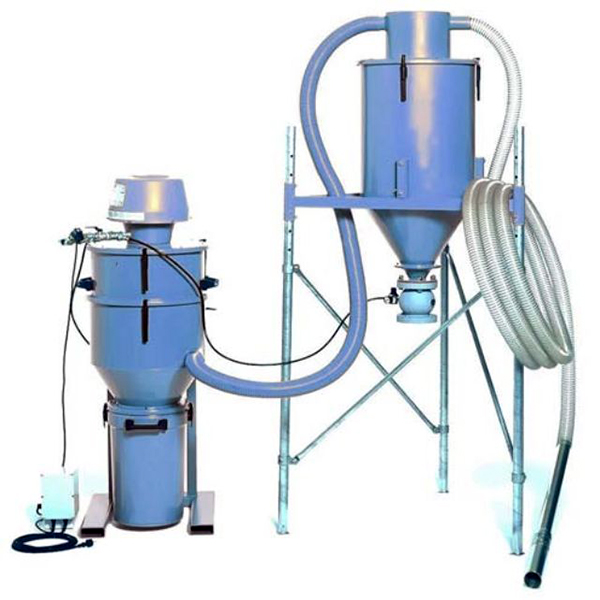
| Nederman 710A | Shipyards, offshore platforms and surface preparation operations requiring blasting media recovery | Heavy-duty pneumatic vacuum system engineered for abrasive media separation and recovery. Maximum vacuum: 7800 mmCA (≈78 kPa). Maximum airflow: 318 Nm³/h. Compressed air consumption: 5.3 Nm³/min at 7 bar. Dual storage system: 67 + 220 liters. Integrated pre-separator separates reusable steel shot from fine dust and returns blasting media to the blasting process. |
Speak with a Minex Industrial Vacuum Specialist
Selecting the correct industrial pneumatic vacuum cleaner requires evaluating the operating environment, material characteristics, transport distances, and safety classifications.
If you need help determining the right system for your application, the Minex team can assist with technical evaluation and system selection.
Contact Minex experts to discuss your industrial vacuum recovery requirements.
Frequently Asked Questions
If your operational area is classified as a hazardous location (ATEX Zone 20, 21, or 22) due to the presence of combustible dust or flammable gases, using ATEX-certified industrial vacuum cleaners becomes a regulatory requirement rather than a recommendation.
These environments present an increased ignition risk, because suspended dust particles can form explosive atmospheres when mixed with air. If a vacuum cleaner generates a spark, static discharge, or excessive heat, ignition may occur.
For this reason, facilities operating in hazardous environments must use ATEX-certified or explosion-proof pneumatic vacuums designed to prevent ignition sources. These systems incorporate conductive components, grounded hoses, and temperature-controlled construction to safely operate in explosive atmospheres.
Using non-certified equipment in such environments can lead to regulatory violations and significant safety hazards.
Many materials commonly handled in industrial environments can become combustible when reduced to fine particles. This includes substances such as:
- Organic materials (flour, sugar, wood dust)
- Certain metals (aluminum, magnesium)
- Chemical powders and synthetic polymers
Industry standards such as NFPA 652 require facilities to perform a Dust Hazard Analysis (DHA) to determine whether the dust produced during operations can form an explosive atmosphere.
During this analysis, the material is typically tested to determine its Kst value, which indicates the explosibility of the dust cloud.
If the material is determined to be combustible, equipment used for cleaning and recovery—including industrial vacuum systems—must be designed to safely operate in hazardous environments.
Industrial vacuum performance depends primarily on two parameters: vacuum pressure and airflow.
Vacuum pressure (measured in kPa or mmCA) represents the lifting force generated by the vacuum system. Higher vacuum pressure is required when recovering heavy materials such as steel shot, wet sludge, or metal debris, especially when vertical lifting is required.
Airflow (measured in m³/h or CFM) represents the volume of air moving through the system and determines how quickly material travels through the hose network.
High airflow is typically required when moving large volumes of lighter materials such as powders or dust over long horizontal distances.
Effective industrial vacuum systems balance these two parameters depending on the specific recovery application.
Pneumatic industrial vacuums, also called compressed air vacuums, operate using an external compressed air supply rather than an electric motor.
This design offers several advantages in industrial environments.
Because pneumatic vacuums do not contain electric motors or electrical switching components, they are inherently safer in hazardous locations where combustible dust may be present.
They also contain fewer moving parts, which reduces mechanical wear and makes the equipment highly reliable for continuous operation.
In heavy industrial applications—such as abrasive material recovery, blasting operations, or steel processing—air powered industrial vacuums can often deliver more consistent performance while requiring minimal maintenance.
Yes, but only if the system is specifically designed as a wet and dry industrial vacuum cleaner.
Wet/dry vacuum systems include several safety features that prevent liquids from damaging the vacuum filters or internal components.
These features typically include:
- A float ball valve that automatically stops suction when the container becomes full of liquids
- A bottom drain valve that allows operators to easily empty collected liquids or sludge
Using a dry-only vacuum cleaner for liquid recovery can cause immediate filter clogging and damage the system.
Facilities that regularly handle both liquids and solid debris should therefore ensure that their vacuum unit is engineered for wet/dry recovery applications.
In industrial environments with heavy dust loads, filters should be inspected regularly, often as part of routine daily maintenance.
Manual filter systems may require replacement approximately every six to twelve months, depending on usage intensity and the characteristics of the collected material.
Industrial vacuum systems equipped with automatic self-cleaning filters, such as NCF filtration technology, significantly extend filter life by preventing dust accumulation on the filter surface.
This allows the vacuum cleaner to maintain consistent suction performance and reduces maintenance interruptions during operation.
Vacuum performance decreases as hose length increases because of friction losses within the hose.
Most standard industrial vacuum systems perform optimally with hose lengths of approximately 10 to 15 meters.
When hose runs exceed 30 meters, higher vacuum pressure becomes necessary to maintain effective material transport.
For long-distance recovery applications, engineers typically select high-vacuum pneumatic systems capable of producing 70 kPa or more to overcome pressure losses and maintain consistent performance.
A pre-separator is installed upstream of the main vacuum filters and captures most of the recovered material before it reaches the filtration system.
In many industrial recovery systems, the pre-separator can remove up to 90% of the recovered debris before it enters the primary vacuum chamber.
This provides several benefits:
- Reduced filter clogging
- Extended filter lifespan
- Higher continuous suction performance
- Efficient separation of reusable materials
In blasting operations, for example, pre-separators allow the recovery and reuse of steel shot or abrasive media while isolating fine dust particles.
Static electricity can accumulate when dust or particles move at high velocity through hoses and vacuum pipes.
If this electrical charge is not safely dissipated, it may produce a spark, which can act as an ignition source in environments containing combustible dust.
For this reason, the entire vacuum system must be properly grounded and bonded.
This includes:
- Antistatic or conductive hoses
- Grounding clips and conductive connectors
- Conductive wheels or chassis components
Even equipment designed for explosive environments becomes unsafe if the vacuum path is not electrically conductive.
Proper grounding is therefore a critical safety requirement in industrial vacuum systems.
Standard industrial vacuum cleaners are typically designed to recover materials with temperatures up to approximately 60°C, which corresponds to the operating limits of certain antistatic hose materials such as the PEC hose used with the Nederman 105 A EX .
However, heavy-duty polyurethane hose systems (PU12) used in larger vacuum systems such as the Nederman 570A and 710A can handle abrasive materials at temperatures up to approximately 90°C.
This capability is particularly valuable in industrial environments such as blasting operations, steel processing facilities, and heavy manufacturing plants where recovered materials may retain elevated temperatures after processing.