Portable Fans
References
How to Select the Right Portable Fan for Industrial Ventilation: A Technical Decision Guide
Portable ventilation equipment sits at the intersection of operational efficiency, worker health, and regulatory compliance. Get the selection right, and the fan disappears into the background — the air clears, the work continues, and no one thinks about it. Get it wrong, and the consequences range from measurable underperformance to a reportable safety incident. This guide is written for engineers, procurement specialists, and operational managers who need to make that selection with confidence, not guesswork.
Industrial facilities across manufacturing, shipbuilding, surface treatment, and chemical processing share a common challenge: maintaining adequate indoor air quality while managing hazardous fumes, combustible dust, and airborne contaminants generated by their processes. The wrong ventilation system — or a fan sized and specified without accounting for real operating conditions — leaves workers exposed to substances that exceed regulatory thresholds and compromises the safety of the entire work environment.
The market is full of portable fans. Choosing between them based on published airflow figures alone is a shortcut that routinely produces the wrong answer. What follows is a structured walk through every variable that actually matters in a real industrial deployment — what each one means, how to read it, and where it should take you in a specification process.
Airflow Capacity and Total Pressure: Why Nameplate Figures Tell Only Half the Story
Airflow capacity, expressed in m³/h, tells you the volume of air a fan can move per hour under ideal conditions — typically measured in free air, with no duct resistance. Total pressure, expressed in Pascal (Pa), tells you how much force the fan can exert to move that air through a real installation: through hoses, bends, connectors, and filters. Both figures matter. Neither is sufficient without the other.
In practice, the operating point of any fan is not its free-air maximum — it is the intersection of the fan's performance curve with your system resistance curve. A fan rated at 1,500 m³/h will deliver noticeably less at the end of a 20-metre flexible hose with two 90° bends and a nozzle attachment. If you are sizing for fume extraction at a welding station or fresh air supply in confined spaces during maintenance, a unit delivering 500 to 1,500 m³/h at the work face is typically sufficient to clear welding fumes, vapours, and particulate matter, and the system resistance is manageable with a standard 160 mm hose connection.
The picture changes entirely when you are ventilating the internal compartments of a ship hull, a large blast enclosure, or a holding tank during construction. These applications require both massive airflow — up to 20,000 m³/h — and high total pressure, in the range of 3,250 Pa, to maintain effective draw through a network of large-diameter hoses connected simultaneously. A fan that performs adequately in a workshop will be completely ineffective in this context. The physics simply do not scale the same way.
The practical takeaway: always request the full performance curve from your equipment supplier and plot your estimated system resistance against it before finalising a specification. Do not rely on a single nameplate figure. Inadequate airflow in a confined space or enclosed building section is not just an efficiency problem — it is a direct health and safety exposure risk for every worker in that area.
Site Power Compatibility: The Variable That Kills Projects Before They Start
Electrical incompatibility is one of the most avoidable causes of deployment failure, yet it is consistently underestimated during procurement. Portable fans span a significant range of electrical requirements, and specifying a unit that your site cannot power is an expensive mistake to discover on commissioning day.
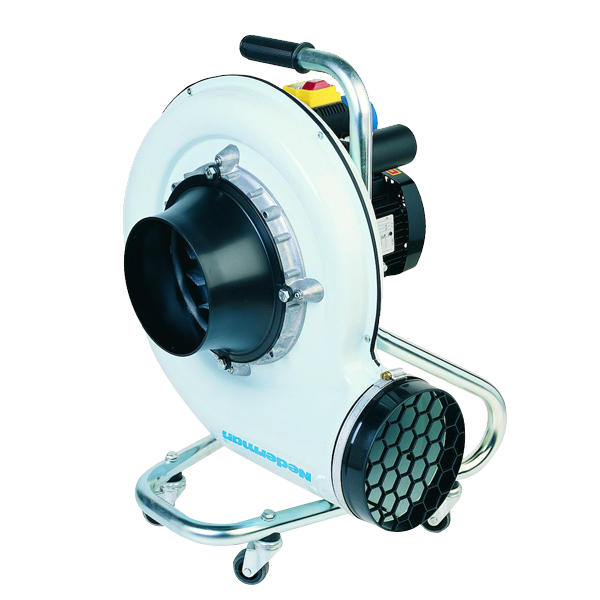
The N16 covers single-phase supply across multiple voltage and frequency configurations: 220/240V at 50 Hz for standard European infrastructure, 110/120V at 50 Hz for lower-voltage site supplies, and a 220–240V 60 Hz configuration for sites operating on higher-frequency supply, including certain maritime and export markets. These units require no special infrastructure; a standard CEE socket and a properly rated extension cable are sufficient.
The N24 offers considerably more flexibility across both single-phase and three-phase supply, and across both 50 Hz and 60 Hz infrastructure. On single-phase, the N24 is available at 220/240V (50 Hz), 110/120V, 115/230V (50 Hz), 115–230V (60 Hz), and 230/460V (60 Hz, 0.75 kW) — the last three variants being particularly relevant for maritime, offshore, and North American grid applications where supply conditions vary significantly. On three-phase, the 50 Hz variants cover 200V and 220–240/380–420V configurations, while the 60 Hz variants cover 440–480V, 230/460V (equipped with the 1.1 kW motor), and 220/380V (equipped with the 0.9 kW motor). This breadth of electrical options makes the N24 a genuinely versatile unit across diverse site conditions — whether you are operating a fixed manufacturing facility on a stable European grid or a mobile fume extraction operation on a vessel running 60 Hz supply — but it also means that confirming the exact electrical configuration required before ordering is essential, as the motor specification and rated current vary accordingly across configurations.
Heavy-duty units are a different proposition entirely. A fan equipped with a 30 kW motor requires a 400V, three-phase supply and, depending on the installation, a frequency controller for managed motor starts and a PLC cabinet for operational control. If your site does not already have this infrastructure, it needs to be budgeted and planned as part of the project scope — not treated as an afterthought. On temporary sites powered by generators, you also need to verify generator output stability against motor inrush current at start-up, which can run at five to seven times the rated running current for a fraction of a second. An undersized or poorly regulated generator will trip under that load.
The discipline here is simple: confirm your available power supply before you confirm your equipment shortlist, not after.
Portability and Handling Requirements: Matching the Equipment to the Operational Reality
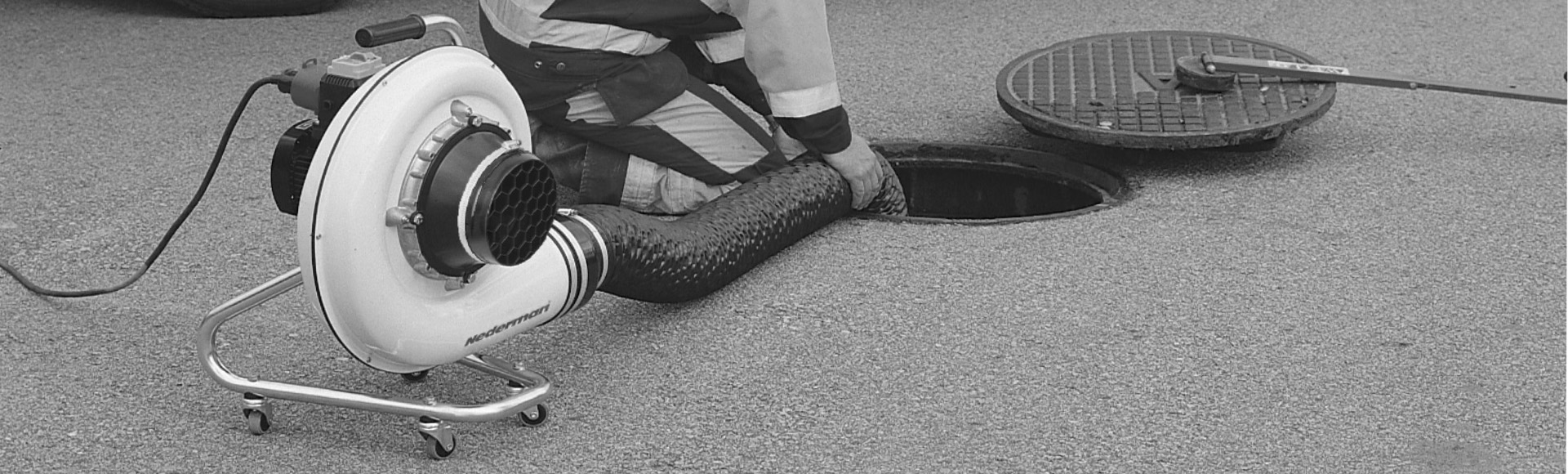
The word "portable" covers a surprisingly wide range of physical realities in industrial ventilation. A 15 kg centrifugal fan with a built-in stand that one person can carry to a new position in under a minute is operationally portable in every meaningful sense. A 2,200 kg unit in a steel frame that requires a forklift or crane to move is portable only in the sense that it is not bolted to a foundation — it is, for all practical purposes, a semi-permanent installation for the duration of a project.
Mobility decisions have a direct impact on how efficiently your fume extraction or air circulation operation runs across a facility. For applications involving frequent repositioning — moving from one workstation to another during a shift, responding to changing work locations across a repair yard, or covering multiple confined spaces during a maintenance shutdown — you need a unit that a single operator can set up and move without additional resources. A built-in stand and an optional wheel set are not minor conveniences; they are operational requirements. In these scenarios, mobile fume extraction capability is as important as the fan's raw extraction performance.
For major structural projects — ventilating a ship during a multi-month construction programme, for example — the calculation reverses. Deployment frequency is low, the operating location is fixed for extended periods, and what matters is extraction performance rather than mobility. In that context, crane or forklift handling is a non-issue, and the engineering priority shifts entirely to airflow capacity, hose network design, and filter protection.
Define your repositioning frequency and your available handling resources before you look at a single spec sheet.
Explosion Risk Classification: The Non-Negotiable Safety Dimension
This is the selection factor where the consequences of error are not operational — they are potentially fatal, and it is the one area where a misreading of the available equipment can place engineers, procurement managers, and the facilities they specify for in serious legal and physical danger.
The starting point is an absolute: the Nederman N16 and N24 portable fans are explicitly not certified for use in environments with a danger of explosion, and must not be used to extract inflammable or explosive gases or combustible dust. This is not a performance limitation — it is a hard safety boundary defined in the manufacturer's technical documentation. No downstream protective device changes this. Installing a CARZ explosion isolation valve in a duct run does not make a standard portable fan safe for combustible dust extraction. The fan itself must be an ATEX certified fan for the application.
The environments that trigger this requirement are broader than many operational teams assume. Woodworking and furniture manufacturing generate organic dust that is highly combustible at certain concentrations. Food processing and flour milling, cement handling, chemical powder production — all of these involve dust types and hazardous substances that can form explosive atmospheres under the right conditions. The European ATEX directive and the American NFPA68 standard both exist specifically because dust explosions in fume extraction systems are a documented, recurring cause of industrial fatalities.
Where combustible or organic dust is present in the extraction stream, two requirements apply simultaneously and cannot substitute for one another. First, the extraction unit itself must be ATEX-certified for the relevant zone classification — a standard portable fan does not meet this requirement and must not be used in this role. Second, a certified explosion isolation valve must be installed in the duct run to prevent pressure waves and flame fronts from propagating back through the ducting into the occupied workspace in the event of a deflagration. The CARZ fulfils this second requirement, but only as part of a compliant system that already begins with an appropriately certified extraction unit.
ATEX and NFPA68 compliance is therefore a system-level requirement in two distinct respects: the fan must be certified for the explosive atmosphere, and the duct circuit must incorporate certified isolation. Neither condition alone is sufficient. The entire ventilation system — extraction unit, ducting, isolation device, and any downstream collection equipment — must be assessed and specified together by a competent person with the relevant ATEX zone classification for your site already established.
If combustible dust is present in your process, the first question is not which fan to select — it is whether the fan being considered carries the correct ATEX certification for your zone. That question must be answered before any other selection criterion is considered, and it falls outside the scope of the standard N16/N24 portfolio covered in this guide.
Operating Temperature Limits: Where Standard Equipment Reaches Its Boundary
Standard portable industrial fans — typically constructed with die-cast aluminium impellers and galvanised steel casings — are engineered for ambient temperatures between -20°C and +40°C and a maximum extracted airstream temperature of 60°C. Within these limits, the equipment performs as specified. Outside them, you are accelerating bearing wear, risking seal failure, and creating conditions that can lead to motor damage — none of which will be covered under warranty.
For the majority of applications in metalworking, shipbuilding, blasting, surface treatment, and general manufacturing, these temperature limits are rarely approached. Welding generates localised heat at the arc, but the extracted airstream quickly cools in the ducting, and ambient workshop temperatures are unlikely to exceed the design envelope. The ventilation system, in these contexts, operates well within its rated range on a regular basis.
The boundary cases are high-temperature process environments: air extraction adjacent to furnaces, downstream of high-temperature treatment processes, or in foundry environments where radiant heat loads are significant. In these situations, standard portable fans are outside their design intent, and specialist high-temperature equipment must be specified. It is worth confirming this early in the design process — the assumption that any industrial fan will tolerate extreme conditions and elevated temperatures is incorrect and can result in accelerated equipment failure.
Noise Emissions and Occupational Health Compliance
Ventilation equipment noise is a background contribution to cumulative workplace sound exposure — and regulatory frameworks treat cumulative exposure, not individual sources. Under EU Directive 2003/10/EC, the lower exposure action value is 80 dB(A), and the exposure limit value is 87 dB(A) for an eight-hour reference period. The fan is rarely the only source on a busy industrial site, which means its acoustic contribution adds to everything else the operator is already exposed to. Regulations in this area exist to protect workers from long-term occupational health damage, and compliance must be maintained on a regular basis as part of your site safety programme.
Within the N-series, acoustic output differs slightly between models: the N16 operates at 62 dB(A) measured at 1,000 m³/h, while the N24 operates at 61 dB(A) measured at 1,200 m³/h. Both figures are well within levels that can be used in close proximity to operators without triggering additional hearing protection requirements attributable to the fan itself. For applications where even this level of noise is a concern — precision work environments or situations requiring close verbal communication — an exhaust silencer accessory is available for the N-series and can reduce acoustic output further without compromising extraction performance or overall system efficiency.
Heavy-duty industrial fans operating at 83 dB(A) sit at the lower action value on their own — and in combination with other site noise sources, they will routinely push total exposure above it. Hearing protection protocols must be in place, documented, and enforced for workers in the vicinity.
This is not a reason to avoid selecting a high-capacity unit when the application requires it. It is a reason to incorporate the noise contribution into your site risk assessment at the specification stage rather than discovering the compliance gap after installation.
Filtration, Hose Configuration, and System Integration
A portable fan does not operate in isolation — it operates as part of a ventilation system that includes ducting, connectors, nozzles, and in some cases pre-filtration to capture airborne contaminants, particles, and hazardous dust before they can affect the broader work environment or damage the equipment itself. The compatibility between the fan and its ancillary components determines whether the system performs as intended or creates new problems.
Hose diameter and connection type are the most immediate practical consideration. The N16 and N24 fans are built around a 160 mm inlet/outlet connection and work with a well-established range of accessories available directly through the Nederman product range. These include flexible hoses with magnetic nozzles for directed fume extraction at the source — particularly useful in welding fume extractors configurations where the capture point must be positioned close to the arc — 160 mm to 100 mm reducers for tighter access configurations, honeycomb intake guards to protect the impeller from inadvertent contact or coarse debris, and exhaust silencers for noise-sensitive environments. For electrical control on site, fan manual starters and contactors are available, providing a safe and compliant means of starting and stopping the unit without relying solely on the onboard switch — particularly relevant for extended maintenance tasks or installations where the fan is not within immediate operator reach. Support brackets for fixed wall or structure mounting are also available, allowing the N-series to be temporarily secured in position during longer-duration work rather than relying on the stand alone. A dedicated hose and nozzle kit and an optional wheel set for enhanced mobility round out the standard accessory range. All of these components should be confirmed at the specification stage, not sourced reactively once the fan is already on site.
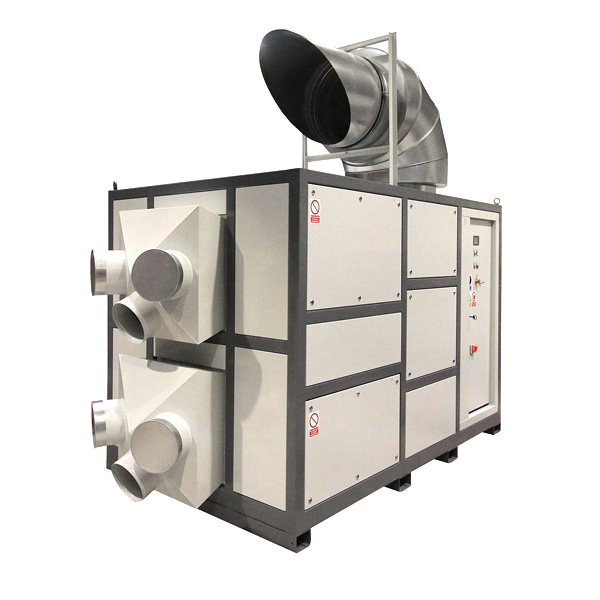
Heavy-duty units designed for large-bore hose networks — with multiple D300 mm connections running simultaneously — require correspondingly large-diameter flexible ducting and appropriate connection hardware. The VE30 MNX accommodates up to six D300 mm hoses simultaneously across its two connector ports, and connection lids are provided to seal unused ports cleanly when fewer hoses are in use.
In abrasive environments, the fan's own protection matters as much as its extraction performance. When extracting heavily particulate-laden air from blasting enclosures or ship compartments during surface treatment, unprotected impellers and motor housings will be damaged by the abrasive load in the airstream. Metal pre-filters — classified G2 and G4 — fitted at the fan inlet intercept coarse particles and hazardous dust before they reach the impeller, extending equipment life significantly in these conditions. The VE30 MNX is supplied with these filters as standard, making it an essential part of a complete fume extraction system for high-contamination industrial operations in shipyards and large-scale surface treatment facilities.
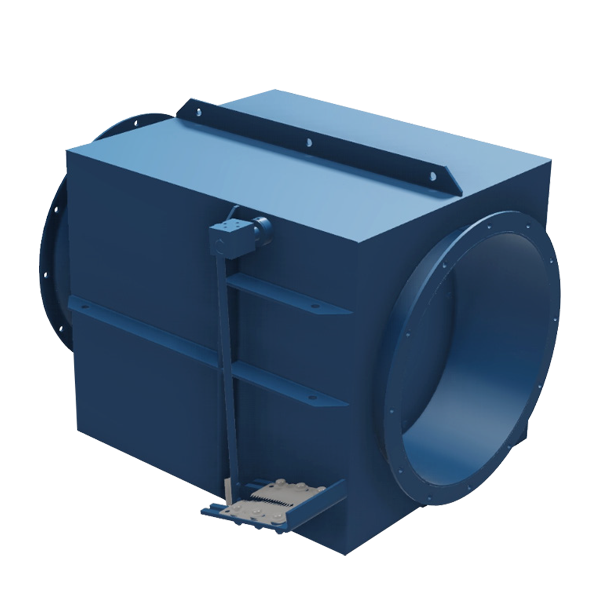
For CARZ explosion isolation installations, duct diameter determines valve sizing, but it is not the only design constraint that must be verified. Standard CARZ flap valves are available from Ø160 mm up to Ø400 mm, covering the majority of industrial extraction duct configurations. For larger structural integrations involving ducting above Ø400 mm and up to Ø1000 mm, Nederman manufactures dedicated suspended and wall-hanging support frames designed to accommodate heavy-duty CARZ mounting. Mechanical engineers designing the duct network must also verify that the extraction system does not exceed the CARZ's maximum flow velocity of 30 m/s. If duct velocity exceeds this limit, the flap valve may not actuate correctly under explosion conditions, or may generate excessive pressure drop during normal operation — either of which would compromise the safety certification of the entire circuit. This aerodynamic constraint should be confirmed at the duct design stage, before equipment is ordered. If your installation involves large-diameter main duct runs — common in centralised fume extraction systems serving multiple workstations simultaneously — both the velocity limit and the extended size range should be confirmed during the system design phase.
The broader principle remains: accessories, pre-filtration, and ancillary hardware are part of the system specification and should be confirmed alongside the primary equipment selection, not sourced as an afterthought once the fan is already on site.
Minex Group Portable Fan Portfolio
The table below covers all three products distributed by Minex Group in the portable fan category. Use it as a decision-support reference once your application parameters have been defined against the selection criteria above.
| Nederman N16-N24 Portable Industrial Fans | Exhaust Fan VE30 MNX | Nederman CARZ — Protective System / Explosion Isolation Flap Valve | |
| Equipment Type | Compact centrifugal portable fan | Heavy-duty industrial exhaust fan | Explosion isolation protective system — inline duct device |
| Airflow Capacity | N16: 500–1,200 m³/h / N24: 500–1,500 m³/h | 20,000 m³/h | N/A — protective device, not a fan |
| Total Pressure | Standard operating range | 3,250 Pa | N/A |
| Motor Power | N16: 0.55 kW (single-phase) / N24: 0.75 kW (single-phase, including 230/460V 60 Hz variant); 0.9 kW (3-phase 50 Hz variants, 440–480V 60 Hz variant, and 220/380V 60 Hz variant); 1.1 kW (3-phase 230/460V 60 Hz variant) | 30 kW (1,475 rpm) | N/A |
| Power Supply | N16: Single-phase — 220/240V (50 Hz), 110/120V (50 Hz), or 220–240V (60 Hz) / N24 Single-phase: 220/240V (50 Hz), 110/120V, 115/230V (50 Hz), 115–230V (60 Hz), or 230/460V (60 Hz, 0.75 kW) / N24 3-phase 50 Hz: 200V or 220–240/380–420V / N24 3-phase 60 Hz: 440–480V (0.9 kW), 230/460V (1.1 kW), or 220/380V (0.9 kW) | 400V, 50 Hz, 3-phase | N/A |
| Engine Start / Controls | On/off switch with motor protection included | Altivar frequency controller + PLC cabinet (Logo V8 / TDE V8) | N/A |
| Noise Level | N16: 62 dB(A) at 1,000 m³/h / N24: 61 dB(A) at 1,200 m³/h; exhaust silencer accessory available for both models | 83 dB(A) | N/A |
| Weight | N16: 15 kg / N24: 17 kg | Approx. 2,200 kg | N/A |
| Dimensions | Compact — stand included | 3.2 × 2.0 × 2.3 m | Standard: Ø160 mm to Ø400 mm; heavy-duty mounting frames available up to Ø1000 mm |
| Handling & Mobility | Built-in stand; optional wheel set; single-person deployment | Fully encased in protective frame; forklift or crane handling | Horizontal inline installation in existing duct run; suspended and wall-hanging support frames available |
| Hose Connection | 160 mm inlet/outlet | 2 × connectors, each with 3 × D300 mm ports (up to 6 × D300 hoses simultaneously); unused ports fitted with lids | Push or pull flow configuration |
| Available Accessories | Hose and nozzle kit; magnetic nozzles; 160–100 mm reducers; honeycomb intake guards; exhaust silencer; fan manual starters / contactors; support brackets for wall or structure mounting; optional wheel set | Rain cap (included); G2 and G4 metal pre-filters (included); vibration dampers; flexible connection | Suspended and wall-hanging support frames for large-diameter duct integration (up to Ø1000 mm) |
| Filtration / Protection | Compatible with standard hose and nozzle kit accessories; honeycomb intake guard available | G2 and G4 metal pre-filters supplied as standard; rain cap for outdoor operation; vibration dampers and flexible connection included | Independently tested; ATEX and NFPA68 certified for organic dust; large opening angle for minimal pressure drop during normal operation; auto-closes and locks on explosion event; no power required to close; max flow velocity: 30 m/s; max reduced explosion pressure (Pred): 0.45 bar |
| Operating Temperature | Ambient: -20°C to +40°C; max airstream: 60°C | Ambient: -20°C to +40°C; max airstream: 60°C | Operating range: -20°C to +70°C; ambient: -20°C to +60°C (applies uniformly across all sizes, Ø160 mm to Ø400 mm) |
| Operation Mode | Extraction of welding smoke, vapours, and dust; or fresh air supply | Fixed frequency or constant pressure operation | Passive automatic actuation — no power required to close |
| Primary Applications | Extraction of welding fumes, vapours, and hazardous dust at the point of use; fresh air supply in enclosed or confined spaces; temporary ventilation for service and repair tasks across a range of manufacturing and industrial operations | Extraction of heavily polluted air from ship hull interiors during construction and repair; large blast enclosures and surface treatment structures requiring high-volume air clearance | Combustible and organic dust extraction systems in woodworking, food processing, cement, and chemical industries — must be integrated as part of a complete explosion protection system alongside an ATEX certified fan and extraction unit |
| Best Sectors | Metalworking, Welding, Vehicle Repair, General Manufacturing | Shipbuilding, Blasting & Surface Treatment | Woodworking, Food Industry, Cement, Chemical Industry |
| Key Differentiator | Lightweight, low-noise, fast single-person setup — the right balance of mobility and performance for point-of-use fume extraction and confined space ventilation applications; N24 available in an extensive range of single-phase and 3-phase configurations across both 50 Hz and 60 Hz infrastructure, including dedicated 115/230V 50 Hz, 115–230V 60 Hz, and 230/460V 60 Hz single-phase variants for maritime, offshore, and North American grid applications | The only unit in this portfolio capable of ventilating large enclosed industrial structures and building sections; engineered specifically for the airflow demands of shipyard operations and large-scale surface treatment facilities | A certified explosion isolation valve — not a standalone solution, but a mandatory component of a compliant fume extraction system that must also include an ATEX certified fan and extraction unit; duct design must verify flow velocity does not exceed 30 m/s; scalable from standard duct sizes up to Ø1000 mm with heavy-duty mounting hardware. |
Not Sure Which Configuration Fits Your Site? Talk to a Minex Technical Adviser.
Portable fan selection is straightforward when the application is straightforward. It becomes significantly more complex when you are dealing with non-standard duct layouts, mixed contamination streams, ATEX zone classification requirements, or sites where power infrastructure is constrained. In these situations, working through the specification with someone who has seen the same application before — and knows where the common failure points are — produces a better outcome faster than iterating through spec sheets alone.
The Minex technical team works across shipbuilding, metalworking, surface treatment, food processing, and chemical industries and can help you translate your operational parameters into the right equipment configuration — including system-level guidance on explosion protection compliance, fume extraction system design, and indoor air quality regulations where they apply.
Every installation has its own set of constraints. If you'd like a second pair of eyes on your configuration before you commit, we're happy to work through it with you. The more you can share about your application — space dimensions, process description, contamination type, available site power — the faster we can get to a useful answer.
Frequently Asked Questions
Airflow capacity (m³/h) measures the volume of air a fan can move per hour, while total pressure (Pa) measures the force available to push or pull that air through a real duct system against resistance. Both figures must be evaluated together. A fan with high airflow capacity but insufficient total pressure will underperform the moment you attach a hose network — the resistance of bends, connectors, and ducting length will reduce actual delivery at the work face significantly below the nameplate figure. Always request the full performance curve and plot your system resistance against it before specifying.
The threshold is primarily determined by the volume and geometry of the space being ventilated. Portable compact fans delivering 500–1,500 m³/h are adequate for point-of-use fume extraction at welding stations, vehicle repair bays, and general confined space applications. When the task involves ventilating large enclosed structures — ship hull interiors, major blast enclosures, or large tanks during construction or repair — you need airflows up to 20,000 m³/h with total pressures in the range of 3,250 Pa to maintain effective draw through a multi-hose network. No compact portable fan can substitute for that performance envelope.
Yes — and the reverse is equally true. Both an ATEX certified fan and extraction unit and a certified explosion isolation valve are required simultaneously; neither substitutes for the other. An ATEX certified fan without a certified isolation valve leaves the duct circuit unprotected against flame front propagation. A CARZ isolation valve installed downstream of a standard, non-ATEX fan does not make that fan safe for combustible dust extraction — the N16 and N24 portable fans are explicitly not certified for explosive atmospheres and must not be used in this role under any circumstances. ATEX and NFPA68 compliance is a system-level requirement: the extraction unit, the ducting, and the isolation device must all be assessed and specified together as a complete, compliant circuit.
The risk is broader than most teams assume. Woodworking and furniture manufacturing, food processing and flour milling, cement handling, and chemical powder production all involve dust types and hazardous substances that can form explosive atmospheres at certain concentrations in a duct. Organic dusts in particular — wood, flour, sugar, certain chemical powders — are classified as combustible under both ATEX and NFPA standards. If your fume extraction system handles any of these materials, both an ATEX certified fan and explosion isolation must be part of the ventilation design, regardless of the fan type or size.
Heavy-duty industrial fans with motors in the 30 kW range require a 400V, 50 Hz, three-phase supply. They also typically require a frequency controller for managed motor starts — to handle the inrush current at start-up, which can reach five to seven times the rated running current — and a PLC cabinet for operational control. If this infrastructure is not already present on site, it needs to be planned and budgeted as part of the project scope. On generator-powered temporary sites, generator output stability under motor start-up load must also be verified before commissioning.
The deciding factor is repositioning frequency. If the fan needs to move multiple times during a shift, or be deployed and recovered quickly by a single operator across different locations — including multiple confined spaces or workstations within a facility — a compact unit in the 15–17 kg range with a built-in stand and optional wheel set is the only operationally realistic choice. If the application involves a fixed location for the duration of a major project — such as continuous ventilation of a vessel under construction — then crane or forklift handling is a non-issue, and the selection priority shifts entirely to extraction performance. Define your repositioning requirements before you look at equipment specifications.
Within the N-series, the N16 operates at 62 dB(A) at 1,000 m³/h and the N24 at 61 dB(A) at 1,200 m³/h — both well below the lower exposure action value and unlikely to independently trigger hearing protection requirements in most environments. For particularly noise-sensitive applications, an exhaust silencer accessory is available for both models. Heavy-duty industrial fans operate at approximately 83 dB(A) — at or near the lower exposure action value of 80 dB(A) set by EU Directive 2003/10/EC — and will routinely push total exposure above the action threshold when combined with other site noise sources, making hearing protection mandatory for nearby workers. The fan's acoustic contribution should be factored into the site noise risk assessment at the specification stage, not after installation.