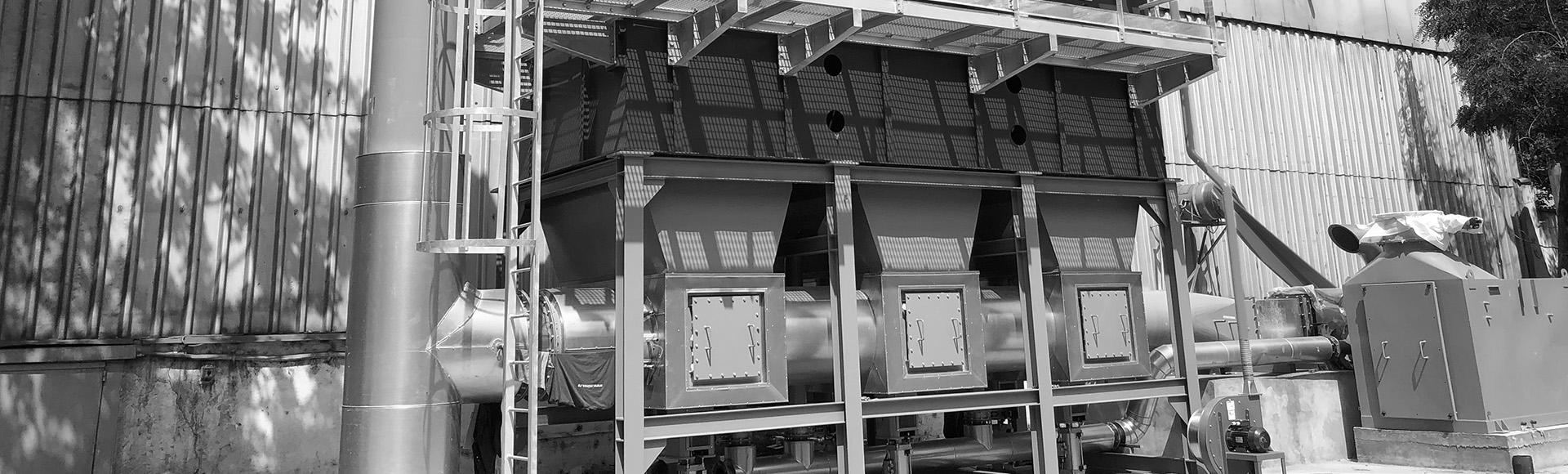
VOC Treatment
References
How to Select the Right VOC Treatment System for Your Industrial Facility
Volatile organic compounds (VOCs) are among the most regulated air pollutants in industrial manufacturing. Left untreated, VOC emissions contribute to ground level ozone formation, pose documented health risks to workers and surrounding communities, and expose facility operators to significant penalties under EU environmental regulations. Selecting the right VOC abatement technology is therefore not just an environmental decision — it is an operational, financial, and regulatory one.
This guide is written for engineers, procurement specialists, and operations managers responsible for specifying industrial VOC treatment systems. It walks through the technical evaluation factors that determine which VOC abatement solution fits your facility, and presents the Minex Group VOC treatment portfolio so you can match your process emissions to the right system with confidence.
Minex Group is an industrial equipment distributor with deployments across shipbuilding, railway, metalworking, chemical processing, and food production. The VOC abatement solutions presented here are field-proven across these industrial applications, and the evaluation framework reflects the real-world sizing and selection considerations that Minex's engineering team works through with clients on every project.
Two VOC Abatement Technologies, Two Distinct Pollutant Problems
Before evaluating specific products, it is important to understand how the two VOC abatement technologies in the Minex portfolio address fundamentally different types of industrial air pollution.
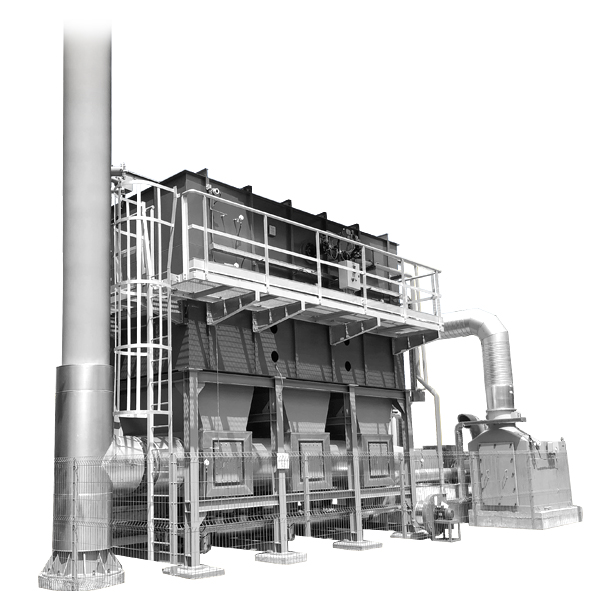
Regenerative thermal oxidizers (RTOs) destroy gaseous volatile organic compounds by raising the temperature of the polluted air inside a combustion chamber to the point where VOCs undergo thermal oxidation, breaking down into carbon dioxide and water vapor. RTO systems achieve this at high combustion chamber temperature ranges and use ceramic media beds for regenerative heat recovery, which dramatically improves thermal efficiency and reduces natural gas consumption compared to older direct-fired oxidizer designs. Regenerative thermal oxidizers are the preferred VOC abatement solution for process emissions with moderate to high VOC concentrations and consistent or inverter-regulated air flow.
Mechanical filtration captures particulate pollutants — powder paint, overspray, combustible dust — using high-efficiency filter media. This is not a VOC abatement technology in the chemical sense (it does not destroy volatile compounds through an oxidation process), but it is essential for particulate-phase air pollution control in painting, blasting, and metalworking environments. In mixed-emission facilities, mechanical filtration often serves as a pre-treatment stage upstream of thermal oxidizers, protecting the combustion chamber from particulate fouling.
The core selection decision is therefore binary: if your dominant pollutant is gaseous VOCs from organic solvents or chemical processes, you need a regenerative thermal oxidizer. If your dominant pollutant is particulate matter from paint application or surface preparation, you need mechanical filtration. If both are present, you need a staged system combining both VOC abatement technologies. The evaluation factors below will help you size and specify the right configuration.
Particulate or Gaseous: Why Pollutant Phase Is the First Decision That Matters
Every VOC abatement selection starts with identifying the physical state of the pollutant in your process stream. This determines the entire technology category.
Particulate emissions — powder paint overspray, coating dust, abrasive residue — require mechanical filtration: a physical barrier that captures solid air pollutants before they reach the atmosphere. Gaseous emissions — organic solvents, volatile organic compounds from chemical reactions, process off-gases from food production — require thermal oxidation: a controlled combustion reaction that breaks down volatile compounds into carbon dioxide and water vapor.
These are fundamentally different VOC control mechanisms. If your facility generates powder paint particles in a spray booth, a high-efficiency filter bank operating at a controlled face velocity of 0.75 m/s will capture 98–99% of that particulate. If your facility generates solvent-laden exhaust, those molecules will pass through any mechanical filter — you need thermal destruction, where the polluted air is heated inside a combustion chamber under controlled turbulence and residence time to trigger decomposition.
Mixed-emission environments — common in integrated coating and curing operations — typically require a staged approach: mechanical pre-filtration upstream to protect the thermal oxidizer's combustion chamber from fouling, followed by thermal oxidation of the gaseous VOC fraction. If your facility falls into this category, the system design needs to be engineered as an integrated VOC abatement solution rather than selected as a standalone unit.
Practical takeaway: characterize your emission stream before reviewing any product specification. Identify the dominant pollutant phase. Particulate points to filtration. Gaseous VOCs point to regenerative thermal oxidizers. Both present means a combined system and a conversation with Minex's engineering team.
Airflow Volume and Variability: Sizing VOC Control Devices to Actual Operating Conditions
Once pollutant type is established, the air flow profile — both volume and consistency — directly governs equipment selection and operating cost.
Air flow volume in m³/hr determines the physical size of the VOC abatement system, fan capacity, ductwork diameter, and energy draw. An undersized system cannot maintain required extraction velocity, allowing pollutants to escape. An oversized system runs below its design point, wasting energy and capital.
For particulate filtration in paint booth applications, standard configurations handle air flow rates of 11,000 m³/hr (3.0 kW motor) to 16,000 m³/hr (5.5 kW motor), matched to filter areas of 4 m² and 6 m² respectively at a loading rate of 45 m³/m². For regenerative thermal oxidizers treating gaseous streams, capacity scales with both volume and VOC concentrations — the heat balance inside the combustion chamber depends on the pollutant loading and caloric value of the volatile organic compounds in the process stream.
Equally important is whether your air flow is steady or variable. Continuous production lines generate stable exhaust — a fixed-speed fan suffices. Batch operations (intermittent painting, shift-based chemical processing) demand a suction regulation system — typically a variable frequency drive (inverter) — to dynamically adjust fan speed. Without this, the system wastes energy during low-demand periods and creates pressure imbalances during idle periods. Inverter-controlled VOC control devices align energy draw to real-time demand, directly reducing operating cost.
Static pressure drop is the other parameter often underestimated. The fan must overcome total system resistance: filter loading, duct friction, bends, elevation changes, and any dampers. A baseline of 50 mmCA is standard for compact paint booth extraction, but actual pressure drop depends on duct complexity. Underrating static pressure means the fan cannot move sufficient combustion air or polluted air through the system, even if volumetric capacity is nominally correct.
Practical takeaway: measure peak and average air flow demand, determine variability across the production cycle, and calculate total system pressure drop. These three parameters drive fan and system sizing.
Explosion Risk and ATEX Compliance: Non-Negotiable for Safe Operation in Hazardous Atmospheres
Any facility where organic solvents are used, paint is sprayed, or combustible dust is generated requires formal explosion risk assessment. This is a legal obligation under EU Directive 2014/34/EU (ATEX).
The ATEX zone classification determines safety specifications for every component in the VOC abatement system: fan, motor, electrical controls, and enclosure. In zones with flammable gases or vapors (Zone 1, Zone 2) or combustible dust atmospheres (Zone 21, Zone 22), all equipment must carry corresponding ATEX certification. Non-certified control devices in a classified zone constitute both a regulatory violation and a direct explosion hazard.
For paint booth extraction, verify: anti-spark fan construction compliant with AMCA-C standards, EEx-rated electrical execution, and motor insulation class of at least IP54. These are minimum requirements for safe operation in environments where volatile organic compounds and combustible particulate are present in the air flow.
A common error is assuming low VOC concentrations equal low risk. Concentration is one variable; ignition source, oxygen, confinement, and dispersion are always present in an enclosed extraction system. The risk assessment determines zone classification; zone classification determines equipment specification — not the reverse.
Practical takeaway: confirm your ATEX zone classification before any equipment selection. Every component of the VOC abatement system must match the assessed zone, verified explicitly in the distributor's technical documentation.
Heat Recovery and Energy Efficiency: Controlling Long-Term Operating Cost
Capital costs get attention at procurement, but operational costs over a 10–15 year service life are where a VOC abatement system's true economics emerge. A system with low capital cost but high fuel consumption is not a saving — it is a deferred expense.
For regenerative thermal oxidizers, the dominant cost driver is natural gas consumption. The thermal oxidation reaction is exothermic — once VOC concentrations and caloric value are sufficient, the combustion reaction itself generates heat. RTO systems exploit this through ceramic media beds that store heat from the purified exhaust and transfer it to incoming polluted air via regenerative heat recovery. This heat exchanger principle dramatically improves thermal efficiency: the temperature of the incoming process stream is raised before it enters the combustion chamber, reducing the supplemental natural gas needed to reach the required combustion chamber temperature. RTO systems with well-designed ceramic media beds achieve thermal efficiency levels that translate to substantially low operating costs — a decisive advantage when evaluating total cost of ownership against other thermal oxidizer designs.
Beyond the primary heat exchanger loop, evaluate whether excess heat can serve secondary facility loads. If your facility operates drying ovens, heated make-up air systems, or building heating, routing recovered thermal energy to these loads turns a waste stream into a resource. Purpose-built valves on RTO systems manage high VOC concentrations safely while enabling ambient-air start-up and stand-by conditions — preventing natural gas burn during non-production hours to further reduce operating costs.
For filtration systems, energy efficiency centers on fan motor control. A fixed-speed fan running at full capacity when extraction demand varies 40–60% across the cycle is measurable waste. Inverter-controlled motors reduce fuel consumption and electricity draw by 20–35% compared to constant-speed operation.
Practical takeaway: request energy and operating cost projections at your actual operating conditions. For RTO systems, quantify heat recovery potential and identify secondary heat sinks. For filtration, confirm inverter compatibility. Compare total cost of ownership — not just capital costs — when evaluating VOC abatement solutions.
Facility Layout and Space Constraints: Fitting VOC Abatement Equipment Without Compromising Performance
Industrial floor space carries real cost, and the footprint of a VOC abatement system includes not just the unit but maintenance access clearances, ductwork routing, and structural support.
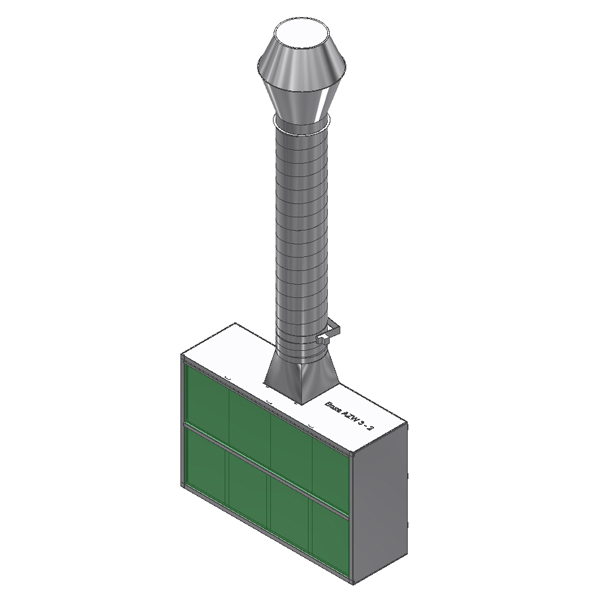
For particulate filtration, two standard configurations are available: the AZW 2-2 (2,000 × 840 × 2,000 mm) and the AZW 3-2/2-3 (3,000 × 940 × 2,000 mm). Both include a rectangular-to-round adapter as standard, eliminating custom transition pieces when connecting to existing round exhaust ducting.
Regenerative thermal oxidizers are engineered for compact dimensions and reduced weight relative to treatment capacity — critical for facilities where the unit may be roof-mounted or elevated. The ceramic media beds and heat exchanger sections are integrated within the oxidizer housing, keeping the system footprint contained without sacrificing VOC abatement performance.
Practical takeaway: overlay system dimensions onto your facility layout, including maintenance envelopes. Verify duct connection format. If space is constrained, engage Minex's engineering team before finalizing — a configuration adjustment at design stage costs far less than a site modification during installation.
Regulatory Compliance: Designing for Current Emission Limits — With Margin for Future Requirements
Your required VOC removal efficiency is dictated by environmental regulations — typically the EU Industrial Emissions Directive (2010/75/EU) and sector-specific BAT reference documents. Regulatory compliance is not optional, and the consequences for exceedance — including significant penalties, operational shutdowns, and permit revocation — make it a primary selection criterion.
Mechanical filtration delivers 98–99% particulate removal. Regenerative thermal oxidizers deliver 98–99.5% VOC destruction efficiency with minimal generation of other pollutants. The difference between 98% and 99.5% may seem small, but it determines your margin against regulatory requirements that tighten over time.
Secondary pollutant limits matter too. Thermal oxidation produces trace nitrogen oxides and CO. Well-designed RTO systems achieve low NOx output, but your permit may set specific limits. Ask for documented outlet emission data — not just primary destruction efficiency, but the full characterization including nitrogen oxides and CO. An effective abatement technology should demonstrate compliance on both primary VOC destruction and secondary pollutant generation.
Environmental regulations across EU member states are trending toward stricter limits and broader VOC definitions. A proper abatement technology selection factors in this trajectory. Specifying equipment that exactly meets today's threshold, with no headroom, creates a regulatory compliance risk the moment limits are revised.
Practical takeaway: obtain exact permit limits for primary and secondary pollutants. Confirm the proposed system's performance against those limits. Verify sufficient margin for foreseeable regulatory tightening. This is where choosing the right VOC abatement technology pays dividends over the system's full service life.
Maintenance, Monitoring, and Operational Uptime
A VOC abatement system's commissioning performance is a snapshot. Year-five and year-ten performance depends on maintainability and execution.
For filtration systems, the primary task is filter replacement. Filter area (4 m² or 6 m²), loading rate (45 m³/m²), and particulate load determine replacement frequency. Optional filter load monitoring enables condition-based replacement — avoiding both premature disposal and operation with saturated filters that increase pressure drop and reduce extraction effectiveness. Galvanized steel construction provides corrosion resistance essential in humid or chemically aggressive environments.
For RTO systems, maintenance centers on the combustion chamber, ceramic media beds, heat exchanger surfaces, and valve mechanisms. Ceramic media degradation over time affects thermal efficiency and heat recovery performance — inspect condition periodically and budget for eventual replacement. Simple operation is a design priority, but establish early whether your team can handle routine inspection or whether a service contract with the distributor is the realistic path.
Practical takeaway: request a maintenance schedule and consumables cost projection at your expected operating conditions. Factor maintenance labor and parts into total cost of ownership alongside capital costs and operating cost.
Minex Group VOC Treatment Portfolio: Solutions at a Glance
Minex Group distributes these VOC abatement solutions and provides technical advisory, sizing, and after-sales support.
| Boxes for emission exhaust for painting halls | Regenerative thermal oxidizers | |
| Pollutant type | Particulate (powder paint, overspray, dust) | Gaseous VOCs (organic solvents, chemical vapors, process off-gases) |
| VOC abatement mechanism | Mechanical filtration (HE + Andreae or Viledon filters) | Thermal oxidation in combustion chamber (VOC + O₂ → CO₂ + H₂O + Heat) |
| Removal efficiency | 98–99% particulate capture | 98–99.5% VOC destruction |
| Air flow capacity | 11,000 m³/hr (AZW 2-2) to 16,000 m³/hr (AZW 3-2/2-3) | Scalable; inverter-based suction regulation for variable VOC loading |
| Heat recovery | N/A | Regenerative heat recovery via ceramic media; integrated coaxial heat exchanger preheats polluted air |
| Thermal efficiency | N/A | High; ceramic media beds minimize natural gas consumption |
| Safety | ATEX construction, AMCA-C anti-spark fan, EEx execution, IP54 motor | Purpose-designed safety valves for high VOC concentrations |
| Dimensions | AZW 2-2: 2,000 × 840 × 2,000 mm | Compact dimensions, reduced weight |
| AZW 3-2/2-3: 3,000 × 940 × 2,000 mm | ||
| Construction | Galvanized steel (high corrosion resistance) | Industrial-grade construction |
| Pressure drop | ~50 mmCA static pressure (baseline) | Managed via ceramic media bed design and air flow regulation |
| Secondary pollutants | None (mechanical process) | Low NOx, minimal CO |
| Operating cost profile | Filter consumables + electricity | Natural gas + electricity; offset by heat recovery |
| Maintenance | Filter replacement; optional load monitoring | Combustion chamber and ceramic media inspection; valve service |
| Best suited industries | Paint booths, blasting, metalworking, shipyards, railway | Chemical industry, food industry, manufacturing with high-volume VOC emissions |
| Proven deployments | Damen Galati SA, SANTIERUL NAVAL ORSOVA SA, Astra Vagoane Calatori SA, MARUB SA, Cummins Generator Technologies SA | European Food SA |
Need Help Selecting the Right VOC Abatement Solution? Talk to Minex Group's Technical Team.
Every facility presents a unique combination of pollutant type, VOC concentrations, air flow variability, temperature profiles, safety classification, and regulatory requirements. While this guide provides the evaluation framework, the final system specification benefits from application-specific engineering input — particularly for facilities with mixed emissions, high VOC loading, or constrained layouts.
Minex Group's technical advisers assess your emission profile, size the proper abatement technology, verify ATEX and regulatory compliance, and design integrated systems where both particulate filtration and regenerative thermal oxidizers are needed.
Frequently Asked Questions
Yes. Any VOC abatement system placed on the EU or EEA market — whether filtration-based or a regenerative thermal oxidizer — must carry CE marking confirming compliance with all applicable EU product legislation, including the EU Machinery Regulation. CE marking is a legal prerequisite, not a quality label.
Regulation (EU) 2023/1230 replaces the previous Machinery Directive 2006/42/EC and sets mandatory health and safety requirements for machinery — including industrial VOC treatment systems — placed on the EU market. It fully applies from 20 January 2027. If you are specifying thermal oxidizers or filtration systems for delivery near or beyond that date, confirm with your distributor that the equipment will conform to the new regulation.
The manufacturer or their authorised EU representative holds primary responsibility for conformity assessment, technical documentation, the EU Declaration of Conformity, and affixing CE marking. Importers of equipment from outside the EU can assume equivalent responsibilities. As a buyer, verify that the Declaration of Conformity and technical documentation accompany delivery. Minex Group, as the equipment distributor, facilitates this process and provides relevant conformity documentation for the VOC abatement solutions it supplies.
Every unit — boxes for emission exhaust for painting halls or regenerative thermal oxidizers — must ship with a signed EU Declaration of Conformity (referencing applicable legislation and harmonised standards) and operating instructions. The manufacturer retains the full technical file (design data, risk assessment, test results) but must make it available to authorities on request. During procurement, request written confirmation that these documents will be provided at delivery.
They are complementary. CE marking under the Machinery Regulation covers general machinery safety. ATEX certification under Directive 2014/34/EU specifically addresses equipment for explosive atmospheres — which includes most paint booth ventilation and many chemical processing VOC abatement installations. Equipment in ATEX-classified zones must carry both markings. Verify that the ATEX category on the nameplate matches your facility's zone classification.
EN ISO 12100 is the foundational standard for machinery risk assessment: defining machinery limits, identifying hazards across the lifecycle, estimating risk, and applying protective measures in a defined hierarchy. For VOC abatement systems, this covers explosion risk from volatile organic compounds and combustible dust, thermal hazards from the combustion chamber, mechanical hazards from fan assemblies, and electrical hazards in explosive atmospheres. Confirm that the manufacturer has completed a risk assessment per EN ISO 12100 and that results are reflected in the equipment's safety features.
Visibly, legibly, and indelibly on the machinery — on or adjacent to the manufacturer's nameplate. Where a Notified Body was involved, its identification number must appear alongside. During commissioning, verify presence and legibility, and cross-reference against the Declaration of Conformity.
EN ISO 12100 is the horizontal standard. Product-specific (C-type) standards apply to fan assemblies, ATEX-rated components, electrical systems, and thermal processing equipment. Check the Declaration of Conformity for listed standards — these establish presumption of regulatory compliance. If listed standards appear incomplete for the equipment's hazard profile, raise this with the distributor before accepting delivery.