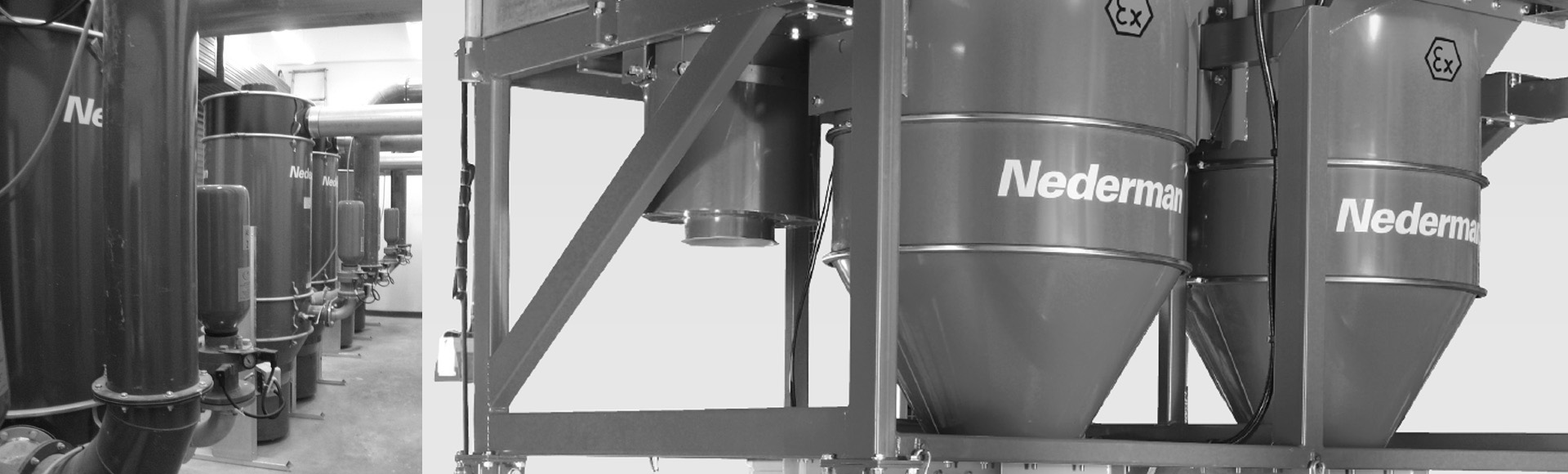
Bag Filters
References
How Industrial Engineers Select the Right Bag Filter System for Safe and Efficient Dust Control
Industrial dust extraction is rarely a simple equipment purchase. In practice, selecting the correct bag filter system requires balancing process safety, airflow performance, regulatory compliance, operational reliability, and lifecycle operating costs.
Manufacturing environments such as woodworking plants, metal fabrication workshops, blasting facilities, and chemical production sites generate airborne dust that can create both operational and safety risks. Depending on the material and concentration, dust may also present a serious explosion hazard.
For engineers, procurement specialists, and operational managers, specifying the right filtration system requires a structured technical evaluation of several parameters, including:
- dust explosibility characteristics
- airflow and capture performance
- filter cleaning mechanisms
- installation environment
- maintenance and waste-handling logistics
The following consultancy guide provides a practical engineering framework for evaluating bag filter systems in industrial environments, illustrated with examples from ventilation and filtration solutions available through Minex Group as a distributor of Nederman equipment.
Combustible Dust Risk and Regulatory Compliance: The Primary Design Constraint
Before evaluating airflow capacity or filtration efficiency, engineers must determine whether the dust produced in a manufacturing process is combustible or potentially explosive.
Many industrial materials generate combustible dust, including:
- wood and biomass particles
- plastics and polymers
- food ingredients such as flour or starch
- chemical powders
- certain metals and metal alloys
When suspended in air under the right conditions, these particles can ignite and propagate an explosion.
Within the European Union, combustible dust safety is governed primarily by the ATEX regulatory framework, consisting of two complementary directives.
ATEX Directive 1999/92/EC – Workplace Directive
This directive defines the responsibilities of plant operators. Facilities that may generate explosive atmospheres must prepare an Explosion Protection Document (EPD) before equipment is installed or operated.
The EPD includes:
- classification of hazardous areas (Zone 20, 21, 22)
- identification of ignition sources defined in EN 1127-1
- implementation of explosion prevention and protection measures
ATEX Directive 2014/34/EU – Equipment Directive
This directive governs equipment used in explosive atmospheres. Any equipment installed in an ATEX zone must carry CE and ATEX certification markings confirming that it does not introduce ignition sources.
For engineering teams, the implication is straightforward: the explosion risk assessment defines which equipment can be installed in the process environment.
Airflow Capacity and Extraction Performance
Once safety requirements are established, engineers must determine the airflow capacity required to capture dust effectively at the point of generation.
Dust collectors operate by maintaining negative pressure at extraction points, pulling contaminated air through ducting toward a filtration unit. If airflow is insufficient, dust escapes into the working environment regardless of filtration efficiency.
Airflow requirements depend on:
- number of extraction points
- capture velocity requirements
- duct geometry and friction losses
- the mass and density of the dust generated
For smaller manufacturing environments such as woodworking shops or single-cell production areas, airflow requirements remain relatively moderate.
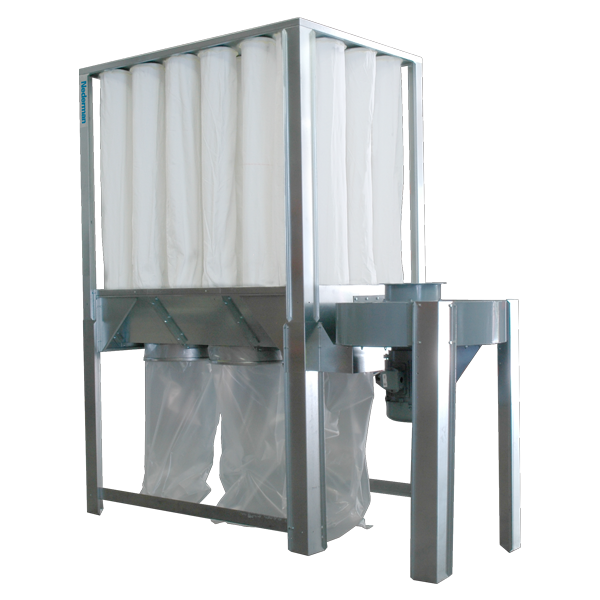
The Nederman S-Series dust collector, for example, handles airflow rates up to approximately 5,000 CFM, making it suitable for indoor light-dust applications.
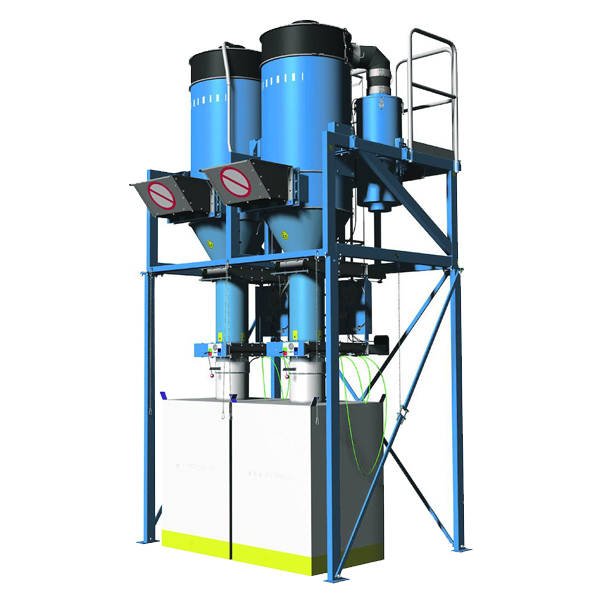
More demanding industrial environments—especially those requiring high-vacuum extraction or explosive dust handling—may require systems such as the Nederman FlexFilter EX,which provides airflow capacities of:
- 1,600 m³/h per unit
- 3,200 m³/h for Twin FlexFilter EX systems
Correct airflow sizing is essential. Undersized systems lead to:
- reduced capture efficiency
- dust accumulation in ductwork
- increased maintenance
- higher safety risks for workers
Matching the Filtration System to Dust Characteristics
Dust properties strongly influence filtration system selection.
Lightweight materials such as wood fibers, paper dust, and plastic particles can be efficiently handled by indoor bag filter systems designed for light bulk materials.
However, processes such as:
- metal grinding
- welding
- abrasive blasting
- surface treatment
produce sparks, hot particles, and abrasive materials.
Using filtration systems designed for lightweight dust in such environments can lead to filter damage, fire hazards, or system failure.
The Nederman FlexFilter EX is designed specifically for explosive dust environments and carries the ATEX classification:
II 3D Ex h IIIC T130°C Dc
The system is engineered to handle explosive dust classes St1 and St2, with the following manufacturer-specified limits:
- Pmax ≤ 10 bar
- Minimum Ignition Energy (MIE) > 1 mJ
- Minimum Ignition Temperature (MIT) > 205 °C
In addition to ATEX compliance, the filtration approach used in FlexFilter EX aligns with ISO 21904, which defines ventilation and filtration performance requirements for welding and metalworking fumes.
Filter Cleaning Systems and Their Operational Impact
As dust accumulates on filter media, airflow resistance increases and system performance gradually declines.
Industrial bag filters therefore include cleaning mechanisms to remove accumulated dust.
Heavy-duty systems typically use reverse air pulse cleaning, which injects short bursts of compressed air into the filter bags while the collector continues operating.
For example, the FlexFilter EX uses reverse pulse cleaning to maintain stable airflow during continuous operation.
Smaller systems may use mechanical shaker cleaning systems, which shake filter bags when the fan stops.
The Nederman S-Series dust collector offers an optional S-Shaker cleaning system, available with manual, mechanical, or automatic actuation.
After cleaning cycles, the S-Shaker system can reduce pressure drop by up to 40%, restoring suction performance and extending filter life.
Waste Discharge and Dust Handling
Dust collected by the filtration system must be removed safely and efficiently to minimize operator exposure and downtime.
Typical discharge options include:
- disposable bags for small installations
- collection barrels for moderate dust volumes
- dump bins for high-capacity systems
For example, tilting dump bins used with systems such as the S-Series increase storage capacity by approximately 80% compared with standard bags. These bins incorporate a tilt-to-empty design, allowing operators to empty collected material safely.
In explosive environments, discharge systems must prevent electrostatic discharge through conductive containers with grounding cables.
The FlexFilter EX supports multiple discharge configurations, including:
- a 70-liter container with pressure balancing kit allowing safe use of antistatic plastic bags
- conductive bulk bags with grounding cables, which can be installed on a fully automated discharge system
Installation Considerations: Indoor vs Outdoor Dust Collectors
The installation environment is another important engineering parameter.
Certain filtration systems are designed for indoor installation, typically with compact footprints suitable for production halls.
The Nederman S-Series dust collector is an enclosureless indoor collector designed for combustible dust environments and aligned with provisions consolidated in NFPA 660-2025, which governs indoor combustible dust collection systems without external enclosures.
However, the S-Series is designed specifically for lightweight combustible dust materials such as wood, paper, or plastics and must not be used with spark-generating processes such as metal grinding.
Systems designed for explosive dust environments, such as the FlexFilter EX , are commonly installed outdoors to allow safe explosion venting.
However, according to manufacturer specifications, the system can also be installed indoors under controlled conditions.
For engineers planning outdoor installations, the ATEX certification specifies an ambient operating temperature range (Ta) between –10 °C and 40 °C, which must be considered in regions with extreme climate conditions.
Energy Efficiency and Operating Cost Optimization
Dust collection systems often operate continuously, making energy consumption a key operational consideration.
Fan motors follow the Affinity Laws, where power consumption is proportional to the cube of fan speed.
Reducing fan speed by 20% can reduce energy consumption by nearly 50%.
Modern systems therefore integrate Variable Frequency Drives (VFDs) with differential pressure monitoring, allowing fan speed to adjust dynamically based on filter resistance.
This approach reduces energy consumption while maintaining required airflow.
In many European industrial environments, the return on investment for VFD implementation typically ranges from 12 to 18 months.
Bag Filter Systems Available Through the Minex Ventilation and Filtration Portfolio
Minex Group supplies industrial ventilation and filtration equipment, providing top solutions developed by manufacturers such as Nederman.
| Product | Best Use Cases | Key Benefits |
| Nederman FlexFilter EX | ATEX-rated environments, metalworking facilities, blasting operations, shipyards, and chemical or food processing plants handling explosive dust (St1 and St2). | ATEX classification II 3D Ex h IIIC T130°C Dc. Handles explosive dust limits Pmax ≤ 10 bar, MIE > 1 mJ, MIT > 205 °C. Reverse air pulse cleaning. Airflow capacity 1,600 m³/h per unit or 3,200 m³/h for Twin EX systems. Integrated control filter allows operation with non-EX vacuum units. Discharge options include 70-L container with pressure balancing kit, conductive bulk bags with grounding cables, or automated discharge systems. Filtration aligned with ISO 21904 welding fume requirements. |
| Nederman S-Series Dust Collector | Indoor woodworking facilities, furniture production plants, cabinet workshops, and processing of lightweight materials such as wood, paper, or plastics. | Airflow capacity up to 5,000 CFM. SuperBag filter media delivering 99.9% filtration efficiency. Fan design 20% more efficient than standard radial fans with noise levels of 70–75 dB(A). Optional S-Shaker cleaning system reducing pressure drop by up to 40%. Dump bin option increases capacity by 80% with tilt-to-empty design. Not suitable for spark-generating processes. |
Frequently Asked Questions
Beyond the Air-to-Cloth ratio (typically 1.0–1.5 m/min), engineers must control CAN velocity, the upward airflow between filter bags.
- Fine dust: below 60 m/min
- Heavy metallic dust: 80–90 m/min maximum
Excessive CAN velocity causes dust to be re-entrained during cleaning cycles.
Capture performance depends on hood placement and duct velocity.
According to the Dalla Valle equations, airflow demand increases with the square of the distance from the dust source.
Transport velocities around 20 m/s are required in ducts to prevent dust settling (saltation).
Under ATEX Directive 2014/34/EU, equipment operating in explosive atmospheres must be certified.
Examples include:
- fans and motors
- rotary valves
- explosion isolation devices
- electrical components
Filter media itself may not carry independent certification but must provide antistatic properties when MIE < 3 mJ.
Polyester filter media degrades through hydrolysis above 90 °C in humid conditions.
In such environments, engineers typically use:
- PPS (Ryton) for chemically aggressive conditions
- Nomex for high-temperature filtration
For explosive environments such as those handled by FlexFilter EX, filter media must also remain compatible with the ATEX temperature class T130°C, ensuring the filter surface temperature does not exceed this limit.
Processes producing sub-micron particles (e.g., welding fumes) benefit from ePTFE membranes or nanofiber coatings, which improve surface filtration and extend filter life.
Fan power consumption follows the Affinity Laws, meaning power demand is proportional to the cube of fan speed.
Reducing fan speed by 20% can reduce energy consumption by nearly 50%.
Integrating VFD fan control with differential pressure monitoring allows dust collection systems to maintain airflow while minimizing energy consumption, often delivering ROI within 12–18 months.