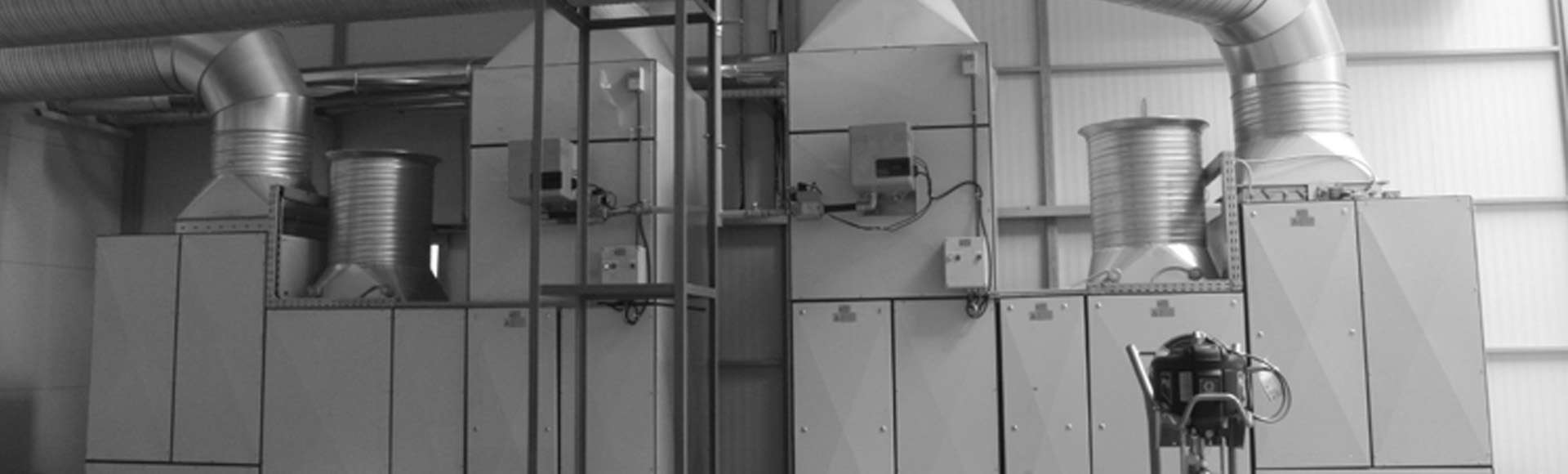
Blasting Halls And Cabins
References
A Practical Guide to Selecting the Right Controlled Blasting Environment
Surface preparation is a crucial stage in industrial manufacturing, coating, and refurbishment. Whether the objective is corrosion protection, painting, refinishing, or restoring a clean surface across a large surface area, choosing the right blasting environment directly impacts safety, quality, lifecycle costs, and regulatory compliance.
Minex Group supports industrial facilities across Europe with engineered blasting halls, compact blast rooms (blasting cabins), and complete systems equipped with abrasive media circuits, media recovery floors, and smart controls. Selecting the best solution requires a structured evaluation of your parts, processes, surface preparation standards, and long-term operational plans.
Before exploring the technical differences, it is useful to clarify that the blasting environments discussed here refer strictly to industrial blasting halls and cabins, not log cabins, log homes, wood blasting, or cob blasting used for removing an old finish or new stain from logs or timber. While the underlying media blasting principles are similar—abrasive media striking a surface to restore or clean it—the industrial context differs entirely.
With this distinction made, we can examine the decision criteria for selecting the right controlled blasting environment for steel, metal, and engineered components.
Understanding the Workpiece: The Starting Point for Every Reliable Decision
Everything begins with the workpiece. Its dimensions, weight, and geometry dictate which environment is physically capable of accommodating the blasting process.
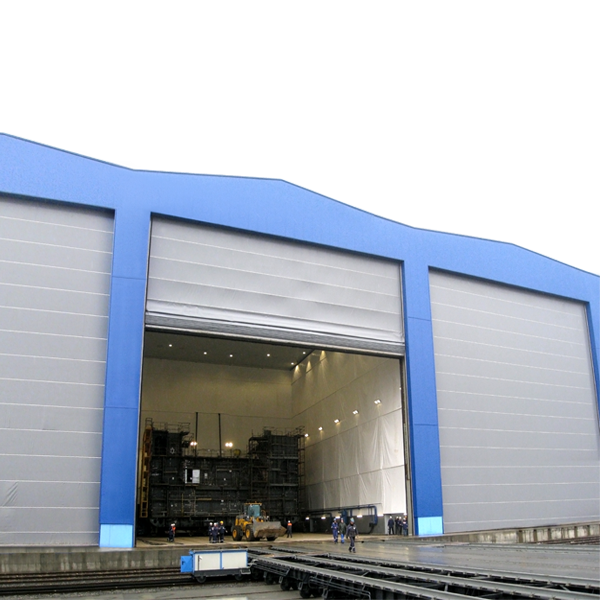
A blasting hall is engineered for oversized or heavy components that demand full operator access, overhead cranes, and a large working floor. Ship sections, rolling-stock frames, petrochemical tanks, and long structural elements cannot fit inside compact blast cabins. These structures often include complex elements that require multi-operator coordination and ample space to achieve the desired surface result.
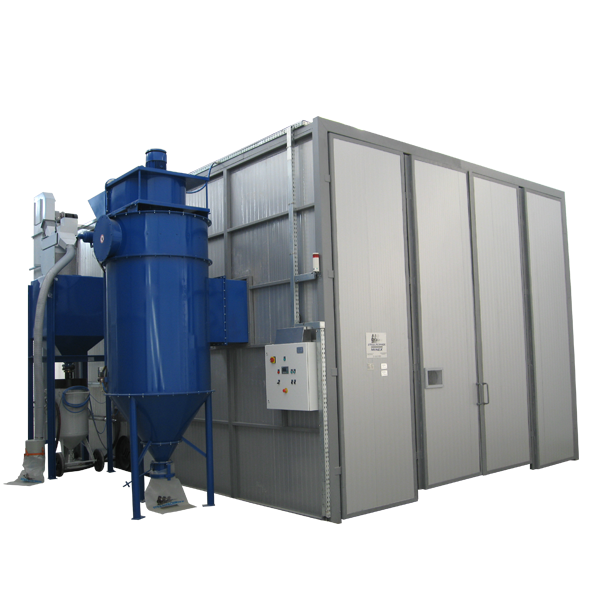
A blasting cabin (blast room) is ideal for small and medium parts that must be blasted quickly and efficiently. The enclosed cabin interior supports controlled airflow, reduced dust, and consistent blasting cycles. Workshops and maintenance plants often choose cabins for their reliability, smaller footprint, and predictable maintenance profile.
Understanding the workpiece naturally leads to evaluating application complexity.
Application Complexity: Flexibility vs. Standardization
Some industrial processes require flexible environments where operators move freely around large components, while others demand repeatable, standardized blasting cycles.
A blasting hall supports high variability. It can be fully customized during construction, with engineered ventilation, ATEX-certified lighting, and heavy-duty logistics. Halls allow operators to work at ground level or elevated positions, depending on the nature of the part.
A blasting cabin, by contrast, is ideal for uniform batches, refinishing metal parts prior to coating, or preparing surfaces for painting and protective layers. The contained environment enables high-quality surface cleaning and efficient media blasting.
This distinction directly affects operator safety.
Operator Safety and Ergonomics
Inside a blasting hall, operators are physically in the workspace and must wear full PPE. Dust extraction, airflow, and lighting must be engineered at a high level to protect operators from dust, noise, and abrasive rebound.
A blasting cabin improves safety because the operator stands outside the enclosure using interior gloves or remote blasting. Dust remains contained, the operator is shielded, and the risk of debris exposure is minimized. Cabin enclosures are among the best ways to ensure ergonomic handling for media blasting.
Environmental and Regulatory Compliance in Europe
European regulations on dust, noise, and emissions require a rigorous engineering approach.
A blasting hall must meet higher compliance thresholds because of its size and operator presence inside the chamber. Airflow systems, dust collectors, ATEX components, and environmental controls must align with EU and national requirements.
A blasting cabin simplifies compliance because it is a sealed system that minimizes dust escape, reducing the regulatory complexity of installation.
Abrasive Media Selection, Media Recovery, and Operational Cost
The choice of abrasive media—steel grit, steel shot, garnet, or specialty media—affects blast intensity, operating costs, and the method used to recycle spent media.
A blasting hall accommodates high-capacity media recovery systems (such as full-floor scrapers or conveyors). This makes it more efficient for heavy media blasting and long production cycles.
A blasting cabin uses compact recovery units suitable for smaller volumes. For workshops or maintenance operations, this yields excellent cost control.
This is very different from corn cob or cob blasting, which are occasionally used for wood, log homes, or natural-surface restoration. Here, abrasive softness is needed to avoid damaging logs. In industrial blasting, however, much harder abrasive media are required for steel.
European Surface Preparation Standards: ISO 8501-1, EN Norms & NACE Equivalents
Industrial blasting must achieve specific surface preparation grades:
- ISO 8501-1: Defines SA 2, SA 2½, SA 3
- ISO 8503: Surface profile measurements
- ISO 8502: Environmental conditions before coating
- NACE/SSPC equivalents for international compatibility
- Relevant EN standards for structural steel, pressure vessels, and coating applications
A blasting hall excels at achieving SA 2½ and SA 3 across large, complex geometries.
A blasting cabin delivers consistent, repeatable SA 2½ finishes for smaller components.
Meeting these standards is crucial for ensuring coating adhesion, durability, and long-term reliability.
Maintenance, Lifecycle Costs, and Long-Term Reliability
A blasting hall requires more complex servicing because of its large infrastructure: ventilation networks, dust filters, wear liners, and mechanical conveyors. However, it offers unmatched durability for many years of heavy industrial use.
A blasting cabin offers simpler maintenance, predictable life-cycle management, and faster replacement of wear parts due to its modular system design.
Expansion Potential and Future Adaptability
A blasting hall can be expanded, reconfigured, or equipped with automated logistics as production grows. Its engineered flexibility makes it a long-term strategic asset.
A blasting cabin can also be relocated or expanded through modular additions, making it ideal for companies expecting incremental growth.
Throughput, Automation, and Production Integration
A blasting hall supports heavy-duty automation—rail systems, crane integration, trolley movement, or semi-automatic blasting heads.
A blasting cabin is optimized for batch workflows, semi-automatic sequences, or programmable patterns, depending on the features installed.
Material Handling and Logistics
Large industrial components require mechanical handling using cranes, driven carts, or rail systems. Only a hall can support such logistics.
Cabins facilitate lighter handling—manual loading, trolleys, or forklift access.
Case Studies and Reference Projects
Which Blasting System Is Right for You? Blasting Hall vs. Blast Room Comparison Guide
| Criteria | Blasting Hall | Blasting Cabin |
|---|---|---|
| Part Size | Oversized steel structures | Small/medium components |
| Flexibility | Fully customizable | Standardized workspace |
| Safety | Requires PPE, internal operators | External operator, high dust containment |
| Compliance | Higher regulatory complexity | Easier permitting |
| Abrasive Media | Supports all media | Compact recovery systems |
| Finish Standards | SA 2½ / SA 3 on large structures | Consistent SA 2½ for batches |
| Integration | Automation-ready | Easy facility integration |
| Investment | Higher CAPEX for scale | Lower, predictable cost |
| Maintenance | Larger infrastructure | Modular, simple maintenance |
| Expansion | Highly scalable | Easily extendable |
| Throughput | High, multi-operator | Batch & semi-auto |
| Handling | Cranes, rails, heavy logistics | Light mechanical handling |
| Best Fit | Heavy industry, shipbuilding | Fabrication, maintenance workshops |
Frequently Asked Questions
A blasting hall is a large, engineered blasting environment built around a structural frame, abrasion‑resistant wall linings, and a heavy‑duty floor designed to absorb continuous impact from steel grit or shot. The blasting process takes place around the workpiece, with operators moving freely inside the hall, supported by full‑scale ventilation, dust extraction, and integrated media recovery systems such as scraper floors, screw conveyors, and bucket elevators. By contrast, a blasting cabin (blast cabinet) is a compact, self‑contained system where blasting is performed inside a sealed enclosure and the operator remains outside, using gloves, guns, or remote controls. The mechanical layout is highly integrated: blast nozzles, reclaim hoppers, cyclones, and dust filters are arranged in a tight footprint to deliver consistent blasting performance for small and medium parts with lower abrasive throughput.
The workpiece is always the starting point: overall dimensions, mass, and geometry dictate which blasting environment is physically and economically viable. A blasting hall is the natural choice for oversized or heavy steel structures—frames, tanks, ship sections, long beams—that require crane handling, rail‑mounted trolleys, or driven carts to move safely through the blasting area. The hall provides a clear, unobstructed working volume so operators can access complex geometries from multiple sides and heights, maintaining uniform surface preparation. A blasting cabin, on the other hand, is optimized for smaller components that can be lifted manually or placed on light fixtures such as turntables, roller beds, or part racks. Here, the internal ergonomics and nozzle reach are tuned for repeatable coverage of compact geometries, making cabins ideal for batch production of medium and small parts with stable dimensions.
In a blasting hall, abrasive is typically supplied from a pressure vessel feeding one or more nozzles through long hose lines, allowing operators to work across the entire floor area. Spent media and contaminants fall to the floor where scraper mechanisms, screw conveyors, or hopper pits collect the abrasive and transport it to an elevator and air‑wash separator. This closed loop cleans and recycles large volumes of steel grit or shot, maintaining consistent particle size and blast intensity over long production runs. In a blasting cabin, the circuit is shorter and more compact: media flows from the blast gun into a small collection hopper, passes through a cyclone or mechanical separator that removes dust and fine particles, and is immediately returned to the feed system. This configuration reduces pressure losses, simplifies adjustment of media flow, and allows quick media changes when switching between different part materials or surface requirements.
Ventilation in a blasting hall must manage a large internal volume while keeping the operator’s breathing zone and working field clear. Air inlets and extraction plenums are engineered to create controlled airflow—often cross‑draft or down‑draft—so that dust is continuously carried away from the blast zone and into external dust collectors. Correct positioning of inlets, outlets, and lighting is essential to maintain stable visibility across the entire hall, especially when multiple operators are blasting simultaneously. In a blasting cabin, the enclosure volume is much smaller, so airflow can be tightly focused around the actual blasting area. High‑velocity extraction ports close to the impact zone, combined with efficient dust filters and well‑placed viewing windows and internal lights, ensure that the operator has a clear view of the workpiece through the glass even during intensive blasting cycles.
Blasting halls operate with high abrasive throughput and heavy mechanical loads, so wear and maintenance are concentrated on structural linings and bulk handling equipment. Rubber or steel wall liners, door seals, floor gratings, and recovery conveyors must be inspected regularly for erosion and impact damage, while the elevator, separator, and ducting require periodic cleaning to prevent blockages and maintain media quality. Dust collectors and their filter elements are also critical components, as declining performance directly affects visibility and cleanliness. In blasting cabins, wear is more localized: blast nozzles, internal deflector plates, window protectors, cabinet gloves, and seals are the main consumable items. Routine maintenance focuses on checking nozzle orifices for enlargement, replacing worn protective screens on viewing windows, inspecting the reclaim cyclone for build‑up, and ensuring that the compact filter system maintains stable airflow and dust capture.
A blasting hall is designed to support high throughput for large components by combining multiple blast operators, large work zones, and integrated logistics. Rail systems, floor trolleys, or crane hooks can move parts through the hall in a continuous flow, and semi‑automatic or fully automatic nozzle manipulators can be added to handle repetitive surfaces while operators focus on complex details. This makes halls suitable for integration into upstream and downstream production steps such as welding, machining, and coating. Blasting cabins, in contrast, typically run in a batch mode, but their compact geometry makes them ideal for automation at the part level: robots, rotary index tables, and multi‑station fixtures can be used to load, rotate, and unload small parts with very high repeatability. As a result, cabins are often the preferred solution for standardized, high‑volume series where consistent surface preparation on smaller components is more important than accommodating large, one‑off structures.